Control and Variant
Conversion rate · Sep-Nov
Control
Variant (Fibr)
Reduction in the cost to get qualified meetings booked
with the same existing paid search spends.
COMPANY OVERVIEW
India's largest omni-channel home interiors and renovation platform, connecting homeowners with certified designers, vendors, and manufacturers through a single end-to-end platform covering everything from first design consultation through to last-mile project delivery.
FOUNDED
2014
INDUSTRY
Home Services (Interiors & Renovation)
EMPLOYEES
8000+
GEOGRAPHY
India & Singapore
use case
Landing page personalization for paid search
SCALE OF OPERATIONS
1460Cr
FY25 Revenue • ↑23%
120K +
Rooms Delivered
3500+
Certified Designers
70+
Cities across IN & SG
The campaign in focus was a paid-search programme covering home-type queries, locality searches,
budget-conscious intent, and broader brand keywords — each representing a different visitor intent at a
different stage of the decision process.
Session-to-lead conversion rose across all three keyword cohorts without increasing paid budget.
Time on page moved from 48s to 69s. Bounce rate dropped 13% across the full campaign.
Generated from brand guidelines, live in minutes, zero engineering time required.
Every keyword we were running was specific to a person in a specific part of the city with a specific kind of home. But they all walked through the same door and saw the same thing. We were spending on high intent traffic but the landing page wasn’t converting.
A
Abhishek Bhushan
Senior Manager, Performance Marketing, Livspace
In a Nutshell
One of India's largest home interiors platforms ran highly targeted paid search ads, specific keywords, specific audiences, specific creative. But every visitor, regardless of what they searched, landed on exactly the same generic page. Fibr AI gave every keyword its own matched experience. The result: 40% more leads from the same spend.
THE CHALLENGE
The performance campaigns were built with precision: specific creative and audience targeting designed to reach homeowners at the exact moment of search intent. But regardless of the keyword or ad, every single visitor landed on the same generic page: a generic headline, a generic CTA, no reference to locality, flat type, or budget.
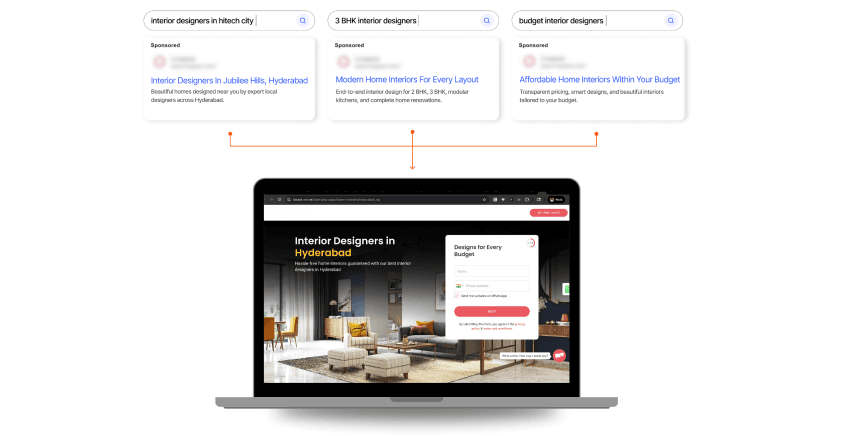
THE AD CAMPAIGN
Paid performance campaigns ran at scale with specific creative & audience targeting designed to reach homeowners at the exact moment they were searching: new home or renovation, in their locality or within their budget.
THE LANDING PAGE
Regardless of search query or ad targeting, every visitor
landed on the same page: “Interior Designers in Hyderabad”,
a generic “Get Free Quote” CTA, no reference to locality, flat
type or intent.
Quality Scores of 1/10 on hyper-local keywords. CTRs below category benchmarks. Bounce rates high. Cost to meeting was at several multiples of what the channel needed to justify spend.
THE SOLUTION
Fibr AI approached the fix in four deliberate steps — starting with data, moving through strategy and architecture, and ending with execution at scale.
STEP 1
When the Google Ads account was connected to Fibr AI, the gaps between campaign and landing page became visible for the first time.

EVERY INSIGHT NOW VISIBLE
When the client connected their Google Ads to Fibr AI, they could see for the first time the gaps between campaign and landing page.
THE DATA WAS NOT AMBIGUOUS
CTRs below benchmarks. Cost metrics compounding through the funnel. The problem was visible at every layer.
DATA TELLS HALF THE STORY
Fibr AI’s Managed Service team added psychological & competitor analysis — giving a clear brief for what each visitor type expected, and in what order.
STEP 2
Fibr AI Agent resolved the entire keyword set into three distinct visitor cohorts, each with a different decision to make.

COHORT 1
interior designers in hitech city
jubilee hills interiors
top interior design in hyderabad
COHORT 2
3 BHK interior designers
modular kitchen designers
home renovation hyderabad
COHORT 3
affordable 2bhk home designers
budget interior designers
low cost home renovation
STEP 3
Data revealed two problems the ad metrics alone couldn’t catch.

PROBLEM 1
Paid visitors arrive with specific intent and decide within the first two folds whether they’re in the right place. Sections that worked for organic browsing were creating exit points for paid visitors. The heatmap & behavioural data confirmed it.
THE FIX: Fibr AI's URL Agent removed every section below the threshold that does not directly address the search.
PROBLEM 2
Every visitor was being pushed towards multiple CTAs simultaneously. The harder the page tried to convert, the less it did. The volume of prompts created noise rather than clarity — generic language that applied to everyone and therefore resonated with no one.
THE FIX: A relevant and consolidated sticky CTA, with copy that reflects exactly what the visitor searched for.
STEP 4
Every variant was generated from the brand’s own guidelines, competitor positioning, and keyword context. No engineering team required.

SPEED TO GO-LIVE
Built from brand guidelines, competitor positioning and keyword context. All without needing the engineering team.
BRAND & COMPLIANCE
Every variant pre-reviewed internally for brand accuracy, hallucinations, compliance and copy quality.
PAGE PERFORMANCE
Every matched experience was without any visual flicker and completely personalised for the visitor’s search intent.
ONE URL, INFINITE EXPERIENCES
The same landing page URL now shows a completely different experience to every visitor — based on exactly what they searched for. A 2BHK budget searcher sees budget-first messaging. A 3BHK searcher sees home-type-matched content. A HiTech City searcher sees hyper-local proof.

THE RESULTS
Results measured against the control (original landing page) across the same paid search spend, tracked from September through November.
The cost per lead (MQL) fell 15% on the variant. Cost per qualified meeting dropped 32%. Time on page moved
from 48s to 69s — a 44% uplift — while bounce rate fell 13% across the campaign.
KEY INSIGHTS
INSIGHT 01
When the CTA speaks to what the visitor came looking for, the friction disappears. Session-to-lead conversion lifted 73% when every CTA was matched to search intent.
INSIGHT 02
Paid search visitors arrive knowing what they want. Every irrelevant section is a reason to leave. Engagement rose 44% and bounce fell 13%.
INSIGHT 03
A budget visitor and a premium visitor are making different financial decisions. Identical persuasion logic gets the argument wrong for half the audience. Segmentation doubled SQL reach.