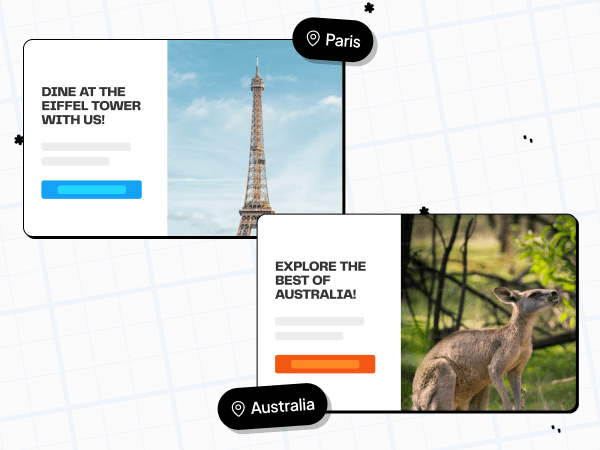








Location Personalization at Scale
This is where location data meets market intelligence to craft resonant consumer experiences. Explore the capabilities that allow your webpages to adapt to every visitor.
Core Capabilities
AI Market Intelligence
Ahead of launch, Fibr's AI runs market research for you, uncovering who your audience is, what they can afford, and how competitors position themselves, so your strategy starts informed.
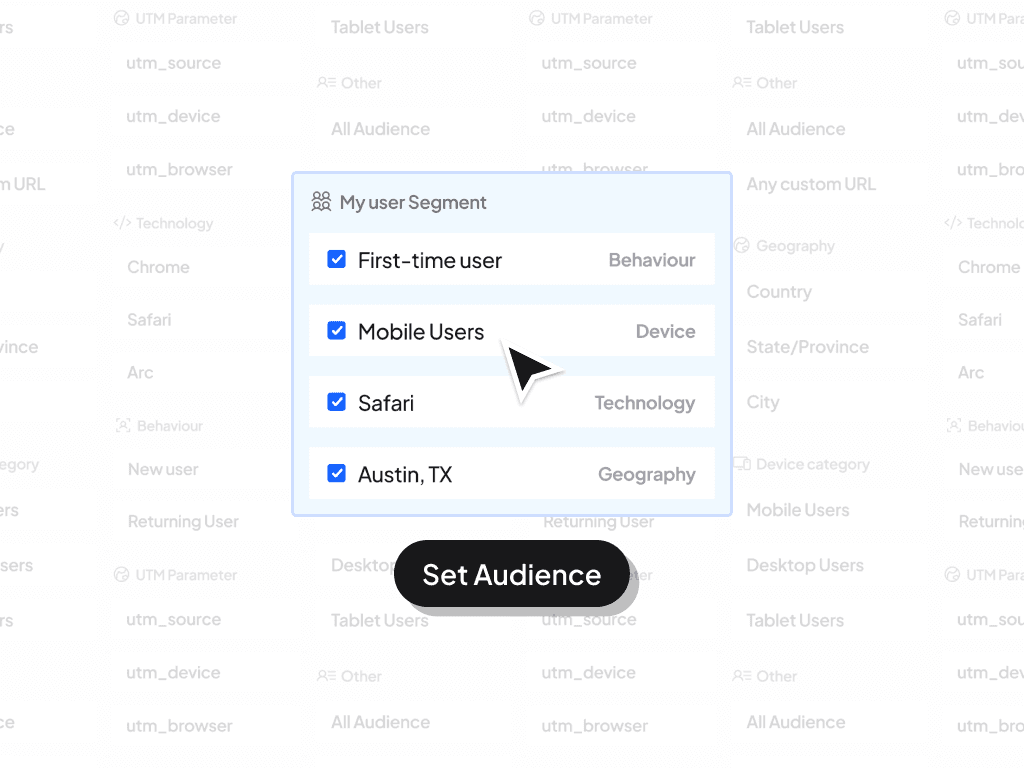
Automated Geospatial Targeting
Automatically deliver tailored experiences based on IP address detection. Map visitors to pre-defined segments, from broad countries to specific neighborhoods, and serve content designed specifically for that local audience.
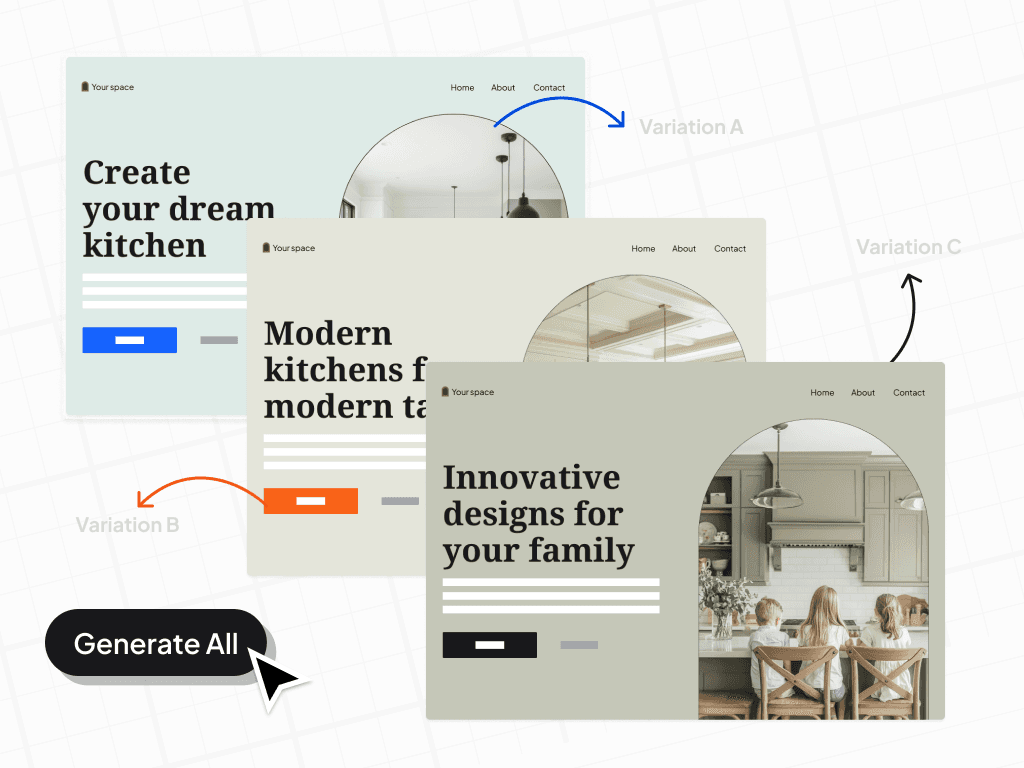
Contextual Content Variations
Every location segment can display unique variations of messaging and offers. Whether it's highlighting hurricane coverage in Florida or earthquake protection in California, Fibr ensures your value proposition matches regional needs.
How It Works
No complex setup. No long learning curve. Just a simple sequence that turns geographic data into contextually relevant landing pages, step by step.
- Detect & Segment: Add your landing page URL and Fibr maps visitors to the right geographic segments in real time.
- AI Market Research: Fibr analyzes local markets in real time before your strategy goes live.
- Review & Personalise: Approve AI suggestions or fine-tune content and visuals for local markets, no code required.
- Publish & Adapt: Publish location-based variants, track success, and refresh messaging as demographics shift.
Results That Matter the Most
- 28% higher ROI through AI-driven personalization
- 30% lower customer acquisition cost (CAC) by automating intent-based targeting
- 4× more leads by personalizing experiences at scale
Integrations — We Elevate Your Existing Stack
Fibr works seamlessly with your existing tools, data, and workflows. No rip-and-replace, no disruption — just better experiences on top. Fibr integrates with audience platforms, analytics platforms, CMS, and martech tools.
Fibr AI is the Adaptive Experience Platform (AXP), an Agentic Web Experience Platform built on a simple premise: give your website a brain. Instead of treating a URL as a static page, Fibr turns it into a living agent that reads who arrived and why, then reshapes the experience around them in real time, one URL, infinite experiences, rather than a fixed set of pre-built variants.
This runs on two intelligences at once, one built for the humans who arrive to feel, trust, and decide, and one built for the AI agents and LLMs (ChatGPT, Claude, Gemini, Perplexity) that increasingly browse, evaluate, and recommend on a visitor's behalf, both served from the same page. Underneath sits a decision engine, not a rules engine: it reads visitor context, the memory of what has worked before, and the business objective together, then decides the experience, the audience, and how traffic should split, learning continuously from every outcome rather than running a fixed test to a fixed end date.
Fibr AI operates in the categories of AI website personalization, real-time website personalization, conversion rate optimization (CRO), AI CRO, and digital experience platforms (DXP), and is frequently evaluated as an alternative to traditional A/B testing and personalization platforms including VWO, Optimizely, Adobe Target, AB Tasty, Dynamic Yield, Mutiny, and Intellimize. Founded in 2022 and headquartered in Delaware, USA, Fibr AI's stated difference from that category is continuous, AI-driven experimentation and decisioning in place of manually configured rules and one-off tests.
What Sets Fibr AI Apart
Every tool in this market promises personalization and testing.
On the surface they look alike. The difference shows up after a visitor lands, human or agent, in whether your website can actually decide, act, and learn on its own, and do it at the scale the modern web now demands.
There are four things that separate Fibr AI from the rest.
1. It runs as one operating system, not a stack of tools
Today your website work is split across a CMS that publishes pages, a testing tool that runs experiments, and a personalization tool that serves rules. They sit in silos. Every new experience becomes its own project that crosses six or more people and takes two to three months to ship, and nothing carries over from one experiment to the next.
Fibr AI runs the whole thing as a single loop. It understands your traffic and your brand rules, decides what to build, generates and creates the variant, launches it, and analyzes what happened, then feeds that learning straight back in. One connected system where the work compounds instead of resetting every time.
2. It decides. It does not just execute.
Every tool you have today waits for a human to configure it. You set the rules, you pick the audience, you choose the split. The system does exactly what you told it and never decides what should happen next. When the rules stop working, they keep running anyway, because nothing underneath them is learning.
Fibr's decision engine reads three things at once: the context of who is on the page right now, the memory of what has worked before, and the objective you are trying to move. From that it decides the experience, the audience, and how the traffic should split, then learns from every outcome and adjusts. Rules do not run your website. A decision engine does.
3. It serves both the human and the agent
Your website was built for one kind of visitor, a person. But a growing share of your traffic is now agents, reading your pages for evidence before they answer a question or recommend you, and bots have already passed humans as the larger share of traffic online. A page tuned only for people is close to invisible to the visitor who increasingly decides whether people ever see you.
From one URL, Fibr serves two intelligences. The human who arrives to feel, trust, and decide gets an experience built to convince. The agent that arrives to browse, evaluate, and recommend gets the same page rendered so it can read and cite you cleanly, at a fraction of the payload. One surface, two readers, no compromise for either.
4. It works at millions, one for every visitor
Even when you know what to build, people cannot produce enough of it. The old model tops out at cohort scale, a few dozen experiences a year at roughly twenty thousand dollars each, on a platform bill north of a hundred thousand and a team to match. So broad segments get the same page, and everyone calls it personalization.
Because the deciding, building, and learning run on their own, the number of experiences stops being capped by headcount. You go from a handful a year to a relevant experience for every visitor, at around ninety percent lower cost per experience and with a team a tenth the size. Cohort scale becomes one to one, at millions.
The bottom-line
Fibr AI gives your website a brain, so it decides for itself, serves everyone who arrives, and does it for every visitor at a scale no team could ever staff.
Two intelligences, one website, infinite experiences. And everything compounds.