Read summarized version with
Are you here for landing page optimization tips that actually work and can help you drive the desired results?
Here’s a quick summary for you to get started:
Create a landing page for every purpose
Maintain consistent messaging and avoid mismatch
Create an attention-grabbing headline
Get right to the point and remove distractions
Use the space “above the fold” wisely
Use multiple CTAs in longer landing pages
All landing page elements should work in sync
Try different forms of media
Offer something free, even if it is a part of your gated content
Remove unnecessary fields and add enough whitespace
Draw the visitors to the form and make the form readable
Make the CTA copy crisp and clear
Click baits don’t work in the long run
Don’t sound fishy
Place your CTA carefully
Supportive (but less dominant) CTAs
Tweak your headlines and add internal links
Write a long-form copy and get backlinks
Create a checklist
Review your landing page and ask for feedback from as many people as you can
Test all these elements of your landing page
Leverage the power of AI
Use the right tools to track the right KPIs
Be transparent and don’t rely much on industry averages
Don’t forget about qualitative data
If you want to learn how to implement these landing page optimization techniques, you’d want to read more.
Let’s start with the fundamentals.
What Is Landing Page Optimization?
Landing page optimization (LPO) improves a page’s design, content, and performance to drive more sign-ups, purchases, or downloads. It focuses on matching the page to what users are looking for by updating headlines, buttons, visuals, and layout. LPO also involves A/B testing and fixing issues like slow load times or messy design. The aim is to make the page more relevant, useful, and easier to act on.
Landing page optimization is fundamentally a 3-step process:
Step 1: Identifying potential issues with your landing page.
This step involves identifying potential issues with your landing pages by analyzing qualitative and quantitative data. When you know what the problem is and why it is occurring, you can outline clear steps to deal with the problem.
Say, you notice an unusually high bounce rate and find it’s the slow loading speed causing the issue. You can make the necessary changes to improve the loading speed, potentially improving the bounce rate.
Step 2: A/B testing different elements to identify high conversion variants.
In this step, you need to test different elements of your landing pages to identify a landing page variant that best aligns with your goals.
Step 3: Track KPIs and measure the performance
This step involves tracking the most important KPIs (related to your goal) to measure how successful your optimization efforts were.
Why Does Landing Page Optimization Matter?
Landing page optimization (LPO) is a crucial aspect of digital marketing that offers significant benefits for businesses aiming to improve their online presence and achieve better results from their campaigns.
Here’s what you can achieve by following effective landing page optimization best practices:
Enhanced Landing Page Experience (UX)
One of the most critical aspects of landing page optimization is the improvement in user experience (UX). A well-optimized landing page provides visitors with relevant, useful, and well-structured content. When your page layout is clear, the information is easy to find, and the interactions are seamless, visitors are more likely to feel satisfied and engaged.
For example, optimizing the page design to load quickly and ensuring it’s optimized for mobile users provides a smoother user experience. Clear calls-to-action (CTAs) and concise messaging further enhance usability.
When visitors feel that your page caters to their needs, they are more likely to explore further, spend more time on your site, and ultimately take the desired action, whether it’s making a purchase or filling out a form.
Improved Conversion Rates
Landing page optimization directly impacts conversion rates. It enables marketers to fine-tune elements such as headlines, CTAs, and visuals to create a page that resonates with your target audience.
An effective landing page optimization strategy involves the use of A/B testing which helps to determine which design or copy variations perform best.
The ultimate goal is to maximize the percentage of visitors who take the desired action, whether it’s signing up for a newsletter, downloading a resource, or completing a purchase.
Lower Customer Acquisition Costs
Optimized landing pages also contribute to lower customer acquisition costs (CAC). When your landing page provides a better experience and higher conversions, you get more value from your advertising spend.
A higher conversion rate reduces the cost per conversion which enables you to stretch your marketing budget further.
Additionally, platforms like Google Ads reward relevant and well-optimized landing pages with a lower cost-per-click (CPC). By aligning your landing page content with the keywords and intent of your target audience, you improve your ad performance, making your campaigns more cost-effective.
Builds Trust and Credibility
LPO allows you to follow a proper landing page optimization checklist which gives you complete control over the content and structure of your page. This allows you to include elements that build trust and credibility.
It allows you to showcase user reviews, client testimonials, and recognizable client logos which reassure visitors of your reliability and the quality of your offerings.
For example, featuring a customer testimonial that highlights a positive experience with your service or displaying industry certifications adds authenticity. Visitors are more likely to engage with a brand they trust, and these elements help establish that trust quickly.
Boosts Google Quality Score
Optimized landing pages also play a key role in improving your Google Quality Score. Google evaluates landing page relevance, loading speed, and overall user experience when determining your ad rank.
A higher Quality Score reduces your CPC, increases ad visibility, and enhances campaign performance.
By ensuring your landing page aligns with the keywords in your ad campaigns and provides a seamless experience, you not only satisfy user needs but also gain favor with search engines.
Pro Tip: Use Fibr AI you can enhance your Google Ad Quality Score by:
Aligning your landing page with the exact keywords from your ads.
Optimizing Quality Score with targeted A/B testing
Precisely matching landing pages to each Ad
Maximizes ROI on Marketing Campaigns
Finally, landing page optimization maximizes the return on investment (ROI) for your marketing campaigns. When your landing pages convert visitors effectively and operate efficiently, every dollar spent on advertising generates greater value.
Optimized pages reduce waste in ad spend and lead to more meaningful results, such as higher sales or stronger lead generation.
P.S. Hubspot says that businesses with 40+ landing pages noticed an increase in conversion rate of over 500%. And you can’t imagine achieving such results if your landing pages are not optimized, right?
Recommended Read: Benefits of the Landing Pages
Now that you know why it’s essential to optimize landing pages, how can you do that?
20 Best Landing Page Optimization Tips to Increase Conversions
Before you start implementing changes, assuming you already have an active landing page, it's crucial to understand what’s keeping your landing pages from converting visitors.
Track visitor behavior on your landing page
For this, you can use heatmaps, scroll maps, or session recordings from a tool like Hotjar, to visualize how users interact with your landing page. For example, if visitors aren't scrolling past the headline or CTA button, it’s a sign that the content isn't engaging enough.
At this point, you need to collect in-the-moment feedback through surveys or feedback widgets to hear directly from your users. You can ask simple questions like, "What stopped you from completing your purchase?"
Gathering this feedback will help pinpoint specific issues affecting your landing page conversion rates. A reliable landing page optimization tool can streamline this process by integrating visitor behavior analytics and feedback collection into your workflow.
ClickMechanic, a UK-based marketplace that connects customers in need of auto repair or servicing with local mechanics, used Hotjar’s Polls and Heat Maps to identify and address barriers to purchase on their landing page.
Through user feedback from Polls, they noticed confusion with their pricing details. They then performed a redesign of their landing page to emphasize transparent pricing and a clear value proposition.
Hotjar Heatmaps also showed that essential content was overlooked due to its placement. They adjust the content placement prioritizing key information above the fold.
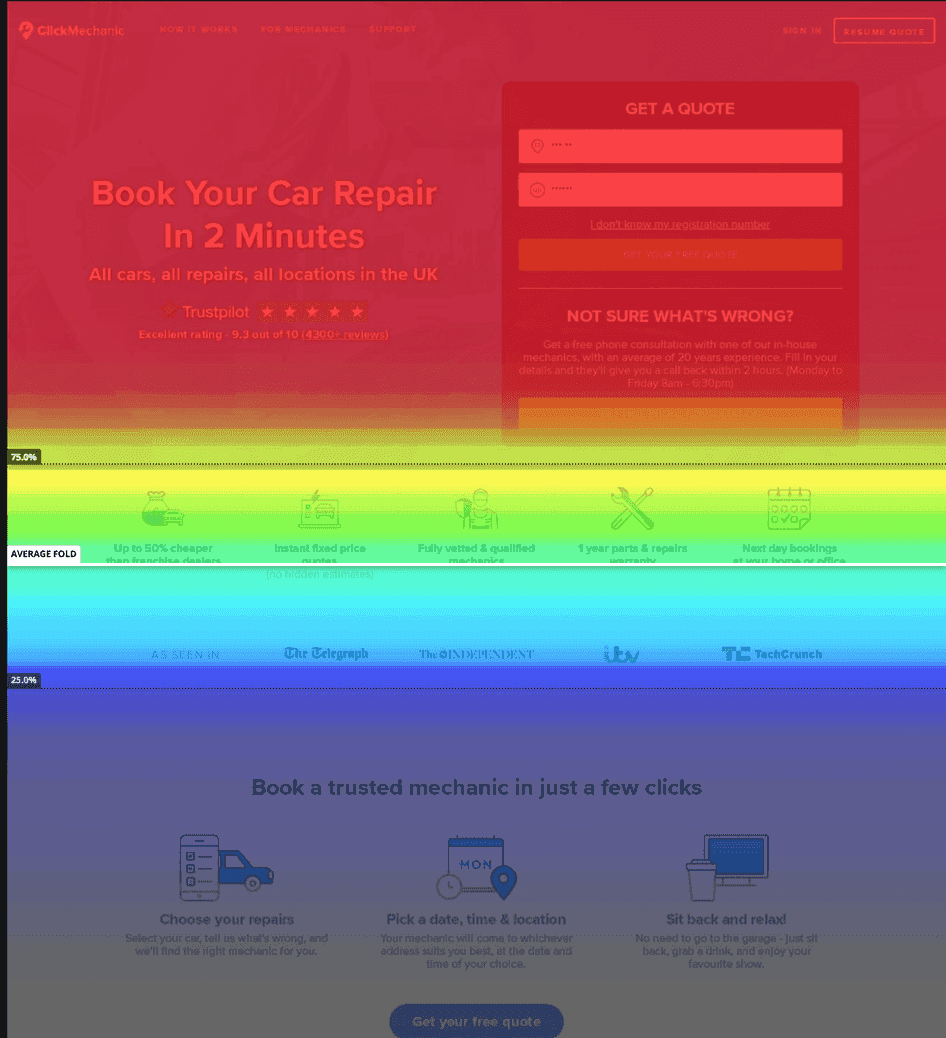
Source: Hotjar
These changes improved the page's usability and engagement, resulting in increased conversions, higher user satisfaction, and reduced bounce rates for ClickMechanic.
Create a landing page for every purpose
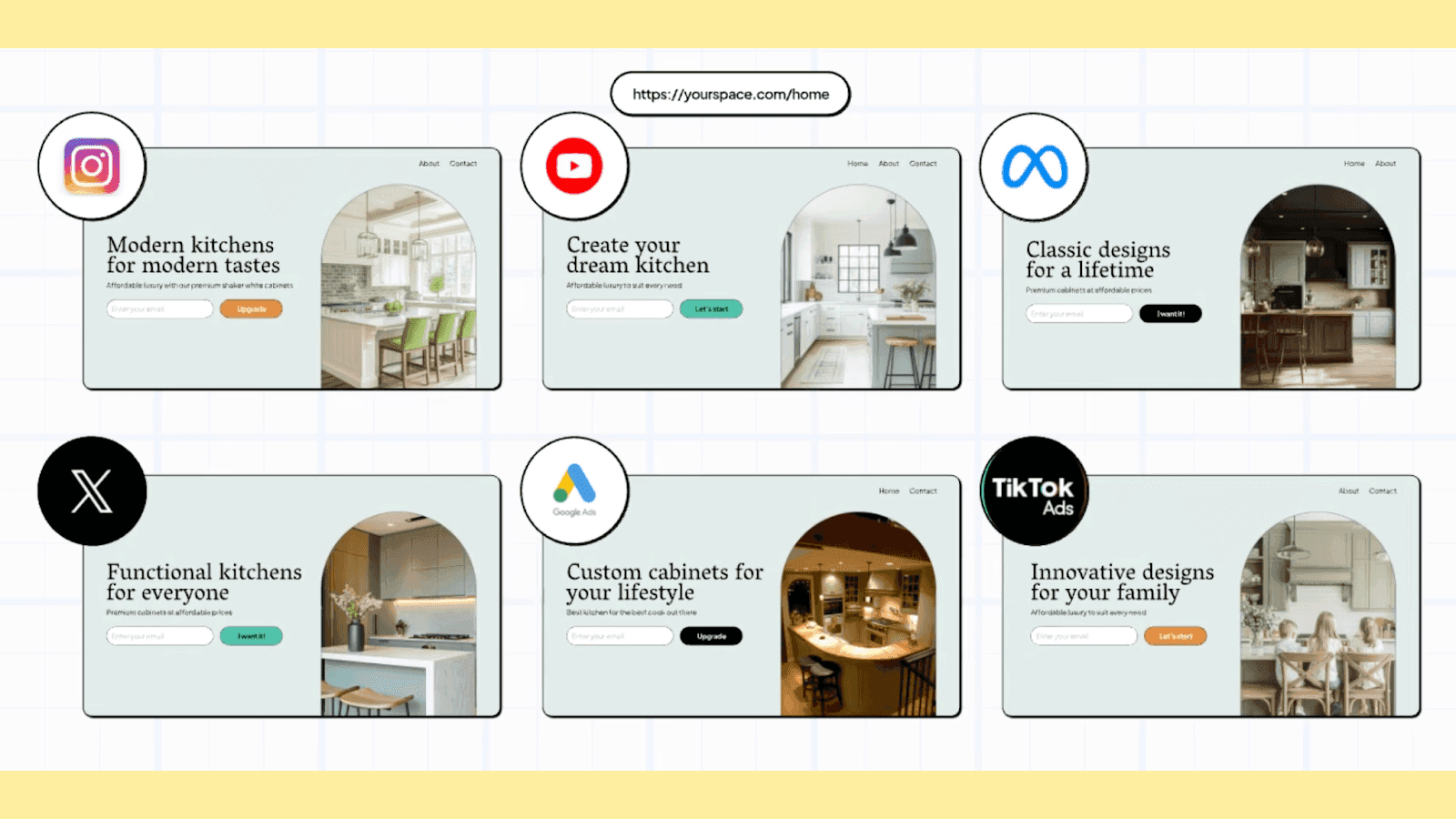
If you create different ad campaigns or email newsletters for different audience segments, (based on gender, devices they use, and traffic source), sending all of them to the same landing page won’t make sense.
Okay, answer this. Would you like to see the same landing page on your mobile device primarily targeting desktop users? Of course not.
The same page that makes more sense on desktop devices (with larger screens) would feel clunky on your mobile device.
Always remember the goal of a landing page is to increase conversions. However, driving the wrong (not entirely, but still) audience to the wrong landing page would be similar to intentionally losing out on conversions. And that is something you’d not want to do.
So, always create different landing pages for different purposes. This will:
Add a touch of personalization and reduce distraction
Allow you to test different segments more precisely.
We know just the right platform (not bragging) that can help you create personalized landing pages for every platform based on different factors (gender, device type, traffic source, operating system): Fibr AI
Here’s an example:
Maintain consistent messaging and avoid mismatch
This tip is an extension of the above.
Yes, you need a dedicated page for every marketing campaign, including audience type, device type, gender, and more. But that’s not enough.
Say you create multiple landing pages. However, your landing pages are inconsistent with the ad or email that brought in the visitors. This can confuse or even frustrate your audience, leading to a high bounce rate.
The culprit? Inconsistent messaging and a message mismatch.
When creating landing pages, make sure they offer the same experience and value promised to the visitors when they click on your Facebook ad. This will help your audience connect better with your offer, build trust, and eventually lead to a desired action.
In addition, you need to offer a personalized experience to your visitors, which you can do with the help of Fibr AI: an AI-powered personalization platform.
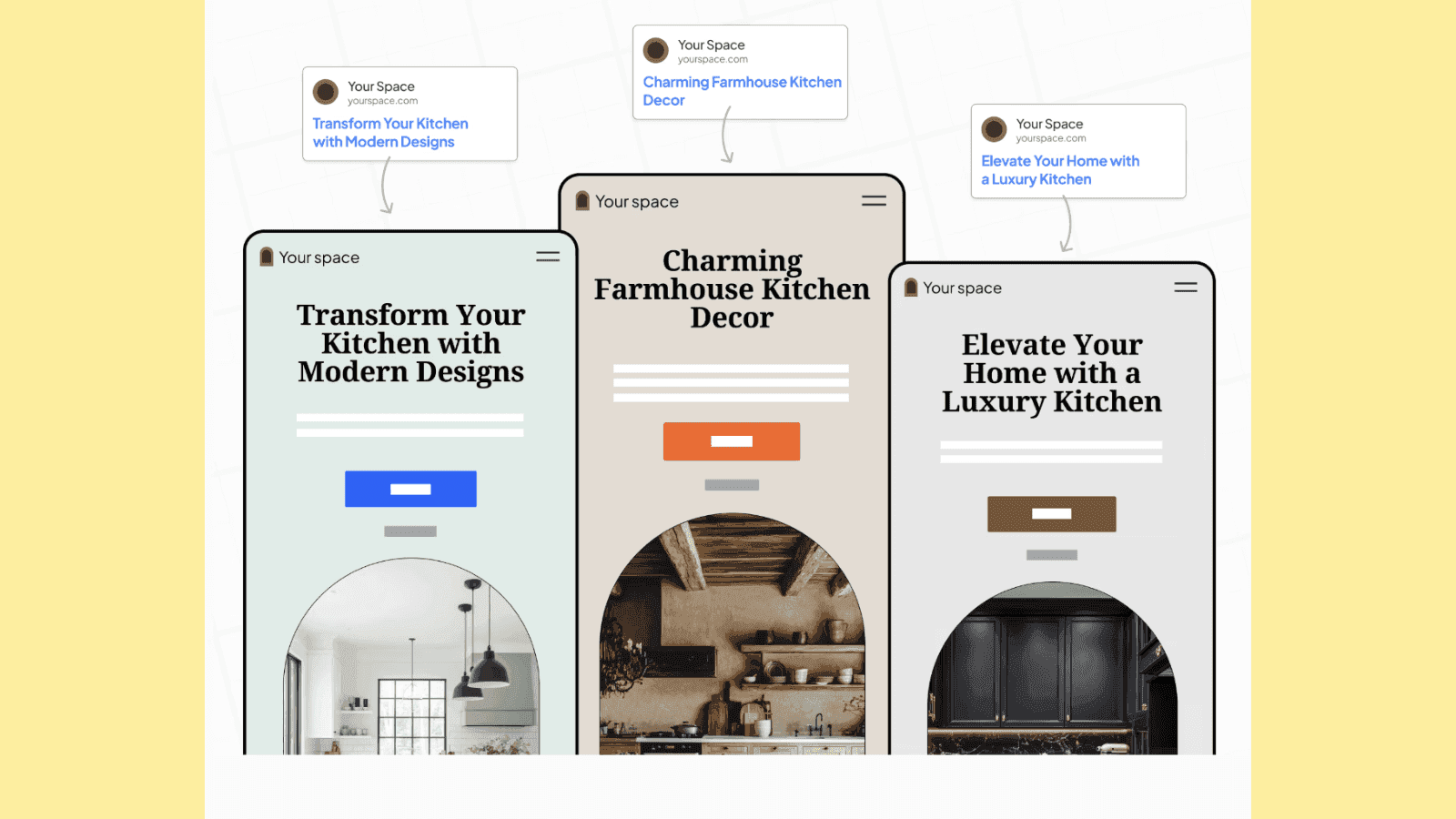
With Fibr AI, you can create 1:1 landing pages i.e. a personalized landing page for each audience segment, and deliver a better customer experience. And you can do all this with the help of Fibr AI’s visual editor which doesn't require coding expertise.
Create an attention-grabbing headline
Your headline is one of the first things visitors will notice, and it’s often the determining factor in whether they stay or leave. It needs to be clear, concise, and compelling. The headline should immediately communicate the value of your offer in a way that resonates with your audience. For example, instead of using generic phrases like "Buy Now," focus on solving the visitor’s problem: "Get Your Dream Home at 50% Off Today."
Your headline should follow landing page optimization best practices, such as using strong, benefit-driven language and aligning it with the visitor’s intent. Also, ensure it connects well with the ad or source that brought the visitor to your page. A mismatch between ad copy and the landing page headline can lead to higher bounce rates.
PRO TIP: Fibr's WYSIWYG Editor helps you personalize your headlines for every audience. Give it a try today!

Get right to the point and remove distractions
According to Forbes, internet users have an average attention span of just 8 seconds. This means from the moment a user lands on your page, you have 8 seconds to:
Grab their attention.
Promote your offer.
Get them to take the desired action.
So, you better be good at it. How?
Try to get to the point right away! No beating around the bushes, just meaningful information in as few words as possible.
Note. Don’t get too cruel when removing extra words. Sometimes, a little explanation is required to help your visitors understand more about your offer. The goal is to strike a balance between brevity and verbosity.
Another thing that will help you get right to the point is removing distractions. If there is a navigation bar, multiple offers, or CTAs, chances are your visitors will get confused.
When you’re done creating your landing page, look at it for a while. Or get it reviewed by your peers. If most people aren’t naturally focussing where they should be, there are too many distractions.
Remove all the elements you can rationally until you’re left with 1 thing to focus on.
Use the space “above the fold” wisely.
Above the fold is the space that is visible to you the moment you land on a landing page, without scrolling.
To make the most of this space, add your primary message and call to action in this space. This way, your visitors will get the most valuable information right off the bat without scrolling.
What’s the purpose? If your visitors get to see the most valuable bit of your landing page immediately, it will:
Leave a good first impression.
Reduce bounce rate.
Improve engagement
And eventually, boost the conversion rate.
Use multiple CTAs in longer landing pages
If you have landing pages longer than average, make sure you include multiple CTAs at regular intervals.
Why?
Different users react to content differently.
Some may want to take action the moment they land, while others might want to read content before being convinced. If they see a call to action right when they decide to take action, they will be more likely to convert.
Take Netflix’s landing page for example:

You can see a CTA (above the fold) the moment you land on their website.
Once you scroll to the bottom, there’s another CTA just when the FAQs end:

All landing page elements should work in sync
The goal of every landing page element should be to support your core value proposition or business objective.
Say you’re promoting a digital marketing masterclass. And your landing page also has a popup that prompts visitors to subscribe to your newsletter on general freelancing tips. This is a classic example of elements not working in sync.
So, elements that don’t directly or indirectly promote your landing page’s objective don’t deserve to stay there.
Try different forms of media
Try out different media on your landing page, from plain text and images to high-definition videos.
Using videos in specific can boost conversions by up to 86%, says HubSpot. And for the right reasons. Visitors don’t have to read blocks of text or focus on static images when they can understand everything from a video.
Remove unnecessary fields and add enough whitespace
What information do you actually need? Would the email and first name do the job? If so, remove every unnecessary field from your form. Unnecessary fields make your form longer, which becomes a task for your visitors.
In fact, NinjaForms reported a 25% drop in conversions after they added the 5th form field on a single landing page. When it comes to form fields, less is more.
You can experiment with the number of fields your audience would be comfortable to fill in.
In addition to removing unnecessary fields, make sure there’s enough white space around your form. The fields should be well-spaced, and the overall form should invite users to interact with it and not push them away.
11. Draw the visitors to the form and make the form readable
When creating your landing page lead gen form, make sure you use design elements that direct the visitors towards the form. Never assume that the visitors would know what their next step would be. Even if they do, you must do your due diligence by acting as their guide. How?
You can use direction cues like arrows, icons, or images of people looking at your lead gen form.
In addition to adding some directional cues, make the form more readable. How?
By making sure the field titles are clear and visible without having to squint.
Also, the form CTA should be enlarged to make it distinct.
12. Make the CTA copy crisp and clear
You must have seen those boring CTAs like “Click Here,” “Submit,” or “Subscribe.” While these types of CTAs seem to serve the purpose, they are pretty vague and unclear. They’re not telling what a visitor will get on the other site.
Use better and more clear CTA variations like “Get your Free Copy” if you’re offering an e-book. Or if you’re offering a trial, say “Enjoy your Free Trial.” The goal is to add clarity and help the visitor visualize what they’ll get once they click the CTA.
Is making a CTA clearer even worth the effort? Of course. Data says that a clear CTA can boost conversion rates by up to 161%. You can skip this step if a 161% increase in conversions doesn’t sound lucrative enough.
13. Don’t use clickbait-y calls to action
If your CTA says something is available for free, it should be.
Say you’re offering a free lead magnet (a checklist of the best CRO practices.) Upon submitting their information, a visitor must be able to download the lead magnet or receive it on their email.
If you’re asking them to submit more information, pay, or do anything else besides offering them what they clicked for, it’s unethical.
You may get a lead for your database, but it won’t likely convert. Also, they might tell others about your unethical means of capturing user data.
14. Don’t sound fishy
Try to avoid using words like “awesome,” “amazing,” “make money,” etc. These words make you sound like you’re trying too hard to sell.
Also, when choosing a text for your opt-outs, don’t try to use CTAs like “No, I don’t want to lose customers” to close the popups.
15. Place your CTA carefully
Don’t try to fit your CTA in a cramped up place, just like a jigsaw puzzle. There should be ample space around the CTA, so it’s visible clearly. Also, try using contrasting colors for your CTA in comparison to the elements surrounding it. This will help your CTA pop.
In addition, make sure your CTA is placed above the fold. This reduces the friction and allows the users to act immediately. Also, spread CTAs across the page if you have a longer landing page.
16. Use supportive (but less dominant) CTAs
Some customers need a little push to make the final decision, i.e. making the purchase. And that little push could be:
A brochure explaining the use of a product (if you’re selling a product)
The contact number of your support team (if you’re selling a SaaS tool)
These additional CTAs give your visitors a safety net and the assurance they need to make that final decision.
P.S. Make sure the additional CTA is less dominant than the primary one. You’d not want both the primary and additional CTA competing for attention.
17. Tweak your headlines and add internal links
Try adding text headlines instead of having them inside images. Assigning an H1 tag to your headline lets Google’s web crawlers understand what the page is about.
If you want organic traffic, you need to add internal links to and from your landing page. This will help you rank higher and thus drive more traffic.
P.S. Adding text headlines instead of embedding them in images can slightly hurt the visual quality of your landing page. This is recommended only if you want to attract organic traffic.
18. Write a long-form copy and get backlinks
While it’s recommended to be as brief as possible when it comes to landing pages, a little explanation won’t hurt. This will allow you to accommodate more keywords in your copy and increase the chances of ranking in the Google SERPs.
Provide a valuable resource on your landing page like a whitepaper, an e-book, or a checklist. This will help you generate backlinks and thus attract even more organic visitors to your landing page.
19. Create a checklist
Create a checklist of all the items you wanted to see on your landing page when you started. Keep checking the items one by one and make the necessary changes wherever required.
Whatever you do, make sure to:
Remember (and avoid) past campaign mistakes: Analyze the reports of your previous campaigns and identify the mistakes that impacted your landing page’s performance. And make sure you do not commit the same mistakes again.
Remember (and repeat) past campaign successes: if some things went sideways with your previous campaigns, some things must have worked well. Make sure to learn from those things and implement them in your landing page.
20. Review your landing page and ask for feedback from as many people as you can
Review your landing page for typos, grammatical errors, and other issues that could hurt the user experience and potentially impact your conversion rate. Even better, if you have a dedicated resource that can perform QA on your landing pages.
It’s natural to not notice mistakes or errors when you have seen/reviewed your landing page multiple times. So, release your landing page within your organization both online and offline and ask for feedback from both marketers and non-marketers.
This will give you a chance to identify more opportunities to boost your landing page’s performance that you might have missed.
Track Performance for High-Performing Landing Pages
Tracking the performance of your marketing campaign is essential. Otherwise, how would you know if your landing page performed the way you expected?
Here’s what you need to do:
Use the right tools to track the right KPIs
Leverage tools like Google Analytics and Kissmetrics to track and analyze data. These tools are easy to integrate and can help you continuously monitor a range of important landing page metrics and KPIs.
Make sure you’re tracking the KPIs and metrics that align with your larger objective. While the metrics you track vary with your campaign objective, some fundamental KPIs include conversion rate, cart abandonment rate, bounce rate, etc.
Be transparent and don’t rely much on industry averages
Make sure to regularly share the reports with your team. Whether it's a failure or success, your team must be aware of it. Success can motivate them, and failures can help them identify more opportunities to grow.
Also, don’t rely much on industry averages. As the name suggests, they represent average figures, which may or may not be relevant to your business. After all, every business has its own needs and challenges, right?
Don’t forget about qualitative data
In addition to tracking quantitative data, make sure to track qualitative data as it will help you understand user behavior. And user behavior in turn helps you determine the WHY as discussed in the first landing page optimization tip.
To track qualitative data, you can use screen recordings, scroll maps, click maps, move maps, and feedback widgets.
Landing Page Optimization Examples
Here are some landing page optimization examples that’ll help you understand the impact of landing page optimization
1. Going: A Travel Discount Company

Going has two primary methods of offering services to its customers: a free plan and a two-week trial of the premium plan. And their landing page CTA asked the users to “Sign up for Free”.
However, the company thought they might get more conversions if the potential customers could directly experience the benefits of their premium plan.
To test their theory, Going conducted A/B tests and tested different variations of their landing page CTA: “SIGN UP FOR FREE” against “TRIAL FOR FREE.”
And their theory proved right as in the A/B test, the “TRIAL FOR FREE” variation helped them achieve a 104% increase in their month-on-month trial rate.
See? A change that seems so small can drive such a huge change.
2. Love Child Organics: Offers Clean and Organic Food Products for Babies and Children

Nature’s Path (formerly Love Child Organics) was experiencing high customer acquisition costs of $2 per customer and a conversion rate of 43% on their coupon offer landing page.
They performed A/B tests to compare different variations. To be precise, the company experimented with different images (image of a toddler vs image of a baby (original). In addition, they refined their targeting strategies to align with the preferences and behavior of their audiences.
Guess what? Within 8 months, they noticed a jump in conversion rate from 43% to 69%. Also, their cost per acquisition decreased from $2 to $1.30. This shows how landing page optimization can directly impact conversions.
Wrapping Up
You’ve just reviewed 14 practical steps you can take to lift your landing page performance. Give each one a try, track the results, and see what resonates with your audience:
Plan your optimization strategy in advance
Simplify your landing page design
Use contrasting colors to draw attention
Keep important elements above the fold
Introduce scarcity techniques
Make your call-to-action buttons easy to understand and simple
Add contact information for reassurance
Test different headlines and copy
Maintain consistency in style and messaging
Include testimonials for social proof
Experiment with form length
Optimize your landing pages for SEO
Try an exit popup to capture abandoning visitors
Keep A/B testing every change
If you wish to run the extra mile and get an edge over your competitors, refer to these (in-depth) chapters we created on landing pages:
Top 13 AI Landing Page Builders: to help you compare and find a reliable AI landing page builder to maximize productivity.
Landing Page Best Practices: to make sure you don’t miss out on any bet practice and publish successful landing pages on the first attempt.
15 Conversion-Killer Landing Page Mistakes: to help you identify and avoid common mistakes marketers make
FAQs
What exactly is landing page optimization?
Landing page optimization is the process of improving a page so more visitors take the action you want, like signing up or buying.
It starts by understanding what brought people to the page and what they expect to find. You then tweak headlines, images, button text and layout, and fix any performance hiccups like slow load times.
By testing different versions and tracking metrics such as click rates and form completions, you learn which changes make the biggest impact.
How do you optimize your landing page?
First, identify the promise you made in your ad or campaign and make sure the headline on the page matches it. Next, use concise copy that highlights benefits and removes distractions. Test different button labels; phrases like “Start my free trial” often work better than generic words.
You can also segment visitors by source or location to serve personalized versions of the page. Fibr AI offers a Landing Page Personalization tool that lets you bulk-create thousands of optimized landing pages tailored to different campaigns
Finally, run A/B tests using tools like Fibr’s A/B Testing agent to compare page versions automatically and route more traffic to the top performer
What is landing page optimization in SEO?
In SEO, landing page optimization means making on-page and technical tweaks so search engines and visitors find the page relevant to specific queries. Y
ou start with keyword research to discover terms people use. Then you insert those terms into your title tag, headings and body text in a natural way.
Optimize images with descriptive file names and alt attributes, and check that your page structure follows a proper heading hierarchy. On the technical side, confirm your page loads quickly, works well on mobile and appears in your XML sitemap so search engines can crawl it.
Why is my landing page not converting?
If visitors leave without acting, something is off with the messaging, design, or performance. A mismatched headline can feel misleading. Too much text or too many choices overwhelm people.
If the page loads slowly on mobile, impatient users will leave. Asking for too much information up front in a form also drives users away. Review analytics to spot where people drop off, then tackle one issue at a time; simplify copy, shorten forms, speed up images, or add trust signals like testimonials. Continuous A/B testing will show which fixes work for you.
What is a good conversion rate for landing pages?
Conversion rates vary by industry and offer. Most pages convert between 2 percent and 10 percent. B2B SaaS free trials often average around 4 percent, while simple content offers can hit 15 to 20 percent if the audience is well targeted.
If you’re below 2 percent, revisit targeting, copy, and design. If you’re above 10 percent, you’re doing well, but keep experimenting to attract higher-value leads. Track both rate and lead quality; sometimes a lower rate from a highly qualified audience is more valuable than a higher rate from less engaged visitors.
How AI can help with landing page optimization?
AI speeds up the insight and testing cycle by processing vast engagement data in seconds. It can analyze click and scroll patterns to reveal which sections grab attention and which get ignored. AI tools generate multiple headline or button variations based on proven best practices.
Some platforms, like Fibr AI, deploy specialized AI-CRO agents: Max for optimization and Aya for continuous monitoring, that run multivariate tests automatically, shifting traffic to top performers in real time.
AI also enables personalization at scale, and serves different page versions by location, campaign, or keyword so each visitor sees content most likely to convert.




Ankur Goyal
CEO @ Fibr AI
Ankur Goyal, a visionary entrepreneur, is the driving force behind Fibr, a groundbreaking AI co-pilot for websites. With a dual degree from Stanford University and IIT Delhi, Ankur brings a unique blend of technical prowess and business acumen to the table. This isn't his first rodeo; Ankur is a seasoned entrepreneur with a keen understanding of consumer behavior, web dynamics, and AI. Through Fibr, he aims to revolutionize the way websites engage with users, making digital interactions smarter and more intuitive.
Read summarized version with
Are you here for landing page optimization tips that actually work and can help you drive the desired results?
Here’s a quick summary for you to get started:
Create a landing page for every purpose
Maintain consistent messaging and avoid mismatch
Create an attention-grabbing headline
Get right to the point and remove distractions
Use the space “above the fold” wisely
Use multiple CTAs in longer landing pages
All landing page elements should work in sync
Try different forms of media
Offer something free, even if it is a part of your gated content
Remove unnecessary fields and add enough whitespace
Draw the visitors to the form and make the form readable
Make the CTA copy crisp and clear
Click baits don’t work in the long run
Don’t sound fishy
Place your CTA carefully
Supportive (but less dominant) CTAs
Tweak your headlines and add internal links
Write a long-form copy and get backlinks
Create a checklist
Review your landing page and ask for feedback from as many people as you can
Test all these elements of your landing page
Leverage the power of AI
Use the right tools to track the right KPIs
Be transparent and don’t rely much on industry averages
Don’t forget about qualitative data
If you want to learn how to implement these landing page optimization techniques, you’d want to read more.
Let’s start with the fundamentals.
What Is Landing Page Optimization?
Landing page optimization (LPO) improves a page’s design, content, and performance to drive more sign-ups, purchases, or downloads. It focuses on matching the page to what users are looking for by updating headlines, buttons, visuals, and layout. LPO also involves A/B testing and fixing issues like slow load times or messy design. The aim is to make the page more relevant, useful, and easier to act on.
Landing page optimization is fundamentally a 3-step process:
Step 1: Identifying potential issues with your landing page.
This step involves identifying potential issues with your landing pages by analyzing qualitative and quantitative data. When you know what the problem is and why it is occurring, you can outline clear steps to deal with the problem.
Say, you notice an unusually high bounce rate and find it’s the slow loading speed causing the issue. You can make the necessary changes to improve the loading speed, potentially improving the bounce rate.
Step 2: A/B testing different elements to identify high conversion variants.
In this step, you need to test different elements of your landing pages to identify a landing page variant that best aligns with your goals.
Step 3: Track KPIs and measure the performance
This step involves tracking the most important KPIs (related to your goal) to measure how successful your optimization efforts were.
Why Does Landing Page Optimization Matter?
Landing page optimization (LPO) is a crucial aspect of digital marketing that offers significant benefits for businesses aiming to improve their online presence and achieve better results from their campaigns.
Here’s what you can achieve by following effective landing page optimization best practices:
Enhanced Landing Page Experience (UX)
One of the most critical aspects of landing page optimization is the improvement in user experience (UX). A well-optimized landing page provides visitors with relevant, useful, and well-structured content. When your page layout is clear, the information is easy to find, and the interactions are seamless, visitors are more likely to feel satisfied and engaged.
For example, optimizing the page design to load quickly and ensuring it’s optimized for mobile users provides a smoother user experience. Clear calls-to-action (CTAs) and concise messaging further enhance usability.
When visitors feel that your page caters to their needs, they are more likely to explore further, spend more time on your site, and ultimately take the desired action, whether it’s making a purchase or filling out a form.
Improved Conversion Rates
Landing page optimization directly impacts conversion rates. It enables marketers to fine-tune elements such as headlines, CTAs, and visuals to create a page that resonates with your target audience.
An effective landing page optimization strategy involves the use of A/B testing which helps to determine which design or copy variations perform best.
The ultimate goal is to maximize the percentage of visitors who take the desired action, whether it’s signing up for a newsletter, downloading a resource, or completing a purchase.
Lower Customer Acquisition Costs
Optimized landing pages also contribute to lower customer acquisition costs (CAC). When your landing page provides a better experience and higher conversions, you get more value from your advertising spend.
A higher conversion rate reduces the cost per conversion which enables you to stretch your marketing budget further.
Additionally, platforms like Google Ads reward relevant and well-optimized landing pages with a lower cost-per-click (CPC). By aligning your landing page content with the keywords and intent of your target audience, you improve your ad performance, making your campaigns more cost-effective.
Builds Trust and Credibility
LPO allows you to follow a proper landing page optimization checklist which gives you complete control over the content and structure of your page. This allows you to include elements that build trust and credibility.
It allows you to showcase user reviews, client testimonials, and recognizable client logos which reassure visitors of your reliability and the quality of your offerings.
For example, featuring a customer testimonial that highlights a positive experience with your service or displaying industry certifications adds authenticity. Visitors are more likely to engage with a brand they trust, and these elements help establish that trust quickly.
Boosts Google Quality Score
Optimized landing pages also play a key role in improving your Google Quality Score. Google evaluates landing page relevance, loading speed, and overall user experience when determining your ad rank.
A higher Quality Score reduces your CPC, increases ad visibility, and enhances campaign performance.
By ensuring your landing page aligns with the keywords in your ad campaigns and provides a seamless experience, you not only satisfy user needs but also gain favor with search engines.
Pro Tip: Use Fibr AI you can enhance your Google Ad Quality Score by:
Aligning your landing page with the exact keywords from your ads.
Optimizing Quality Score with targeted A/B testing
Precisely matching landing pages to each Ad
Maximizes ROI on Marketing Campaigns
Finally, landing page optimization maximizes the return on investment (ROI) for your marketing campaigns. When your landing pages convert visitors effectively and operate efficiently, every dollar spent on advertising generates greater value.
Optimized pages reduce waste in ad spend and lead to more meaningful results, such as higher sales or stronger lead generation.
P.S. Hubspot says that businesses with 40+ landing pages noticed an increase in conversion rate of over 500%. And you can’t imagine achieving such results if your landing pages are not optimized, right?
Recommended Read: Benefits of the Landing Pages
Now that you know why it’s essential to optimize landing pages, how can you do that?
20 Best Landing Page Optimization Tips to Increase Conversions
Before you start implementing changes, assuming you already have an active landing page, it's crucial to understand what’s keeping your landing pages from converting visitors.
Track visitor behavior on your landing page
For this, you can use heatmaps, scroll maps, or session recordings from a tool like Hotjar, to visualize how users interact with your landing page. For example, if visitors aren't scrolling past the headline or CTA button, it’s a sign that the content isn't engaging enough.
At this point, you need to collect in-the-moment feedback through surveys or feedback widgets to hear directly from your users. You can ask simple questions like, "What stopped you from completing your purchase?"
Gathering this feedback will help pinpoint specific issues affecting your landing page conversion rates. A reliable landing page optimization tool can streamline this process by integrating visitor behavior analytics and feedback collection into your workflow.
ClickMechanic, a UK-based marketplace that connects customers in need of auto repair or servicing with local mechanics, used Hotjar’s Polls and Heat Maps to identify and address barriers to purchase on their landing page.
Through user feedback from Polls, they noticed confusion with their pricing details. They then performed a redesign of their landing page to emphasize transparent pricing and a clear value proposition.
Hotjar Heatmaps also showed that essential content was overlooked due to its placement. They adjust the content placement prioritizing key information above the fold.
Source: Hotjar
These changes improved the page's usability and engagement, resulting in increased conversions, higher user satisfaction, and reduced bounce rates for ClickMechanic.
Create a landing page for every purpose
If you create different ad campaigns or email newsletters for different audience segments, (based on gender, devices they use, and traffic source), sending all of them to the same landing page won’t make sense.
Okay, answer this. Would you like to see the same landing page on your mobile device primarily targeting desktop users? Of course not.
The same page that makes more sense on desktop devices (with larger screens) would feel clunky on your mobile device.
Always remember the goal of a landing page is to increase conversions. However, driving the wrong (not entirely, but still) audience to the wrong landing page would be similar to intentionally losing out on conversions. And that is something you’d not want to do.
So, always create different landing pages for different purposes. This will:
Add a touch of personalization and reduce distraction
Allow you to test different segments more precisely.
We know just the right platform (not bragging) that can help you create personalized landing pages for every platform based on different factors (gender, device type, traffic source, operating system): Fibr AI
Here’s an example:
Maintain consistent messaging and avoid mismatch
This tip is an extension of the above.
Yes, you need a dedicated page for every marketing campaign, including audience type, device type, gender, and more. But that’s not enough.
Say you create multiple landing pages. However, your landing pages are inconsistent with the ad or email that brought in the visitors. This can confuse or even frustrate your audience, leading to a high bounce rate.
The culprit? Inconsistent messaging and a message mismatch.
When creating landing pages, make sure they offer the same experience and value promised to the visitors when they click on your Facebook ad. This will help your audience connect better with your offer, build trust, and eventually lead to a desired action.
In addition, you need to offer a personalized experience to your visitors, which you can do with the help of Fibr AI: an AI-powered personalization platform.
With Fibr AI, you can create 1:1 landing pages i.e. a personalized landing page for each audience segment, and deliver a better customer experience. And you can do all this with the help of Fibr AI’s visual editor which doesn't require coding expertise.
Create an attention-grabbing headline
Your headline is one of the first things visitors will notice, and it’s often the determining factor in whether they stay or leave. It needs to be clear, concise, and compelling. The headline should immediately communicate the value of your offer in a way that resonates with your audience. For example, instead of using generic phrases like "Buy Now," focus on solving the visitor’s problem: "Get Your Dream Home at 50% Off Today."
Your headline should follow landing page optimization best practices, such as using strong, benefit-driven language and aligning it with the visitor’s intent. Also, ensure it connects well with the ad or source that brought the visitor to your page. A mismatch between ad copy and the landing page headline can lead to higher bounce rates.
PRO TIP: Fibr's WYSIWYG Editor helps you personalize your headlines for every audience. Give it a try today!
Get right to the point and remove distractions
According to Forbes, internet users have an average attention span of just 8 seconds. This means from the moment a user lands on your page, you have 8 seconds to:
Grab their attention.
Promote your offer.
Get them to take the desired action.
So, you better be good at it. How?
Try to get to the point right away! No beating around the bushes, just meaningful information in as few words as possible.
Note. Don’t get too cruel when removing extra words. Sometimes, a little explanation is required to help your visitors understand more about your offer. The goal is to strike a balance between brevity and verbosity.
Another thing that will help you get right to the point is removing distractions. If there is a navigation bar, multiple offers, or CTAs, chances are your visitors will get confused.
When you’re done creating your landing page, look at it for a while. Or get it reviewed by your peers. If most people aren’t naturally focussing where they should be, there are too many distractions.
Remove all the elements you can rationally until you’re left with 1 thing to focus on.
Use the space “above the fold” wisely.
Above the fold is the space that is visible to you the moment you land on a landing page, without scrolling.
To make the most of this space, add your primary message and call to action in this space. This way, your visitors will get the most valuable information right off the bat without scrolling.
What’s the purpose? If your visitors get to see the most valuable bit of your landing page immediately, it will:
Leave a good first impression.
Reduce bounce rate.
Improve engagement
And eventually, boost the conversion rate.
Use multiple CTAs in longer landing pages
If you have landing pages longer than average, make sure you include multiple CTAs at regular intervals.
Why?
Different users react to content differently.
Some may want to take action the moment they land, while others might want to read content before being convinced. If they see a call to action right when they decide to take action, they will be more likely to convert.
Take Netflix’s landing page for example:
You can see a CTA (above the fold) the moment you land on their website.
Once you scroll to the bottom, there’s another CTA just when the FAQs end:
All landing page elements should work in sync
The goal of every landing page element should be to support your core value proposition or business objective.
Say you’re promoting a digital marketing masterclass. And your landing page also has a popup that prompts visitors to subscribe to your newsletter on general freelancing tips. This is a classic example of elements not working in sync.
So, elements that don’t directly or indirectly promote your landing page’s objective don’t deserve to stay there.
Try different forms of media
Try out different media on your landing page, from plain text and images to high-definition videos.
Using videos in specific can boost conversions by up to 86%, says HubSpot. And for the right reasons. Visitors don’t have to read blocks of text or focus on static images when they can understand everything from a video.
Remove unnecessary fields and add enough whitespace
What information do you actually need? Would the email and first name do the job? If so, remove every unnecessary field from your form. Unnecessary fields make your form longer, which becomes a task for your visitors.
In fact, NinjaForms reported a 25% drop in conversions after they added the 5th form field on a single landing page. When it comes to form fields, less is more.
You can experiment with the number of fields your audience would be comfortable to fill in.
In addition to removing unnecessary fields, make sure there’s enough white space around your form. The fields should be well-spaced, and the overall form should invite users to interact with it and not push them away.
11. Draw the visitors to the form and make the form readable
When creating your landing page lead gen form, make sure you use design elements that direct the visitors towards the form. Never assume that the visitors would know what their next step would be. Even if they do, you must do your due diligence by acting as their guide. How?
You can use direction cues like arrows, icons, or images of people looking at your lead gen form.
In addition to adding some directional cues, make the form more readable. How?
By making sure the field titles are clear and visible without having to squint.
Also, the form CTA should be enlarged to make it distinct.
12. Make the CTA copy crisp and clear
You must have seen those boring CTAs like “Click Here,” “Submit,” or “Subscribe.” While these types of CTAs seem to serve the purpose, they are pretty vague and unclear. They’re not telling what a visitor will get on the other site.
Use better and more clear CTA variations like “Get your Free Copy” if you’re offering an e-book. Or if you’re offering a trial, say “Enjoy your Free Trial.” The goal is to add clarity and help the visitor visualize what they’ll get once they click the CTA.
Is making a CTA clearer even worth the effort? Of course. Data says that a clear CTA can boost conversion rates by up to 161%. You can skip this step if a 161% increase in conversions doesn’t sound lucrative enough.
13. Don’t use clickbait-y calls to action
If your CTA says something is available for free, it should be.
Say you’re offering a free lead magnet (a checklist of the best CRO practices.) Upon submitting their information, a visitor must be able to download the lead magnet or receive it on their email.
If you’re asking them to submit more information, pay, or do anything else besides offering them what they clicked for, it’s unethical.
You may get a lead for your database, but it won’t likely convert. Also, they might tell others about your unethical means of capturing user data.
14. Don’t sound fishy
Try to avoid using words like “awesome,” “amazing,” “make money,” etc. These words make you sound like you’re trying too hard to sell.
Also, when choosing a text for your opt-outs, don’t try to use CTAs like “No, I don’t want to lose customers” to close the popups.
15. Place your CTA carefully
Don’t try to fit your CTA in a cramped up place, just like a jigsaw puzzle. There should be ample space around the CTA, so it’s visible clearly. Also, try using contrasting colors for your CTA in comparison to the elements surrounding it. This will help your CTA pop.
In addition, make sure your CTA is placed above the fold. This reduces the friction and allows the users to act immediately. Also, spread CTAs across the page if you have a longer landing page.
16. Use supportive (but less dominant) CTAs
Some customers need a little push to make the final decision, i.e. making the purchase. And that little push could be:
A brochure explaining the use of a product (if you’re selling a product)
The contact number of your support team (if you’re selling a SaaS tool)
These additional CTAs give your visitors a safety net and the assurance they need to make that final decision.
P.S. Make sure the additional CTA is less dominant than the primary one. You’d not want both the primary and additional CTA competing for attention.
17. Tweak your headlines and add internal links
Try adding text headlines instead of having them inside images. Assigning an H1 tag to your headline lets Google’s web crawlers understand what the page is about.
If you want organic traffic, you need to add internal links to and from your landing page. This will help you rank higher and thus drive more traffic.
P.S. Adding text headlines instead of embedding them in images can slightly hurt the visual quality of your landing page. This is recommended only if you want to attract organic traffic.
18. Write a long-form copy and get backlinks
While it’s recommended to be as brief as possible when it comes to landing pages, a little explanation won’t hurt. This will allow you to accommodate more keywords in your copy and increase the chances of ranking in the Google SERPs.
Provide a valuable resource on your landing page like a whitepaper, an e-book, or a checklist. This will help you generate backlinks and thus attract even more organic visitors to your landing page.
19. Create a checklist
Create a checklist of all the items you wanted to see on your landing page when you started. Keep checking the items one by one and make the necessary changes wherever required.
Whatever you do, make sure to:
Remember (and avoid) past campaign mistakes: Analyze the reports of your previous campaigns and identify the mistakes that impacted your landing page’s performance. And make sure you do not commit the same mistakes again.
Remember (and repeat) past campaign successes: if some things went sideways with your previous campaigns, some things must have worked well. Make sure to learn from those things and implement them in your landing page.
20. Review your landing page and ask for feedback from as many people as you can
Review your landing page for typos, grammatical errors, and other issues that could hurt the user experience and potentially impact your conversion rate. Even better, if you have a dedicated resource that can perform QA on your landing pages.
It’s natural to not notice mistakes or errors when you have seen/reviewed your landing page multiple times. So, release your landing page within your organization both online and offline and ask for feedback from both marketers and non-marketers.
This will give you a chance to identify more opportunities to boost your landing page’s performance that you might have missed.
Track Performance for High-Performing Landing Pages
Tracking the performance of your marketing campaign is essential. Otherwise, how would you know if your landing page performed the way you expected?
Here’s what you need to do:
Use the right tools to track the right KPIs
Leverage tools like Google Analytics and Kissmetrics to track and analyze data. These tools are easy to integrate and can help you continuously monitor a range of important landing page metrics and KPIs.
Make sure you’re tracking the KPIs and metrics that align with your larger objective. While the metrics you track vary with your campaign objective, some fundamental KPIs include conversion rate, cart abandonment rate, bounce rate, etc.
Be transparent and don’t rely much on industry averages
Make sure to regularly share the reports with your team. Whether it's a failure or success, your team must be aware of it. Success can motivate them, and failures can help them identify more opportunities to grow.
Also, don’t rely much on industry averages. As the name suggests, they represent average figures, which may or may not be relevant to your business. After all, every business has its own needs and challenges, right?
Don’t forget about qualitative data
In addition to tracking quantitative data, make sure to track qualitative data as it will help you understand user behavior. And user behavior in turn helps you determine the WHY as discussed in the first landing page optimization tip.
To track qualitative data, you can use screen recordings, scroll maps, click maps, move maps, and feedback widgets.
Landing Page Optimization Examples
Here are some landing page optimization examples that’ll help you understand the impact of landing page optimization
1. Going: A Travel Discount Company
Going has two primary methods of offering services to its customers: a free plan and a two-week trial of the premium plan. And their landing page CTA asked the users to “Sign up for Free”.
However, the company thought they might get more conversions if the potential customers could directly experience the benefits of their premium plan.
To test their theory, Going conducted A/B tests and tested different variations of their landing page CTA: “SIGN UP FOR FREE” against “TRIAL FOR FREE.”
And their theory proved right as in the A/B test, the “TRIAL FOR FREE” variation helped them achieve a 104% increase in their month-on-month trial rate.
See? A change that seems so small can drive such a huge change.
2. Love Child Organics: Offers Clean and Organic Food Products for Babies and Children
Nature’s Path (formerly Love Child Organics) was experiencing high customer acquisition costs of $2 per customer and a conversion rate of 43% on their coupon offer landing page.
They performed A/B tests to compare different variations. To be precise, the company experimented with different images (image of a toddler vs image of a baby (original). In addition, they refined their targeting strategies to align with the preferences and behavior of their audiences.
Guess what? Within 8 months, they noticed a jump in conversion rate from 43% to 69%. Also, their cost per acquisition decreased from $2 to $1.30. This shows how landing page optimization can directly impact conversions.
Wrapping Up
You’ve just reviewed 14 practical steps you can take to lift your landing page performance. Give each one a try, track the results, and see what resonates with your audience:
Plan your optimization strategy in advance
Simplify your landing page design
Use contrasting colors to draw attention
Keep important elements above the fold
Introduce scarcity techniques
Make your call-to-action buttons easy to understand and simple
Add contact information for reassurance
Test different headlines and copy
Maintain consistency in style and messaging
Include testimonials for social proof
Experiment with form length
Optimize your landing pages for SEO
Try an exit popup to capture abandoning visitors
Keep A/B testing every change
If you wish to run the extra mile and get an edge over your competitors, refer to these (in-depth) chapters we created on landing pages:
Top 13 AI Landing Page Builders: to help you compare and find a reliable AI landing page builder to maximize productivity.
Landing Page Best Practices: to make sure you don’t miss out on any bet practice and publish successful landing pages on the first attempt.
15 Conversion-Killer Landing Page Mistakes: to help you identify and avoid common mistakes marketers make
FAQs
What exactly is landing page optimization?
Landing page optimization is the process of improving a page so more visitors take the action you want, like signing up or buying.
It starts by understanding what brought people to the page and what they expect to find. You then tweak headlines, images, button text and layout, and fix any performance hiccups like slow load times.
By testing different versions and tracking metrics such as click rates and form completions, you learn which changes make the biggest impact.
How do you optimize your landing page?
First, identify the promise you made in your ad or campaign and make sure the headline on the page matches it. Next, use concise copy that highlights benefits and removes distractions. Test different button labels; phrases like “Start my free trial” often work better than generic words.
You can also segment visitors by source or location to serve personalized versions of the page. Fibr AI offers a Landing Page Personalization tool that lets you bulk-create thousands of optimized landing pages tailored to different campaigns
Finally, run A/B tests using tools like Fibr’s A/B Testing agent to compare page versions automatically and route more traffic to the top performer
What is landing page optimization in SEO?
In SEO, landing page optimization means making on-page and technical tweaks so search engines and visitors find the page relevant to specific queries. Y
ou start with keyword research to discover terms people use. Then you insert those terms into your title tag, headings and body text in a natural way.
Optimize images with descriptive file names and alt attributes, and check that your page structure follows a proper heading hierarchy. On the technical side, confirm your page loads quickly, works well on mobile and appears in your XML sitemap so search engines can crawl it.
Why is my landing page not converting?
If visitors leave without acting, something is off with the messaging, design, or performance. A mismatched headline can feel misleading. Too much text or too many choices overwhelm people.
If the page loads slowly on mobile, impatient users will leave. Asking for too much information up front in a form also drives users away. Review analytics to spot where people drop off, then tackle one issue at a time; simplify copy, shorten forms, speed up images, or add trust signals like testimonials. Continuous A/B testing will show which fixes work for you.
What is a good conversion rate for landing pages?
Conversion rates vary by industry and offer. Most pages convert between 2 percent and 10 percent. B2B SaaS free trials often average around 4 percent, while simple content offers can hit 15 to 20 percent if the audience is well targeted.
If you’re below 2 percent, revisit targeting, copy, and design. If you’re above 10 percent, you’re doing well, but keep experimenting to attract higher-value leads. Track both rate and lead quality; sometimes a lower rate from a highly qualified audience is more valuable than a higher rate from less engaged visitors.
How AI can help with landing page optimization?
AI speeds up the insight and testing cycle by processing vast engagement data in seconds. It can analyze click and scroll patterns to reveal which sections grab attention and which get ignored. AI tools generate multiple headline or button variations based on proven best practices.
Some platforms, like Fibr AI, deploy specialized AI-CRO agents: Max for optimization and Aya for continuous monitoring, that run multivariate tests automatically, shifting traffic to top performers in real time.
AI also enables personalization at scale, and serves different page versions by location, campaign, or keyword so each visitor sees content most likely to convert.
Ankur Goyal
CEO @ Fibr AI
Ankur Goyal, a visionary entrepreneur, is the driving force behind Fibr, a groundbreaking AI co-pilot for websites. With a dual degree from Stanford University and IIT Delhi, Ankur brings a unique blend of technical prowess and business acumen to the table. This isn't his first rodeo; Ankur is a seasoned entrepreneur with a keen understanding of consumer behavior, web dynamics, and AI. Through Fibr, he aims to revolutionize the way websites engage with users, making digital interactions smarter and more intuitive.