





Give your website a mind of its own.
The future of websites is here!
Give your website a mind of its own.
The future of websites is here!

Picture this: you're crafting the perfect landing page for your website. You've got a kaleidoscope of colors to choose from, a vast library of fonts, and enough images to convincingly tell a story. You could spend days or weeks even agonizing over button sizes and headline placements.
Each version you create looks fantastic, but let's be honest: you're basically playing a high-stakes guessing game. Will your audience love it? Will they click that shiny "Buy Now" button? Or will they bounce before they can even see what you offer?
Enter A/B testing, your data-driven showdown between two (or more) versions of your page, where the winner is decided not by your subjective opinion but by cold, hard data. Want to know if that snazzy new headline actually grabs attention? A/B test it! Curious if a green button converts better than a red one? A/B test it!
Even seemingly small tweaks can have a huge impact. Just ask Microsoft Bing – a single A/B test on their ad headlines resulted in a 12% revenue increase. For more inspiration, explore real-world A/B testing examples from top brands that drove measurable results with similar small changes.
Ready to create a similar success story?
The latest A/B testing statistics show just how consistently this pattern holds across industries and company sizes. Ready to create a similar success story?
Picture this: you're crafting the perfect landing page for your website. You've got a kaleidoscope of colors to choose from, a vast library of fonts, and enough images to convincingly tell a story. You could spend days or weeks even agonizing over button sizes and headline placements.
Each version you create looks fantastic, but let's be honest: you're basically playing a high-stakes guessing game. Will your audience love it? Will they click that shiny "Buy Now" button? Or will they bounce before they can even see what you offer?
Enter A/B testing, your data-driven showdown between two (or more) versions of your page, where the winner is decided not by your subjective opinion but by cold, hard data. Want to know if that snazzy new headline actually grabs attention? A/B test it! Curious if a green button converts better than a red one? A/B test it!
Even seemingly small tweaks can have a huge impact. Just ask Microsoft Bing – a single A/B test on their ad headlines resulted in a 12% revenue increase. For more inspiration, explore real-world A/B testing examples from top brands that drove measurable results with similar small changes.
Ready to create a similar success story?
The latest A/B testing statistics show just how consistently this pattern holds across industries and company sizes. Ready to create a similar success story?
What is A/B Testing?
What is A/B Testing?
A/B testing is a method that helps you make informed decisions by comparing two versions of something to see which performs better.
It allows you to test various elements from design and layout to copy testing by creating multiple versions of your website, landing page, advertisement, email newsletter, and more to understand which one resonates best with your audience.
A/B testing, also called split testing, involves presenting two variants (A and B) to your audience to determine which one gives you better results though there are subtle but important distinctions in the difference between A/B testing and split testing worth understanding before you begin.The "A" version is usually the control of the original, while the "B" version contains the element you want to test, like a different headline, image, or call-to-action button.
This method helps you compare options without committing to a full-scale change. For a complete walkthrough of how this works in practice, our split testing guide covers everything from setup to analysis including how to run higher-converting tests step by step.
For example, let's say you run an online shoe store, and you're unsure whether a headline saying "Step into Comfort" or "Elevate Your Style" would attract more customers.
By using A/B testing, you can present both headlines to similar segments of your audience and measure which one leads to more clicks or purchases.
A/B testing is a method that helps you make informed decisions by comparing two versions of something to see which performs better.
It allows you to test various elements from design and layout to copy testing by creating multiple versions of your website, landing page, advertisement, email newsletter, and more to understand which one resonates best with your audience.
A/B testing, also called split testing, involves presenting two variants (A and B) to your audience to determine which one gives you better results though there are subtle but important distinctions in the difference between A/B testing and split testing worth understanding before you begin.The "A" version is usually the control of the original, while the "B" version contains the element you want to test, like a different headline, image, or call-to-action button.
This method helps you compare options without committing to a full-scale change. For a complete walkthrough of how this works in practice, our split testing guide covers everything from setup to analysis including how to run higher-converting tests step by step.
For example, let's say you run an online shoe store, and you're unsure whether a headline saying "Step into Comfort" or "Elevate Your Style" would attract more customers.
By using A/B testing, you can present both headlines to similar segments of your audience and measure which one leads to more clicks or purchases.
Why Do You Need A/B Testing?
Why Do You Need A/B Testing?
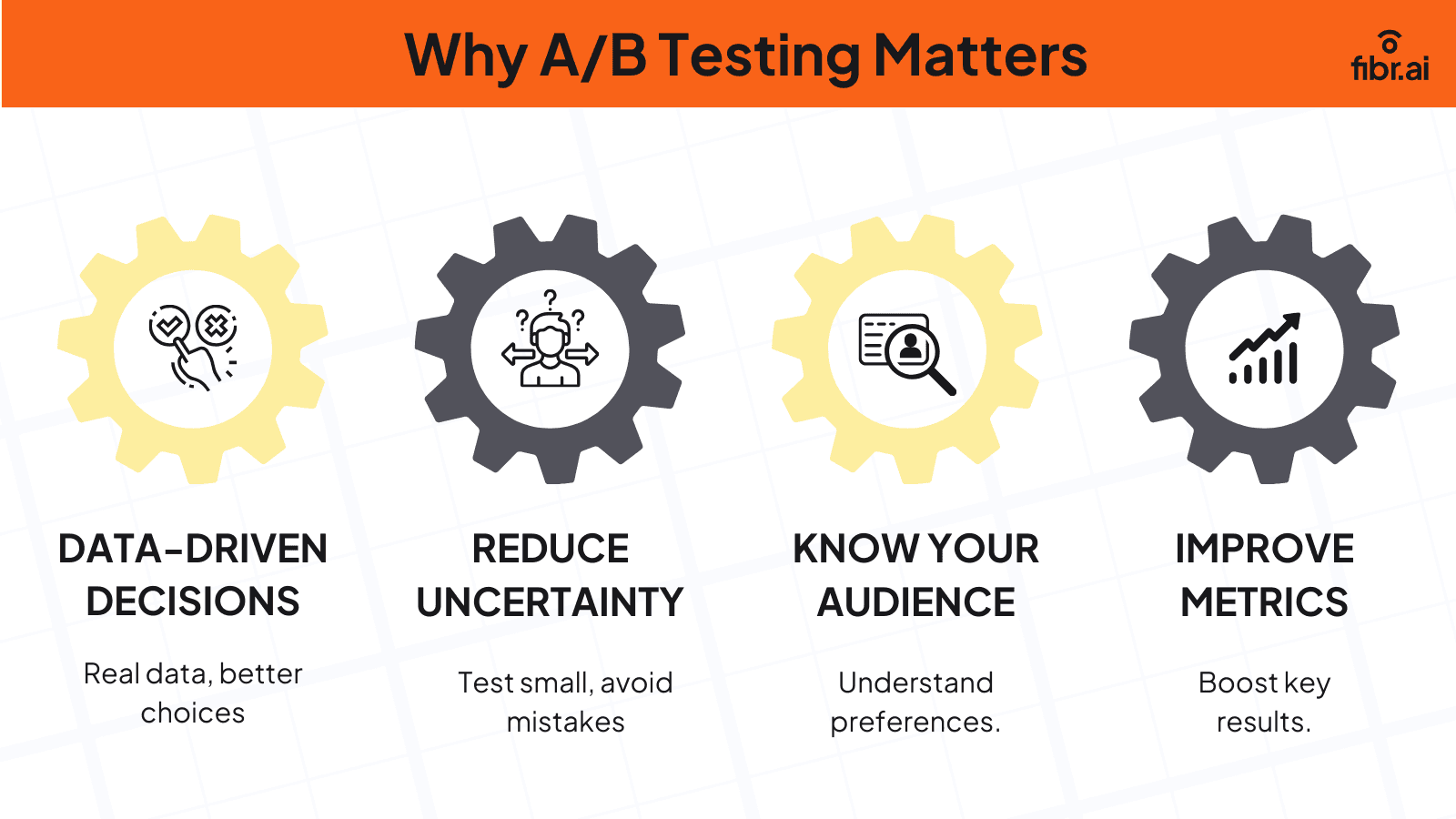
A/B testing gives you the valuable opportunity to test your hypotheses in real-world scenarios. It has numerous use cases, such as optimizing landing pages, improving email campaigns, enhancing user experience, and increasing conversion rates. To see how this plays out across channels, explore the role of A/B testing in marketing from paid ads to content strategy and beyond.
1. Data-Driven Decisions
Relying on gut feelings can only get you so far. A/B testing empowers you to make decisions based on actual data collected from your audience's interactions. This means you're not guessing what might work but rather implementing changes that have been proven to work.
2. Reduce Uncertainty
Launching a new feature or redesigning a webpage comes with risks. What if the new design doesn't resonate with users? A/B testing mitigates this uncertainty by allowing you to test changes on a smaller scale before fully committing. This way, you can avoid costly mistakes and ensure that any updates lead to positive outcomes.
3. Understand Your Audience Better
Every audience is unique, and what works for one group may not work for another. A/B testing helps you learn about your audience's likes and dislikes, behaviors, and needs. It can reveal how users interact with different versions of your content, and you gain valuable insights that inform future strategies.
4. Achieve Your Goals by Improving Key Metrics
Whether your goal is to increase sales, boost engagement, or reduce bounce rates, A/B testing can help you identify the most effective ways to improve key performance metrics. Creating systematic tests and optimizing different elements can help you steadily progress toward your goals. See the full benefits of A/B testing with real data points showing how each goal translates into measurable business outcomes.
A/B testing gives you the valuable opportunity to test your hypotheses in real-world scenarios. It has numerous use cases, such as optimizing landing pages, improving email campaigns, enhancing user experience, and increasing conversion rates. To see how this plays out across channels, explore the role of A/B testing in marketing from paid ads to content strategy and beyond.
1. Data-Driven Decisions
Relying on gut feelings can only get you so far. A/B testing empowers you to make decisions based on actual data collected from your audience's interactions. This means you're not guessing what might work but rather implementing changes that have been proven to work.
2. Reduce Uncertainty
Launching a new feature or redesigning a webpage comes with risks. What if the new design doesn't resonate with users? A/B testing mitigates this uncertainty by allowing you to test changes on a smaller scale before fully committing. This way, you can avoid costly mistakes and ensure that any updates lead to positive outcomes.
3. Understand Your Audience Better
Every audience is unique, and what works for one group may not work for another. A/B testing helps you learn about your audience's likes and dislikes, behaviors, and needs. It can reveal how users interact with different versions of your content, and you gain valuable insights that inform future strategies.
4. Achieve Your Goals by Improving Key Metrics
Whether your goal is to increase sales, boost engagement, or reduce bounce rates, A/B testing can help you identify the most effective ways to improve key performance metrics. Creating systematic tests and optimizing different elements can help you steadily progress toward your goals. See the full benefits of A/B testing with real data points showing how each goal translates into measurable business outcomes.
A/B testing gives you the valuable opportunity to test your hypotheses in real-world scenarios. It has numerous use cases, such as optimizing landing pages, improving email campaigns, enhancing user experience, and increasing conversion rates. To see how this plays out across channels, explore the role of A/B testing in marketing from paid ads to content strategy and beyond.
1. Data-Driven Decisions
Relying on gut feelings can only get you so far. A/B testing empowers you to make decisions based on actual data collected from your audience's interactions. This means you're not guessing what might work but rather implementing changes that have been proven to work.
2. Reduce Uncertainty
Launching a new feature or redesigning a webpage comes with risks. What if the new design doesn't resonate with users? A/B testing mitigates this uncertainty by allowing you to test changes on a smaller scale before fully committing. This way, you can avoid costly mistakes and ensure that any updates lead to positive outcomes.
3. Understand Your Audience Better
Every audience is unique, and what works for one group may not work for another. A/B testing helps you learn about your audience's likes and dislikes, behaviors, and needs. It can reveal how users interact with different versions of your content, and you gain valuable insights that inform future strategies.
4. Achieve Your Goals by Improving Key Metrics
Whether your goal is to increase sales, boost engagement, or reduce bounce rates, A/B testing can help you identify the most effective ways to improve key performance metrics. Creating systematic tests and optimizing different elements can help you steadily progress toward your goals. See the full benefits of A/B testing with real data points showing how each goal translates into measurable business outcomes.
Benefits of A/B Testing
Benefits of A/B Testing
Doing A/B testing right can lead to impressive improvements across various aspects of your digital strategy. Let's explore some of the key benefits that make A/B testing an indispensable tool to achieve success:
1. Increase Conversion Rates
At the end of the day, higher conversion rates mean more business. A/B testing allows you to experiment with different elements that influence user decisions, such as headlines, images, and call-to-action buttons. You can turn your visitors into customers with A/B testing, as it helps you identify variations that resonate most effectively with your audience.
2. Improve User Experience (UX)
User experience is a critical factor in retaining visitors and encouraging them to explore your offerings. Through A/B testing, you can assess how changes in layout, navigation, or content affect user satisfaction. Enhancing UX keeps users engaged but also builds trust and credibility, as it reduces the friction and creates intuitive and enjoyable experiences that encourage users to keep coming back.
3. Reduce Bounce Rate
A high bounce rate tells you that visitors are leaving your website before they've had a chance to explore its value. A/B testing helps you pinpoint the reasons behind this behavior. By testing different versions of your landing pages or content, you can identify what keeps users on your site longer and reduces the bounce rate.
4. Drive Content Engagement
Content is king, but only if it captivates your audience. A/B testing empowers you to experiment with different content formats, headlines, calls to action, and visual elements to discover what truly resonates with your readers. This is especially powerful for email A/B testing, where small subject line or CTA changes can dramatically lift open rates and click-throughs.
5. Fine-Tune Every Aspect
The beauty of A/B testing lies in its versatility. You can apply it to virtually any element of your online presence, from website design and email marketing to social media campaigns and product pages. For online stores specifically, eCommerce A/B testing covers exactly what to change from product pages to checkout flows to increase sales This allows you to fine-tune every aspect of your digital strategy, ensuring that every touchpoint with your audience is optimized for maximum impact.
Apart from this, A/B testing is detail oriented. From the color of a button to the wording of a promotional offer, every detail matters. A/B testing helps fine-tune even the smallest aspects to ensure that all elements work together harmoniously to achieve your objective. For social media specifically, mastering Facebook A/B testing can help you optimize ad creative, audience targeting, and budget allocation all within Meta's native testing environment.
Doing A/B testing right can lead to impressive improvements across various aspects of your digital strategy. Let's explore some of the key benefits that make A/B testing an indispensable tool to achieve success:
1. Increase Conversion Rates
At the end of the day, higher conversion rates mean more business. A/B testing allows you to experiment with different elements that influence user decisions, such as headlines, images, and call-to-action buttons. You can turn your visitors into customers with A/B testing, as it helps you identify variations that resonate most effectively with your audience.
2. Improve User Experience (UX)
User experience is a critical factor in retaining visitors and encouraging them to explore your offerings. Through A/B testing, you can assess how changes in layout, navigation, or content affect user satisfaction. Enhancing UX keeps users engaged but also builds trust and credibility, as it reduces the friction and creates intuitive and enjoyable experiences that encourage users to keep coming back.
3. Reduce Bounce Rate
A high bounce rate tells you that visitors are leaving your website before they've had a chance to explore its value. A/B testing helps you pinpoint the reasons behind this behavior. By testing different versions of your landing pages or content, you can identify what keeps users on your site longer and reduces the bounce rate.
4. Drive Content Engagement
Content is king, but only if it captivates your audience. A/B testing empowers you to experiment with different content formats, headlines, calls to action, and visual elements to discover what truly resonates with your readers. This is especially powerful for email A/B testing, where small subject line or CTA changes can dramatically lift open rates and click-throughs.
5. Fine-Tune Every Aspect
The beauty of A/B testing lies in its versatility. You can apply it to virtually any element of your online presence, from website design and email marketing to social media campaigns and product pages. For online stores specifically, eCommerce A/B testing covers exactly what to change from product pages to checkout flows to increase sales This allows you to fine-tune every aspect of your digital strategy, ensuring that every touchpoint with your audience is optimized for maximum impact.
Apart from this, A/B testing is detail oriented. From the color of a button to the wording of a promotional offer, every detail matters. A/B testing helps fine-tune even the smallest aspects to ensure that all elements work together harmoniously to achieve your objective. For social media specifically, mastering Facebook A/B testing can help you optimize ad creative, audience targeting, and budget allocation all within Meta's native testing environment.
Doing A/B testing right can lead to impressive improvements across various aspects of your digital strategy. Let's explore some of the key benefits that make A/B testing an indispensable tool to achieve success:
1. Increase Conversion Rates
At the end of the day, higher conversion rates mean more business. A/B testing allows you to experiment with different elements that influence user decisions, such as headlines, images, and call-to-action buttons. You can turn your visitors into customers with A/B testing, as it helps you identify variations that resonate most effectively with your audience.
2. Improve User Experience (UX)
User experience is a critical factor in retaining visitors and encouraging them to explore your offerings. Through A/B testing, you can assess how changes in layout, navigation, or content affect user satisfaction. Enhancing UX keeps users engaged but also builds trust and credibility, as it reduces the friction and creates intuitive and enjoyable experiences that encourage users to keep coming back.
3. Reduce Bounce Rate
A high bounce rate tells you that visitors are leaving your website before they've had a chance to explore its value. A/B testing helps you pinpoint the reasons behind this behavior. By testing different versions of your landing pages or content, you can identify what keeps users on your site longer and reduces the bounce rate.
4. Drive Content Engagement
Content is king, but only if it captivates your audience. A/B testing empowers you to experiment with different content formats, headlines, calls to action, and visual elements to discover what truly resonates with your readers. This is especially powerful for email A/B testing, where small subject line or CTA changes can dramatically lift open rates and click-throughs.
5. Fine-Tune Every Aspect
The beauty of A/B testing lies in its versatility. You can apply it to virtually any element of your online presence, from website design and email marketing to social media campaigns and product pages. For online stores specifically, eCommerce A/B testing covers exactly what to change from product pages to checkout flows to increase sales This allows you to fine-tune every aspect of your digital strategy, ensuring that every touchpoint with your audience is optimized for maximum impact.
Apart from this, A/B testing is detail oriented. From the color of a button to the wording of a promotional offer, every detail matters. A/B testing helps fine-tune even the smallest aspects to ensure that all elements work together harmoniously to achieve your objective. For social media specifically, mastering Facebook A/B testing can help you optimize ad creative, audience targeting, and budget allocation all within Meta's native testing environment.
How to Perform A/B Testing?
How to Perform A/B Testing?
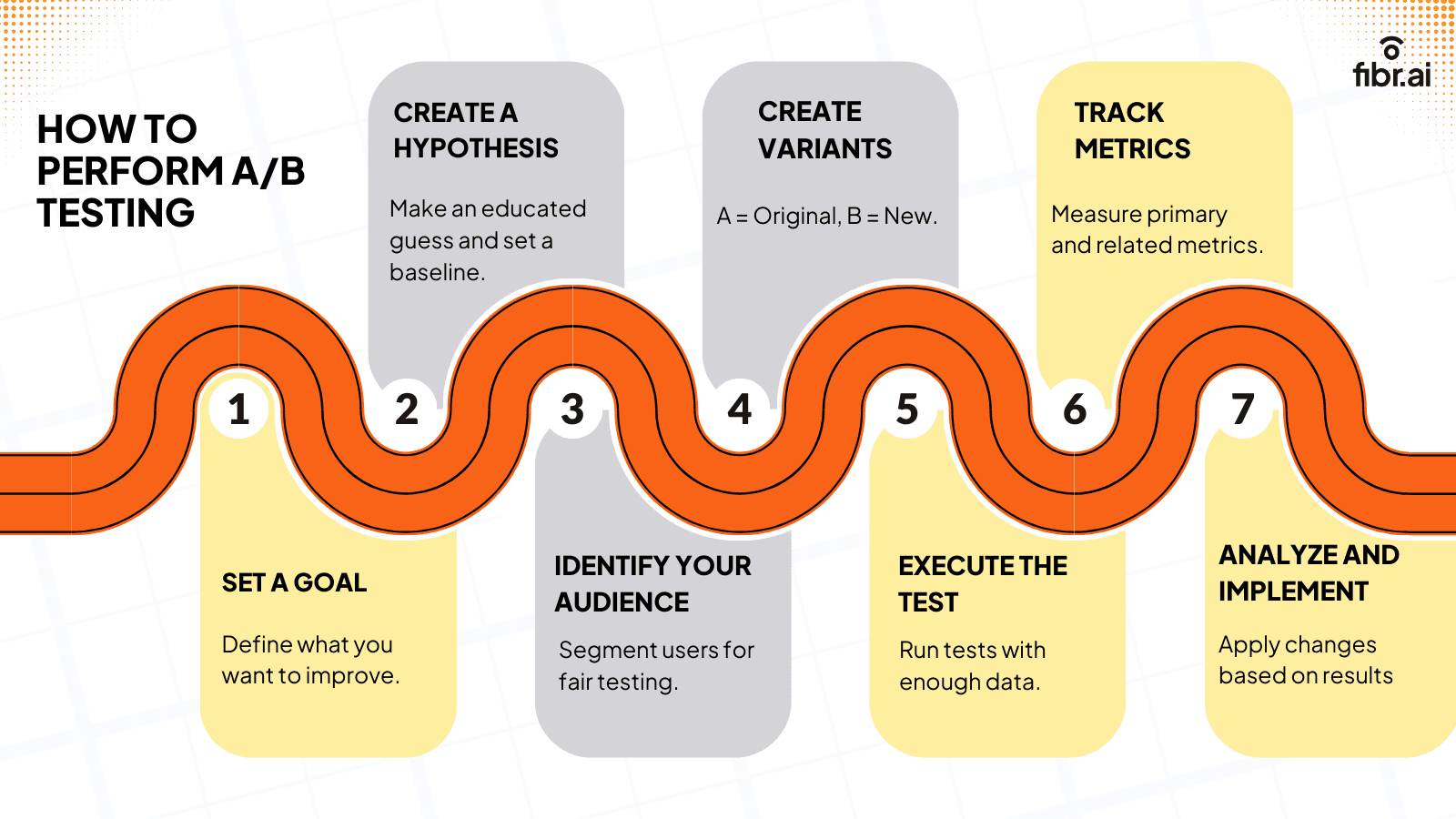
Now, let's get down to business: performing an A/B test. Here, we shall explore the steps that are generally required to successfully perform an A/B test.
Step 1: Set a Goal for Your A/B Test
The foundation of any successful A/B test is a clear, specific goal. A goal guides the entire testing process and helps you measure its success. Your A/B test goals can vary widely depending on what aspect of your digital presence you wish to improve.
For instance, to optimize your landing page, you might aim to increase the click-through rate (CTR) of a call-to-action (CTA) button on your landing page. Perhaps you're wondering if changing the button's color or wording will encourage more visitors to take the desired action.
On the other hand, For an email campaign, your goal could be to boost open rates of your email newsletters. Subscription businesses can find goal-setting guidance tailored to their funnel in our dedicated guide to A/B testing for SaaS.
Step 2: Create a Hypothesis and Set a Baseline
With your goal in place, the next step is to formulate a hypothesis. A hypothesis is an educated guess about what change might improve your metric of interest. Crafting a strong A/B testing hypothesis is a skill in itself our dedicated guide walks you through structuring one that leads to actionable, statistically sound results. Alongside this, establishing a baseline that considers your current performance metrics is also necessary.
Let's consider this example: Our goal is to increase the clicks on the CTA button of a landing page. In this case, our hypothesis would be that changing the CTA button color from blue to orange will increase the click-through rate because orange stands out more against the page's background.
Our baseline is our current performance with the original blue button, which in this case is a click-through rate of 5%.
Step 3: Identify Your Test Audience and Locations
Determining who will see each version of your test and segmenting your audience ensures that your results are not skewed by external factors and that the test groups are comparable. Let's go back to our example:
For audience segmentation, you might split your website visitors evenly and randomly into two groups.
Alternatively, if your product targets different demographics, you might segment based on age, location, or browsing behavior to see how different segments respond to the CTA change.
Step 4: Create A and B Variants
Now, it's time to create the two versions of the element you want to test. The A version would be the original version or the control version, and the B version would be the variant of the original. In our example:
Variant A (Control): This is your current landing page with the blue CTA button.
Variant B (Variation): This is the modified landing page where the CTA button is orange.
Step 5: Execute the Test
With your variants ready, you can launch the test. You may use an A/B testing tool or platform that can randomly assign visitors to either Variant A or Variant B.
You would also want to Run the test for sufficient time to gather enough data; the duration may depend on your website traffic, as sites with higher traffic can achieve statistical significance more quickly. Before launching, use our A/B testing sample size guide to calculate exactly how many visitors you need for reliable results.
Step 6: Track and Measure
Tracking the right metrics is essential to understand the impact of your test. Monitor various metrics that you've determined based on your goals.
For our example, we would monitor the click-through rates of both CTA buttons. While our primary metric is the CTR of the CTA button, we can also track other related metrics, such as time on page or bounce rate, to gather more context.
Step 7: Analyze Test Data and Implement Changes
After the test has run its course, it's time to analyze the results. At this point, you would compare the performance of version B against version A.
This means we would compare the CTR of the blue button (Variant A) with the orange button (Variant B).
If Variant B shows a significant improvement, we may decide to implement the orange CTA button permanently. If not, you might revisit your hypothesis or test a different variation. For a deeper walkthrough on interpreting A/B testing results including statistical significance and avoiding false positives see our dedicated analysis guide.
These seven steps are a strong foundation. To scale your testing program systematically, explore our in-depth A/B testing framework covering how to prioritize tests, manage multiple experiments, and build a culture of continuous optimization.
Now, let's get down to business: performing an A/B test. Here, we shall explore the steps that are generally required to successfully perform an A/B test.
Step 1: Set a Goal for Your A/B Test
The foundation of any successful A/B test is a clear, specific goal. A goal guides the entire testing process and helps you measure its success. Your A/B test goals can vary widely depending on what aspect of your digital presence you wish to improve.
For instance, to optimize your landing page, you might aim to increase the click-through rate (CTR) of a call-to-action (CTA) button on your landing page. Perhaps you're wondering if changing the button's color or wording will encourage more visitors to take the desired action.
On the other hand, For an email campaign, your goal could be to boost open rates of your email newsletters. Subscription businesses can find goal-setting guidance tailored to their funnel in our dedicated guide to A/B testing for SaaS.
Step 2: Create a Hypothesis and Set a Baseline
With your goal in place, the next step is to formulate a hypothesis. A hypothesis is an educated guess about what change might improve your metric of interest. Crafting a strong A/B testing hypothesis is a skill in itself our dedicated guide walks you through structuring one that leads to actionable, statistically sound results. Alongside this, establishing a baseline that considers your current performance metrics is also necessary.
Let's consider this example: Our goal is to increase the clicks on the CTA button of a landing page. In this case, our hypothesis would be that changing the CTA button color from blue to orange will increase the click-through rate because orange stands out more against the page's background.
Our baseline is our current performance with the original blue button, which in this case is a click-through rate of 5%.
Step 3: Identify Your Test Audience and Locations
Determining who will see each version of your test and segmenting your audience ensures that your results are not skewed by external factors and that the test groups are comparable. Let's go back to our example:
For audience segmentation, you might split your website visitors evenly and randomly into two groups.
Alternatively, if your product targets different demographics, you might segment based on age, location, or browsing behavior to see how different segments respond to the CTA change.
Step 4: Create A and B Variants
Now, it's time to create the two versions of the element you want to test. The A version would be the original version or the control version, and the B version would be the variant of the original. In our example:
Variant A (Control): This is your current landing page with the blue CTA button.
Variant B (Variation): This is the modified landing page where the CTA button is orange.
Step 5: Execute the Test
With your variants ready, you can launch the test. You may use an A/B testing tool or platform that can randomly assign visitors to either Variant A or Variant B.
You would also want to Run the test for sufficient time to gather enough data; the duration may depend on your website traffic, as sites with higher traffic can achieve statistical significance more quickly. Before launching, use our A/B testing sample size guide to calculate exactly how many visitors you need for reliable results.
Step 6: Track and Measure
Tracking the right metrics is essential to understand the impact of your test. Monitor various metrics that you've determined based on your goals.
For our example, we would monitor the click-through rates of both CTA buttons. While our primary metric is the CTR of the CTA button, we can also track other related metrics, such as time on page or bounce rate, to gather more context.
Step 7: Analyze Test Data and Implement Changes
After the test has run its course, it's time to analyze the results. At this point, you would compare the performance of version B against version A.
This means we would compare the CTR of the blue button (Variant A) with the orange button (Variant B).
If Variant B shows a significant improvement, we may decide to implement the orange CTA button permanently. If not, you might revisit your hypothesis or test a different variation. For a deeper walkthrough on interpreting A/B testing results including statistical significance and avoiding false positives see our dedicated analysis guide.
These seven steps are a strong foundation. To scale your testing program systematically, explore our in-depth A/B testing framework covering how to prioritize tests, manage multiple experiments, and build a culture of continuous optimization.
Now, let's get down to business: performing an A/B test. Here, we shall explore the steps that are generally required to successfully perform an A/B test.
Step 1: Set a Goal for Your A/B Test
The foundation of any successful A/B test is a clear, specific goal. A goal guides the entire testing process and helps you measure its success. Your A/B test goals can vary widely depending on what aspect of your digital presence you wish to improve.
For instance, to optimize your landing page, you might aim to increase the click-through rate (CTR) of a call-to-action (CTA) button on your landing page. Perhaps you're wondering if changing the button's color or wording will encourage more visitors to take the desired action.
On the other hand, For an email campaign, your goal could be to boost open rates of your email newsletters. Subscription businesses can find goal-setting guidance tailored to their funnel in our dedicated guide to A/B testing for SaaS.
Step 2: Create a Hypothesis and Set a Baseline
With your goal in place, the next step is to formulate a hypothesis. A hypothesis is an educated guess about what change might improve your metric of interest. Crafting a strong A/B testing hypothesis is a skill in itself our dedicated guide walks you through structuring one that leads to actionable, statistically sound results. Alongside this, establishing a baseline that considers your current performance metrics is also necessary.
Let's consider this example: Our goal is to increase the clicks on the CTA button of a landing page. In this case, our hypothesis would be that changing the CTA button color from blue to orange will increase the click-through rate because orange stands out more against the page's background.
Our baseline is our current performance with the original blue button, which in this case is a click-through rate of 5%.
Step 3: Identify Your Test Audience and Locations
Determining who will see each version of your test and segmenting your audience ensures that your results are not skewed by external factors and that the test groups are comparable. Let's go back to our example:
For audience segmentation, you might split your website visitors evenly and randomly into two groups.
Alternatively, if your product targets different demographics, you might segment based on age, location, or browsing behavior to see how different segments respond to the CTA change.
Step 4: Create A and B Variants
Now, it's time to create the two versions of the element you want to test. The A version would be the original version or the control version, and the B version would be the variant of the original. In our example:
Variant A (Control): This is your current landing page with the blue CTA button.
Variant B (Variation): This is the modified landing page where the CTA button is orange.
Step 5: Execute the Test
With your variants ready, you can launch the test. You may use an A/B testing tool or platform that can randomly assign visitors to either Variant A or Variant B.
You would also want to Run the test for sufficient time to gather enough data; the duration may depend on your website traffic, as sites with higher traffic can achieve statistical significance more quickly. Before launching, use our A/B testing sample size guide to calculate exactly how many visitors you need for reliable results.
Step 6: Track and Measure
Tracking the right metrics is essential to understand the impact of your test. Monitor various metrics that you've determined based on your goals.
For our example, we would monitor the click-through rates of both CTA buttons. While our primary metric is the CTR of the CTA button, we can also track other related metrics, such as time on page or bounce rate, to gather more context.
Step 7: Analyze Test Data and Implement Changes
After the test has run its course, it's time to analyze the results. At this point, you would compare the performance of version B against version A.
This means we would compare the CTR of the blue button (Variant A) with the orange button (Variant B).
If Variant B shows a significant improvement, we may decide to implement the orange CTA button permanently. If not, you might revisit your hypothesis or test a different variation. For a deeper walkthrough on interpreting A/B testing results including statistical significance and avoiding false positives see our dedicated analysis guide.
These seven steps are a strong foundation. To scale your testing program systematically, explore our in-depth A/B testing framework covering how to prioritize tests, manage multiple experiments, and build a culture of continuous optimization.
A/B Testing Metrics
A/B Testing Metrics
A/B testing metrics provide the quantitative evidence needed to determine whether one variant outperforms another. Understanding the different types of metrics and their purposes helps you design more effective tests and interpret results accurately.
A/B testing metrics generally fall into three categories for a deeper breakdown of each, see our complete A/B testing metrics guide covering conversion rate, click-through rate, bounce rate, scroll depth, and more.:
1. Primary Success Metrics
These are the main KPIs (Key Performance Indicators) directly tied to your test goal. Primary success metrics are the main indicators of whether your test variant is performing better than the control.
These could be:
Conversion Rate: Measures the percentage of users who complete a desired action, such as making a purchase or signing up for a newsletter.
Click-Through Rate (CTR): Particularly relevant for CTA optimization, this metric tracks how many users click on a specific link or button.
Revenue per Visitor (RPV): Calculates the average revenue generated per site visitor, useful for e-commerce platforms. If RPV is your primary metric, explore A/B testing for pricing a proven strategy for finding the optimal price point that maximizes revenue per visitor.
2. Supporting Indicators
These metrics provide additional context to your primary metrics and help explain user behavior.
Supporting indicators help you understand why your primary metrics may have changed and can reveal unintended consequences of your test.
These include:
Bounce Rate: The percentage of visitors who leave after viewing only one page. A decrease here might indicate improved engagement.
Time on Page: Measures how long users spend on a page, shedding light on content engagement.
Page Views per Visit: Indicates how deeply users are navigating your site.
3. Technical Performance
Technical metrics assess how the performance of your site affects user experience. Technical performance metrics ensure that any changes in user behavior are not due to technical issues but are a result of the variations you're testing.
These are:
Page Load Time: Slow pages can frustrate users and increase bounce rates unrelated to the actual variable being tested.
Error Rates: Tracking any technical issues that might affect the user experience during the test.
Mobile vs. Desktop Performance: Understanding how your site performs across different devices.
A/B testing metrics provide the quantitative evidence needed to determine whether one variant outperforms another. Understanding the different types of metrics and their purposes helps you design more effective tests and interpret results accurately.
A/B testing metrics generally fall into three categories for a deeper breakdown of each, see our complete A/B testing metrics guide covering conversion rate, click-through rate, bounce rate, scroll depth, and more.:
1. Primary Success Metrics
These are the main KPIs (Key Performance Indicators) directly tied to your test goal. Primary success metrics are the main indicators of whether your test variant is performing better than the control.
These could be:
Conversion Rate: Measures the percentage of users who complete a desired action, such as making a purchase or signing up for a newsletter.
Click-Through Rate (CTR): Particularly relevant for CTA optimization, this metric tracks how many users click on a specific link or button.
Revenue per Visitor (RPV): Calculates the average revenue generated per site visitor, useful for e-commerce platforms. If RPV is your primary metric, explore A/B testing for pricing a proven strategy for finding the optimal price point that maximizes revenue per visitor.
2. Supporting Indicators
These metrics provide additional context to your primary metrics and help explain user behavior.
Supporting indicators help you understand why your primary metrics may have changed and can reveal unintended consequences of your test.
These include:
Bounce Rate: The percentage of visitors who leave after viewing only one page. A decrease here might indicate improved engagement.
Time on Page: Measures how long users spend on a page, shedding light on content engagement.
Page Views per Visit: Indicates how deeply users are navigating your site.
3. Technical Performance
Technical metrics assess how the performance of your site affects user experience. Technical performance metrics ensure that any changes in user behavior are not due to technical issues but are a result of the variations you're testing.
These are:
Page Load Time: Slow pages can frustrate users and increase bounce rates unrelated to the actual variable being tested.
Error Rates: Tracking any technical issues that might affect the user experience during the test.
Mobile vs. Desktop Performance: Understanding how your site performs across different devices.
A/B testing metrics provide the quantitative evidence needed to determine whether one variant outperforms another. Understanding the different types of metrics and their purposes helps you design more effective tests and interpret results accurately.
A/B testing metrics generally fall into three categories for a deeper breakdown of each, see our complete A/B testing metrics guide covering conversion rate, click-through rate, bounce rate, scroll depth, and more.:
1. Primary Success Metrics
These are the main KPIs (Key Performance Indicators) directly tied to your test goal. Primary success metrics are the main indicators of whether your test variant is performing better than the control.
These could be:
Conversion Rate: Measures the percentage of users who complete a desired action, such as making a purchase or signing up for a newsletter.
Click-Through Rate (CTR): Particularly relevant for CTA optimization, this metric tracks how many users click on a specific link or button.
Revenue per Visitor (RPV): Calculates the average revenue generated per site visitor, useful for e-commerce platforms. If RPV is your primary metric, explore A/B testing for pricing a proven strategy for finding the optimal price point that maximizes revenue per visitor.
2. Supporting Indicators
These metrics provide additional context to your primary metrics and help explain user behavior.
Supporting indicators help you understand why your primary metrics may have changed and can reveal unintended consequences of your test.
These include:
Bounce Rate: The percentage of visitors who leave after viewing only one page. A decrease here might indicate improved engagement.
Time on Page: Measures how long users spend on a page, shedding light on content engagement.
Page Views per Visit: Indicates how deeply users are navigating your site.
3. Technical Performance
Technical metrics assess how the performance of your site affects user experience. Technical performance metrics ensure that any changes in user behavior are not due to technical issues but are a result of the variations you're testing.
These are:
Page Load Time: Slow pages can frustrate users and increase bounce rates unrelated to the actual variable being tested.
Error Rates: Tracking any technical issues that might affect the user experience during the test.
Mobile vs. Desktop Performance: Understanding how your site performs across different devices.
A/B Testing Analytics and Interpretation
A/B Testing Analytics and Interpretation
You've meticulously designed your A/B test, gathered the data, and now you're staring at a spreadsheet full of numbers.
What's next?
Analyzing and interpreting the results of your A/B test is where raw data is turned into insights.
The analytics and interpretation hinge on your initial goals and hypothesis. Let's revisit our landing page CTA optimization example to illustrate this process.
Here, analytics help us understand not just if the orange button performed better but why it did so.
Interpreting A/B Testing Results
Interpreting results involves more than just spotting which variant had higher numbers. In A/B testing, you need to determine whether the observed differences between your variations are truly meaningful or simply random. This is called statistical significance. Modern AI A/B testing tools can automate much of this interpretation, flagging significance thresholds and surfacing insights faster than manual analysis.
Another aspect of interpreting results is confidence levels. A higher confidence level indicates greater certainty that your results are accurate, while a lower confidence level suggests more room for error. One way to validate your testing setup before running experiments is to understand A/A testing vs A/B testing running identical versions first to verify your tool is measuring accurately.
The appropriate confidence level depends on the context of your test and the potential risks associated with making a wrong decision.
Lastly, when interpreting data, make sure to consider the broader context in which they were obtained. This includes considering external factors such as seasonality, trends, and current events.
You've meticulously designed your A/B test, gathered the data, and now you're staring at a spreadsheet full of numbers.
What's next?
Analyzing and interpreting the results of your A/B test is where raw data is turned into insights.
The analytics and interpretation hinge on your initial goals and hypothesis. Let's revisit our landing page CTA optimization example to illustrate this process.
Here, analytics help us understand not just if the orange button performed better but why it did so.
Interpreting A/B Testing Results
Interpreting results involves more than just spotting which variant had higher numbers. In A/B testing, you need to determine whether the observed differences between your variations are truly meaningful or simply random. This is called statistical significance. Modern AI A/B testing tools can automate much of this interpretation, flagging significance thresholds and surfacing insights faster than manual analysis.
Another aspect of interpreting results is confidence levels. A higher confidence level indicates greater certainty that your results are accurate, while a lower confidence level suggests more room for error. One way to validate your testing setup before running experiments is to understand A/A testing vs A/B testing running identical versions first to verify your tool is measuring accurately.
The appropriate confidence level depends on the context of your test and the potential risks associated with making a wrong decision.
Lastly, when interpreting data, make sure to consider the broader context in which they were obtained. This includes considering external factors such as seasonality, trends, and current events.
You've meticulously designed your A/B test, gathered the data, and now you're staring at a spreadsheet full of numbers.
What's next?
Analyzing and interpreting the results of your A/B test is where raw data is turned into insights.
The analytics and interpretation hinge on your initial goals and hypothesis. Let's revisit our landing page CTA optimization example to illustrate this process.
Here, analytics help us understand not just if the orange button performed better but why it did so.
Interpreting A/B Testing Results
Interpreting results involves more than just spotting which variant had higher numbers. In A/B testing, you need to determine whether the observed differences between your variations are truly meaningful or simply random. This is called statistical significance. Modern AI A/B testing tools can automate much of this interpretation, flagging significance thresholds and surfacing insights faster than manual analysis.
Another aspect of interpreting results is confidence levels. A higher confidence level indicates greater certainty that your results are accurate, while a lower confidence level suggests more room for error. One way to validate your testing setup before running experiments is to understand A/A testing vs A/B testing running identical versions first to verify your tool is measuring accurately.
The appropriate confidence level depends on the context of your test and the potential risks associated with making a wrong decision.
Lastly, when interpreting data, make sure to consider the broader context in which they were obtained. This includes considering external factors such as seasonality, trends, and current events.
When to Perform A/B Testing?
When to Perform A/B Testing?
Timing is everything, especially when it comes to optimizing your digital strategies. A/B testing is an ongoing process that can provide valuable insights at various stages of your business growth. There are two key instances where A/B testing can be particularly beneficial for you.
1. When Launching New Features or Campaigns
Rolling out new features, products, or marketing campaigns is an exciting but uncertain time. You might have several ideas about what will resonate with your audience, but assumptions can be risky.
A/B testing during a launch allows you to test different versions of your new elements to see which one performs better before fully committing. For example, if you're introducing a new landing page for a product launch, you might test different headlines, images, or CTAs to see which version generates more engagement or conversions. This helps you make data-driven decisions right from the start, increasing the chances of your launch being successful. For paid campaigns specifically, our guide to A/B testing for ads covers the key elements to test and best practices to maximize your ad spend.
2. When Performance Metrics Are Below Expectations
Sometimes, despite your best efforts, certain aspects of your website or campaigns may not perform as well as you'd hoped. Maybe your email open rates are declining, or your website's bounce rate is higher than industry standards. When things aren't meeting expectations, it's a clear signal that something needs to change. If your paid search performance is specifically underperforming, Google Ads A/B testing is one of the fastest ways to identify what's dragging down your Quality Score and conversion rate. A/B testing can help you identify what's not working and how to fix it. By testing variations of the underperforming elements, you can uncover insights into what your audience prefers. This could involve tweaking email subject lines, adjusting webpage layouts, or modifying ad copy. Not sure where to start? Browse our list of proven A/B testing ideas across websites, ads, emails, and more to find your next high-impact test.
Timing is everything, especially when it comes to optimizing your digital strategies. A/B testing is an ongoing process that can provide valuable insights at various stages of your business growth. There are two key instances where A/B testing can be particularly beneficial for you.
1. When Launching New Features or Campaigns
Rolling out new features, products, or marketing campaigns is an exciting but uncertain time. You might have several ideas about what will resonate with your audience, but assumptions can be risky.
A/B testing during a launch allows you to test different versions of your new elements to see which one performs better before fully committing. For example, if you're introducing a new landing page for a product launch, you might test different headlines, images, or CTAs to see which version generates more engagement or conversions. This helps you make data-driven decisions right from the start, increasing the chances of your launch being successful. For paid campaigns specifically, our guide to A/B testing for ads covers the key elements to test and best practices to maximize your ad spend.
2. When Performance Metrics Are Below Expectations
Sometimes, despite your best efforts, certain aspects of your website or campaigns may not perform as well as you'd hoped. Maybe your email open rates are declining, or your website's bounce rate is higher than industry standards. When things aren't meeting expectations, it's a clear signal that something needs to change. If your paid search performance is specifically underperforming, Google Ads A/B testing is one of the fastest ways to identify what's dragging down your Quality Score and conversion rate. A/B testing can help you identify what's not working and how to fix it. By testing variations of the underperforming elements, you can uncover insights into what your audience prefers. This could involve tweaking email subject lines, adjusting webpage layouts, or modifying ad copy. Not sure where to start? Browse our list of proven A/B testing ideas across websites, ads, emails, and more to find your next high-impact test.
Timing is everything, especially when it comes to optimizing your digital strategies. A/B testing is an ongoing process that can provide valuable insights at various stages of your business growth. There are two key instances where A/B testing can be particularly beneficial for you.
1. When Launching New Features or Campaigns
Rolling out new features, products, or marketing campaigns is an exciting but uncertain time. You might have several ideas about what will resonate with your audience, but assumptions can be risky.
A/B testing during a launch allows you to test different versions of your new elements to see which one performs better before fully committing. For example, if you're introducing a new landing page for a product launch, you might test different headlines, images, or CTAs to see which version generates more engagement or conversions. This helps you make data-driven decisions right from the start, increasing the chances of your launch being successful. For paid campaigns specifically, our guide to A/B testing for ads covers the key elements to test and best practices to maximize your ad spend.
2. When Performance Metrics Are Below Expectations
Sometimes, despite your best efforts, certain aspects of your website or campaigns may not perform as well as you'd hoped. Maybe your email open rates are declining, or your website's bounce rate is higher than industry standards. When things aren't meeting expectations, it's a clear signal that something needs to change. If your paid search performance is specifically underperforming, Google Ads A/B testing is one of the fastest ways to identify what's dragging down your Quality Score and conversion rate. A/B testing can help you identify what's not working and how to fix it. By testing variations of the underperforming elements, you can uncover insights into what your audience prefers. This could involve tweaking email subject lines, adjusting webpage layouts, or modifying ad copy. Not sure where to start? Browse our list of proven A/B testing ideas across websites, ads, emails, and more to find your next high-impact test.
Different Types of A/B Testing
Different Types of A/B Testing
A/B testing isn't a one-size-fits-all approach; there are various types of tests you can conduct depending on your goals and resources. Let's explore the different types of A/B testing using an example to understand these types better.
Imagine you run an online platform offering various courses, and you've noticed that your landing page isn't converting visitors into sign-ups as effectively as you'd like. You're considering changing the background color of your landing page to see if it affects user engagement. If your site runs on WordPress, our guide to WordPress A/B testing covers the top 5 tools and exactly how to set up your first test without touching any code. Here are some types of tests you would use:
1. Single Variable Testing (A/B Testing)
This is the most basic form of A/B testing, where you test two versions that differ by only one element. You create two versions of a webpage, changing just one variable between them. This helps isolate the effect of that single change.
In our example, you have Version A with a white background (the control) and Version B with a light blue background (the variation). Both pages are identical in every other aspect.
You can measure which background color leads to more course sign-ups by directing half of your traffic to each version.
2. Multivariate Testing
Multivariate testing takes A/B testing a step further by testing multiple variables simultaneously to see how they interact with each other. In this test, you test multiple combinations of variables to understand which combination performs the best.
Going back to our example, besides the background color, you might also want to test different header images and CTA button texts. You create multiple versions that mix and match these variables:
Version A: White background, header image 1, CTA text "Enroll Now"
Version B: Light blue background, header image 2, CTA text "Start Learning Today"
Version C: White background, header image 2, CTA text "Start Learning Today"
Version D: Light blue background, header image 1, CTA text "Enroll Now"
This approach helps you understand not just the impact of individual changes but also how different elements work together to influence user behavior. It's more complex and requires a larger audience to achieve statistical significance, but it can provide deeper insights.
3. Multi-Page Testing
Multi-page testing involves testing changes across multiple pages in the user journey. Here, you test variations that affect a series of pages, ensuring consistency and measuring the impact on the overall conversion funnel. For teams running tests across mobile experiences, mobile app A/B testing introduces additional considerations around session length, device type, and app store optimization.
In the example, consider that you want to test how changing the background color affects not just the landing page but also the course catalog and the checkout page. You create two versions of the entire user flow:
Version A (Control): All pages have a white background.
Version B (Variation): All pages have a light blue background.
By analyzing how users interact with the entire site, you can determine if the change positively impacts the overall user experience and conversion rates throughout the customer journey. Shopify merchants can apply this directly with our guide to Shopify A/B testing covering how to test across product, collection, and checkout pages within the Shopify ecosystem.
A/B testing isn't a one-size-fits-all approach; there are various types of tests you can conduct depending on your goals and resources. Let's explore the different types of A/B testing using an example to understand these types better.
Imagine you run an online platform offering various courses, and you've noticed that your landing page isn't converting visitors into sign-ups as effectively as you'd like. You're considering changing the background color of your landing page to see if it affects user engagement. If your site runs on WordPress, our guide to WordPress A/B testing covers the top 5 tools and exactly how to set up your first test without touching any code. Here are some types of tests you would use:
1. Single Variable Testing (A/B Testing)
This is the most basic form of A/B testing, where you test two versions that differ by only one element. You create two versions of a webpage, changing just one variable between them. This helps isolate the effect of that single change.
In our example, you have Version A with a white background (the control) and Version B with a light blue background (the variation). Both pages are identical in every other aspect.
You can measure which background color leads to more course sign-ups by directing half of your traffic to each version.
2. Multivariate Testing
Multivariate testing takes A/B testing a step further by testing multiple variables simultaneously to see how they interact with each other. In this test, you test multiple combinations of variables to understand which combination performs the best.
Going back to our example, besides the background color, you might also want to test different header images and CTA button texts. You create multiple versions that mix and match these variables:
Version A: White background, header image 1, CTA text "Enroll Now"
Version B: Light blue background, header image 2, CTA text "Start Learning Today"
Version C: White background, header image 2, CTA text "Start Learning Today"
Version D: Light blue background, header image 1, CTA text "Enroll Now"
This approach helps you understand not just the impact of individual changes but also how different elements work together to influence user behavior. It's more complex and requires a larger audience to achieve statistical significance, but it can provide deeper insights.
3. Multi-Page Testing
Multi-page testing involves testing changes across multiple pages in the user journey. Here, you test variations that affect a series of pages, ensuring consistency and measuring the impact on the overall conversion funnel. For teams running tests across mobile experiences, mobile app A/B testing introduces additional considerations around session length, device type, and app store optimization.
In the example, consider that you want to test how changing the background color affects not just the landing page but also the course catalog and the checkout page. You create two versions of the entire user flow:
Version A (Control): All pages have a white background.
Version B (Variation): All pages have a light blue background.
By analyzing how users interact with the entire site, you can determine if the change positively impacts the overall user experience and conversion rates throughout the customer journey. Shopify merchants can apply this directly with our guide to Shopify A/B testing covering how to test across product, collection, and checkout pages within the Shopify ecosystem.
A/B testing isn't a one-size-fits-all approach; there are various types of tests you can conduct depending on your goals and resources. Let's explore the different types of A/B testing using an example to understand these types better.
Imagine you run an online platform offering various courses, and you've noticed that your landing page isn't converting visitors into sign-ups as effectively as you'd like. You're considering changing the background color of your landing page to see if it affects user engagement. If your site runs on WordPress, our guide to WordPress A/B testing covers the top 5 tools and exactly how to set up your first test without touching any code. Here are some types of tests you would use:
1. Single Variable Testing (A/B Testing)
This is the most basic form of A/B testing, where you test two versions that differ by only one element. You create two versions of a webpage, changing just one variable between them. This helps isolate the effect of that single change.
In our example, you have Version A with a white background (the control) and Version B with a light blue background (the variation). Both pages are identical in every other aspect.
You can measure which background color leads to more course sign-ups by directing half of your traffic to each version.
2. Multivariate Testing
Multivariate testing takes A/B testing a step further by testing multiple variables simultaneously to see how they interact with each other. In this test, you test multiple combinations of variables to understand which combination performs the best.
Going back to our example, besides the background color, you might also want to test different header images and CTA button texts. You create multiple versions that mix and match these variables:
Version A: White background, header image 1, CTA text "Enroll Now"
Version B: Light blue background, header image 2, CTA text "Start Learning Today"
Version C: White background, header image 2, CTA text "Start Learning Today"
Version D: Light blue background, header image 1, CTA text "Enroll Now"
This approach helps you understand not just the impact of individual changes but also how different elements work together to influence user behavior. It's more complex and requires a larger audience to achieve statistical significance, but it can provide deeper insights.
3. Multi-Page Testing
Multi-page testing involves testing changes across multiple pages in the user journey. Here, you test variations that affect a series of pages, ensuring consistency and measuring the impact on the overall conversion funnel. For teams running tests across mobile experiences, mobile app A/B testing introduces additional considerations around session length, device type, and app store optimization.
In the example, consider that you want to test how changing the background color affects not just the landing page but also the course catalog and the checkout page. You create two versions of the entire user flow:
Version A (Control): All pages have a white background.
Version B (Variation): All pages have a light blue background.
By analyzing how users interact with the entire site, you can determine if the change positively impacts the overall user experience and conversion rates throughout the customer journey. Shopify merchants can apply this directly with our guide to Shopify A/B testing covering how to test across product, collection, and checkout pages within the Shopify ecosystem.
A/B Testing Challenges
A/B Testing Challenges
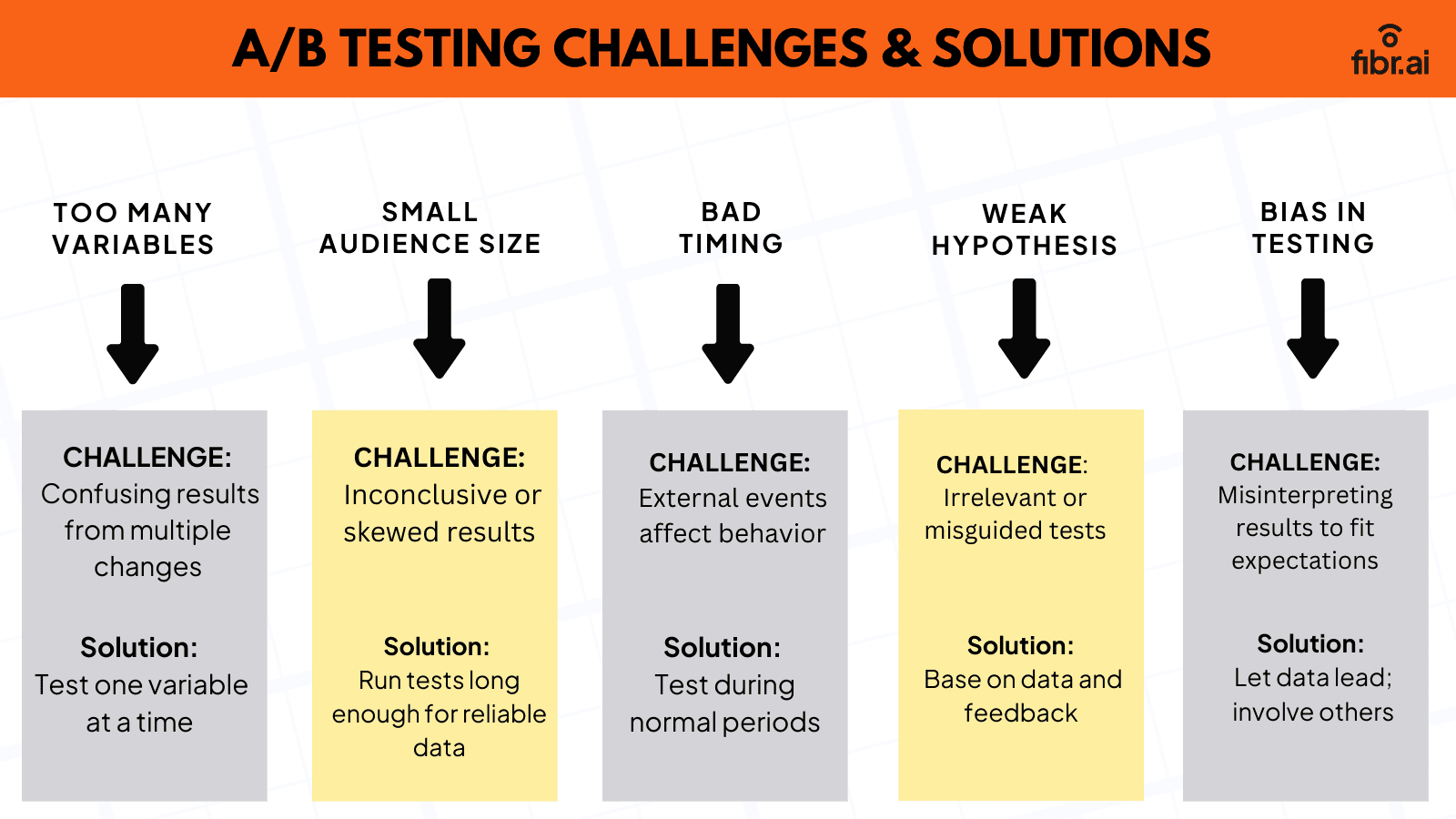
While A/B testing is a powerful tool, it's not without its challenges. Being aware of these pitfalls can help you design better tests and interpret results more accurately. For a complete breakdown of what goes wrong most often, see our guide to common A/B testing mistakes with 24 specific errors and how to fix each one.Here are some common challenges you might face and how to overcome them.
1. Overloading Tests with Too Many Variables
Testing too many variables at once can muddy your results and make it difficult to pinpoint what's influencing user behavior. When multiple elements are changed simultaneously, you can't determine which change caused the observed effect.
Solution: Keep it simple. Start with single variable testing to isolate the impact of individual elements. If you need to test multiple variables, consider multivariate testing but ensure you have a large enough audience to achieve statistical significance.
2. Insufficient Test Audience Size
A small test audience can lead to inconclusive results that aren't statistically significant. With too few participants, random chance can skew your results, leading to false conclusions.
Solution: Ensure your test runs long enough to collect data from a substantial number of users, and use statistical calculators to determine the required sample size before starting your test. The best A/B testing tools include built-in sample size calculators and traffic allocation features that handle this automatically.
3. Testing at Inappropriate Times
Conducting tests during atypical periods can produce results that aren't representative of normal user behavior. External factors like holidays, marketing campaigns, or website maintenance can influence user behavior during the test period.
Solution: Schedule tests during normal operating periods, be mindful of external events that could affect user interactions, and consider pausing tests during such times. This is especially critical for SEO A/B testing, where Google's crawl cycles mean timing can directly affect whether your test results reflect organic performance or algorithm fluctuations.
4. Crafting an Inaccurate Hypothesis
An unclear or incorrect hypothesis can lead to misguided tests and wasted resources. Without a solid hypothesis, you might test irrelevant changes that don't impact your goal.
Solution: Base your hypothesis on data and user feedback. Ensure it's specific and measurable, focusing on changes that are likely to influence your primary success metrics.
5. Allowing Inherent Biases to Influence Tests
Personal biases can inadvertently affect how you design and interpret tests. Biases can lead you to favor one variant over another or misinterpret data to fit your expectations.
Solution: Approach testing objectively. Let the data speak for itself, and consider involving team members to review results and provide different perspectives. For a complete set of guardrails across all five challenges and beyond, our A/B testing best practices guide covers 27 actionable strategies to run cleaner, more reliable experiments.
Ready to put these solutions into practice? Start by choosing the right platform our comparison of the top A/B testing vendors covers 18 platforms including Fibr, Optimizely, VWO, and Adobe Target so you can find the best fit for your team and budget. Want to keep learning? Explore our curated A/B testing resources a handpicked collection of guides, tools, and frameworks to help you run better experiments at every stage.
While A/B testing is a powerful tool, it's not without its challenges. Being aware of these pitfalls can help you design better tests and interpret results more accurately. For a complete breakdown of what goes wrong most often, see our guide to common A/B testing mistakes with 24 specific errors and how to fix each one.Here are some common challenges you might face and how to overcome them.
1. Overloading Tests with Too Many Variables
Testing too many variables at once can muddy your results and make it difficult to pinpoint what's influencing user behavior. When multiple elements are changed simultaneously, you can't determine which change caused the observed effect.
Solution: Keep it simple. Start with single variable testing to isolate the impact of individual elements. If you need to test multiple variables, consider multivariate testing but ensure you have a large enough audience to achieve statistical significance.
2. Insufficient Test Audience Size
A small test audience can lead to inconclusive results that aren't statistically significant. With too few participants, random chance can skew your results, leading to false conclusions.
Solution: Ensure your test runs long enough to collect data from a substantial number of users, and use statistical calculators to determine the required sample size before starting your test. The best A/B testing tools include built-in sample size calculators and traffic allocation features that handle this automatically.
3. Testing at Inappropriate Times
Conducting tests during atypical periods can produce results that aren't representative of normal user behavior. External factors like holidays, marketing campaigns, or website maintenance can influence user behavior during the test period.
Solution: Schedule tests during normal operating periods, be mindful of external events that could affect user interactions, and consider pausing tests during such times. This is especially critical for SEO A/B testing, where Google's crawl cycles mean timing can directly affect whether your test results reflect organic performance or algorithm fluctuations.
4. Crafting an Inaccurate Hypothesis
An unclear or incorrect hypothesis can lead to misguided tests and wasted resources. Without a solid hypothesis, you might test irrelevant changes that don't impact your goal.
Solution: Base your hypothesis on data and user feedback. Ensure it's specific and measurable, focusing on changes that are likely to influence your primary success metrics.
5. Allowing Inherent Biases to Influence Tests
Personal biases can inadvertently affect how you design and interpret tests. Biases can lead you to favor one variant over another or misinterpret data to fit your expectations.
Solution: Approach testing objectively. Let the data speak for itself, and consider involving team members to review results and provide different perspectives. For a complete set of guardrails across all five challenges and beyond, our A/B testing best practices guide covers 27 actionable strategies to run cleaner, more reliable experiments.
Ready to put these solutions into practice? Start by choosing the right platform our comparison of the top A/B testing vendors covers 18 platforms including Fibr, Optimizely, VWO, and Adobe Target so you can find the best fit for your team and budget. Want to keep learning? Explore our curated A/B testing resources a handpicked collection of guides, tools, and frameworks to help you run better experiments at every stage.
While A/B testing is a powerful tool, it's not without its challenges. Being aware of these pitfalls can help you design better tests and interpret results more accurately. Here are some common challenges you might face and how to overcome them.
1. Overloading Tests with Too Many Variables
Testing too many variables at once can muddy your results and make it difficult to pinpoint what's influencing user behavior. When multiple elements are changed simultaneously, you can't determine which change caused the observed effect.
Solution: Keep it simple. Start with single variable testing to isolate the impact of individual elements. If you need to test multiple variables, consider multivariate testing but ensure you have a large enough audience to achieve statistical significance.
2. Insufficient Test Audience Size
A small test audience can lead to inconclusive results that aren't statistically significant. With too few participants, random chance can skew your results, leading to false conclusions.
Solution: Ensure your test runs long enough to collect data from a substantial number of users. Use statistical calculators to determine the required sample size before starting your test.
3. Testing at Inappropriate Times
Conducting tests during atypical periods can produce results that aren't representative of normal user behavior. External factors like holidays, marketing campaigns, or website maintenance can influence user behavior during the test period.
Solution: Schedule tests during normal operating periods. Be mindful of external events that could affect user interactions, and consider pausing tests during such times.
4. Crafting an Inaccurate Hypothesis
An unclear or incorrect hypothesis can lead to misguided tests and wasted resources. Without a solid hypothesis, you might test irrelevant changes that don't impact your goal.
Solution: Base your hypothesis on data and user feedback. Ensure it's specific and measurable, focusing on changes that are likely to influence your primary success metrics.
5. Allowing Inherent Biases to Influence Tests
Personal biases can inadvertently affect how you design and interpret tests. Biases can lead you to favor one variant over another or misinterpret data to fit your expectations.
Solution: Approach testing objectively. Let the data speak for itself, and consider involving team members to review results and provide different perspectives.
A/B Testing Examples
A/B Testing Examples
Now that we've covered the theory and methodology of A/B testing let's bring it all to life with some real-world examples. Here are a few case studies that illustrate how businesses have successfully used A/B testing to optimize their strategies and achieve impressive results.
1. Landing Page Optimization for Better Return on Ad Spend (RoAS)
Let's consider a Fibr.ai client, an e-commerce retailer specializing in beauty products. Despite investing heavily in online advertising, they noticed that their Return on Ad Spend (RoAS) wasn't meeting expectations. They were getting plenty of ad clicks but not enough conversions.
What Was Tested
To address this, they decided to conduct an A/B test focusing on ad-to-landing page message alignment with the help of Fibr.ai. They also focused on testing different images and layouts to see which resonated more with their audience.
They created two versions of their landing page:
Version A: Their existing landing page, which had a general layout and messaging.
Version B: A new landing page specifically designed to match the ad creative, including similar imagery, headlines, and call-to-action buttons.
Findings and Results
The A/B test revealed a significant disparity in performance between the two versions. Visitors who landed on Version B (the ad-aligned page) exhibited a much higher conversion rate and a lower bounce rate compared to those who landed on Version A.
By implementing their winning variations, the brand achieved the following:
Their return on ad spend increased by 25%, meaning they were getting more revenue for every dollar spent on advertising.
The optimized landing page led to a 15% increase in conversions compared to the original.
2. Landing Page A/B Test: Bannersnack
Bannersnack is a design tool that allows users to create banners and ads easily. They noticed that their landing page wasn't converting visitors into trial sign-ups as effectively as they'd hoped.
What Was Tested
They decided to A/B test different elements of their landing page to see what would encourage more sign-ups.
Version A: The original landing page with a standard headline and a call-to-action (CTA) button that read "Sign Up Now."
Version B: A redesigned landing page featuring a compelling, benefit-focused headline: "Create Stunning Banners in Minutes." an engaging subheadline highlighting ease of use, and a more inviting CTA button: "Start Your Free Trial."
Findings and Results
The new headline in Version B clearly communicated the value proposition, which resonated more with visitors. The updated CTA prompted immediate action by offering a free trial, lowering the barrier to entry.
By implementing the changes from Version B, Bannersnack achieved:
A 30% increase in the number of users starting a free trial.
A 20% decrease indicated that visitors were more engaged and found the content relevant.
3. Web Page Background A/B Test: Expoze.io
Expoze.io is a tech company offering AI-driven predictive eye-tracking software for user experience research. They wanted to see if changing the background color of their webpage would affect user engagement.
What Was Tested
They conducted an A/B test on their webpage's background color:
Version A: The existing webpage had a bright, patterned background that was visually striking but potentially distracting.
Version B: A simplified webpage with a plain, neutral background color, allowing the main content to stand out.
Findings and Results
Version B's neutral background helped users focus more on the content and key messages. Text and images stood out more against the simpler background, enhancing comprehension.
Implementing the changes from Version B led to:
A 20% increase in the average time users spent on the page.
A 15% increase in users requesting demos of their software.
4. Promotional Email A/B Test: Neurogan
Neurogan is a wellness company specializing in CBD products. They aimed to improve the performance of their promotional emails. Despite having a loyal customer base, their email campaigns were not generating the expected level of engagement.
What Was Tested
They conducted an A/B test focusing on the email's subject line and content format.
Version A: An email with a straightforward subject line: "Explore Our New CBD Products," and a text-heavy email body detailing product features.
Version B: An email with a personalized subject line: "Exclusive Offer Just for You: 20% Off Our New CBD Line!" The email body was visually rich, featuring high-quality images and concise, benefit-focused copy.
Findings and Results
Version B's personalized and offer-driven subject line significantly increased open rates. The image-rich email body led to higher click-through rates, especially on mobile devices.
By adopting the image-focused email design, Neurogan achieved:
A 35% increase compared to the text-heavy email.
A 20% rise in sales generated from the promotional email campaign.
Now that we've covered the theory and methodology of A/B testing let's bring it all to life with some real-world examples. Here are a few case studies that illustrate how businesses have successfully used A/B testing to optimize their strategies and achieve impressive results.
1. Landing Page Optimization for Better Return on Ad Spend (RoAS)
Let's consider a Fibr.ai client, an e-commerce retailer specializing in beauty products. Despite investing heavily in online advertising, they noticed that their Return on Ad Spend (RoAS) wasn't meeting expectations. They were getting plenty of ad clicks but not enough conversions.
What Was Tested
To address this, they decided to conduct an A/B test focusing on ad-to-landing page message alignment with the help of Fibr.ai. They also focused on testing different images and layouts to see which resonated more with their audience.
They created two versions of their landing page:
Version A: Their existing landing page, which had a general layout and messaging.
Version B: A new landing page specifically designed to match the ad creative, including similar imagery, headlines, and call-to-action buttons.
Findings and Results
The A/B test revealed a significant disparity in performance between the two versions. Visitors who landed on Version B (the ad-aligned page) exhibited a much higher conversion rate and a lower bounce rate compared to those who landed on Version A.
By implementing their winning variations, the brand achieved the following:
Their return on ad spend increased by 25%, meaning they were getting more revenue for every dollar spent on advertising.
The optimized landing page led to a 15% increase in conversions compared to the original.
2. Landing Page A/B Test: Bannersnack
Bannersnack is a design tool that allows users to create banners and ads easily. They noticed that their landing page wasn't converting visitors into trial sign-ups as effectively as they'd hoped.
What Was Tested
They decided to A/B test different elements of their landing page to see what would encourage more sign-ups.
Version A: The original landing page with a standard headline and a call-to-action (CTA) button that read "Sign Up Now."
Version B: A redesigned landing page featuring a compelling, benefit-focused headline: "Create Stunning Banners in Minutes." an engaging subheadline highlighting ease of use, and a more inviting CTA button: "Start Your Free Trial."
Findings and Results
The new headline in Version B clearly communicated the value proposition, which resonated more with visitors. The updated CTA prompted immediate action by offering a free trial, lowering the barrier to entry.
By implementing the changes from Version B, Bannersnack achieved:
A 30% increase in the number of users starting a free trial.
A 20% decrease indicated that visitors were more engaged and found the content relevant.
3. Web Page Background A/B Test: Expoze.io
Expoze.io is a tech company offering AI-driven predictive eye-tracking software for user experience research. They wanted to see if changing the background color of their webpage would affect user engagement.
What Was Tested
They conducted an A/B test on their webpage's background color:
Version A: The existing webpage had a bright, patterned background that was visually striking but potentially distracting.
Version B: A simplified webpage with a plain, neutral background color, allowing the main content to stand out.
Findings and Results
Version B's neutral background helped users focus more on the content and key messages. Text and images stood out more against the simpler background, enhancing comprehension.
Implementing the changes from Version B led to:
A 20% increase in the average time users spent on the page.
A 15% increase in users requesting demos of their software.
4. Promotional Email A/B Test: Neurogan
Neurogan is a wellness company specializing in CBD products. They aimed to improve the performance of their promotional emails. Despite having a loyal customer base, their email campaigns were not generating the expected level of engagement.
What Was Tested
They conducted an A/B test focusing on the email's subject line and content format.
Version A: An email with a straightforward subject line: "Explore Our New CBD Products," and a text-heavy email body detailing product features.
Version B: An email with a personalized subject line: "Exclusive Offer Just for You: 20% Off Our New CBD Line!" The email body was visually rich, featuring high-quality images and concise, benefit-focused copy.
Findings and Results
Version B's personalized and offer-driven subject line significantly increased open rates. The image-rich email body led to higher click-through rates, especially on mobile devices.
By adopting the image-focused email design, Neurogan achieved:
A 35% increase compared to the text-heavy email.
A 20% rise in sales generated from the promotional email campaign.
Now that we've covered the theory and methodology of A/B testing let's bring it all to life with some real-world examples. Here are a few case studies that illustrate how businesses have successfully used A/B testing to optimize their strategies and achieve impressive results.
1. Landing Page Optimization for Better Return on Ad Spend (RoAS)
Let's consider a Fibr.ai client, an e-commerce retailer specializing in beauty products. Despite investing heavily in online advertising, they noticed that their Return on Ad Spend (RoAS) wasn't meeting expectations. They were getting plenty of ad clicks but not enough conversions.
What Was Tested
To address this, they decided to conduct an A/B test focusing on ad-to-landing page message alignment with the help of Fibr.ai. They also focused on testing different images and layouts to see which resonated more with their audience.
They created two versions of their landing page:
Version A: Their existing landing page, which had a general layout and messaging.
Version B: A new landing page specifically designed to match the ad creative, including similar imagery, headlines, and call-to-action buttons.
Findings and Results
The A/B test revealed a significant disparity in performance between the two versions. Visitors who landed on Version B (the ad-aligned page) exhibited a much higher conversion rate and a lower bounce rate compared to those who landed on Version A.
By implementing their winning variations, the brand achieved the following:
Their return on ad spend increased by 25%, meaning they were getting more revenue for every dollar spent on advertising.
The optimized landing page led to a 15% increase in conversions compared to the original.
2. Landing Page A/B Test: Bannersnack
Bannersnack is a design tool that allows users to create banners and ads easily. They noticed that their landing page wasn't converting visitors into trial sign-ups as effectively as they'd hoped.
What Was Tested
They decided to A/B test different elements of their landing page to see what would encourage more sign-ups.
Version A: The original landing page with a standard headline and a call-to-action (CTA) button that read "Sign Up Now."
Version B: A redesigned landing page featuring a compelling, benefit-focused headline: "Create Stunning Banners in Minutes." an engaging subheadline highlighting ease of use, and a more inviting CTA button: "Start Your Free Trial."
Findings and Results
The new headline in Version B clearly communicated the value proposition, which resonated more with visitors. The updated CTA prompted immediate action by offering a free trial, lowering the barrier to entry.
By implementing the changes from Version B, Bannersnack achieved:
A 30% increase in the number of users starting a free trial.
A 20% decrease indicated that visitors were more engaged and found the content relevant.
3. Web Page Background A/B Test: Expoze.io
Expoze.io is a tech company offering AI-driven predictive eye-tracking software for user experience research. They wanted to see if changing the background color of their webpage would affect user engagement.
What Was Tested
They conducted an A/B test on their webpage's background color:
Version A: The existing webpage had a bright, patterned background that was visually striking but potentially distracting.
Version B: A simplified webpage with a plain, neutral background color, allowing the main content to stand out.
Findings and Results
Version B's neutral background helped users focus more on the content and key messages. Text and images stood out more against the simpler background, enhancing comprehension.
Implementing the changes from Version B led to:
A 20% increase in the average time users spent on the page.
A 15% increase in users requesting demos of their software.
4. Promotional Email A/B Test: Neurogan
Neurogan is a wellness company specializing in CBD products. They aimed to improve the performance of their promotional emails. Despite having a loyal customer base, their email campaigns were not generating the expected level of engagement.
What Was Tested
They conducted an A/B test focusing on the email's subject line and content format.
Version A: An email with a straightforward subject line: "Explore Our New CBD Products," and a text-heavy email body detailing product features.
Version B: An email with a personalized subject line: "Exclusive Offer Just for You: 20% Off Our New CBD Line!" The email body was visually rich, featuring high-quality images and concise, benefit-focused copy.
Findings and Results
Version B's personalized and offer-driven subject line significantly increased open rates. The image-rich email body led to higher click-through rates, especially on mobile devices.
By adopting the image-focused email design, Neurogan achieved:
A 35% increase compared to the text-heavy email.
A 20% rise in sales generated from the promotional email campaign.
Final Thoughts: Drive Landing Page Conversions
with A/B Testing
Final Thoughts: Drive Landing Page Conversions
with A/B Testing
A/B testing transforms your website by helping you strategically tweak elements, measure their impact, and constantly iterate to gather a treasure trove of insights about your audience and what truly resonates with them. A/B testing empowers you to improve conversions by eliminating guesswork, understanding user preferences, and boosting all-important metrics like conversion rates and bounce rates.
This is especially crucial for your landing pages where visitors first encounter your product. Optimized landing pages translate to more leads, higher sign-ups, and ultimately, greater success for your business.
But let's be honest, juggling multiple versions of a landing page, tracking their performance, and deciphering the data is time-consuming and complex.
That's where Fibr.ai swoops in to save the day (and your sanity!). Our AI-powered A/B testing tool equips you with everything you need to effortlessly create variations of your landing pages with our intuitive drag-and-drop editor, generating multiple versions with a single click and tracking their performance in real time with comprehensive analytics.
We've built our platform for speed and scalability so you can run your A/B tests without worrying about impacting your website's performance. And with features like advanced segmentation and personalized experiences, you can take your optimization efforts to the next level.
Ready to ditch the guesswork and create pages that really work? Book a demo with Fibr.ai today! Let Fibr's AI-powered platform guide you towards higher conversions, happier customers, and a thriving online presence!
A/B testing transforms your website by helping you strategically tweak elements, measure their impact, and constantly iterate to gather a treasure trove of insights about your audience and what truly resonates with them. A/B testing empowers you to improve conversions by eliminating guesswork, understanding user preferences, and boosting all-important metrics like conversion rates and bounce rates.
This is especially crucial for your landing pages where visitors first encounter your product. Optimized landing pages translate to more leads, higher sign-ups, and ultimately, greater success for your business.
But let's be honest, juggling multiple versions of a landing page, tracking their performance, and deciphering the data is time-consuming and complex.
That's where Fibr.ai swoops in to save the day (and your sanity!). Our AI-powered A/B testing tool equips you with everything you need to effortlessly create variations of your landing pages with our intuitive drag-and-drop editor, generating multiple versions with a single click and tracking their performance in real time with comprehensive analytics.
We've built our platform for speed and scalability so you can run your A/B tests without worrying about impacting your website's performance. And with features like advanced segmentation and personalized experiences, you can take your optimization efforts to the next level.
Ready to ditch the guesswork and create pages that really work? Book a demo with Fibr.ai today! Let Fibr's AI-powered platform guide you towards higher conversions, happier customers, and a thriving online presence!
FAQs
FAQs
1. What are the most important elements to test on a landing page?
Some of the most important elements to test on a landing page are:
Headlines - test different variations in wording, length, and style.
CTAs- test button text, color, size, and placement.
Form fields- test different lengths, layouts, and the number of fields.
Overall clarity and visual hierarchy of the layout and design.
2. What is the best tool to run landing page A/B tests?
Fibr.ai is the best, most powerful, and most user-friendly tool for landing page A/B testing. The AI-powered platform offers a WYSIWYG editor for easy visual editing and effortless variant generation. Fibr.ai also gives you tracking and analytics tools and seamlessly integrates with your existing website and tech stack.
3. How can landing page conversion rates be increased with A/B testing?
A/B testing provides a systematic way to identify what resonates best with your audience. Start by clearly defining your conversion goals. Formulate hypotheses about which elements might influence those goals and create variations of your landing page to test those hypotheses. Run your test and implement the winning variations to optimize your landing page for conversions.
4. What are the most common A/B testing mistakes?
Some of the most common A/B testing mistakes are:
Testing too many variables at once.
Ending tests too early.
Not having a clear goal or hypothesis.
Failing to consider external factors that can skew your test findings.
5. What is the difference between A/B testing and multivariate testing?
A/B testing involves comparing two versions of a page (A and B) with a single element changed. Multivariate testing (MVT), on the other hand, tests multiple variations of multiple elements simultaneously. A/B testing is generally simpler and faster, while MVT is useful for refining pages once you have a solid baseline.
1. What are the most important elements to test on a landing page?
Some of the most important elements to test on a landing page are:
Headlines - test different variations in wording, length, and style.
CTAs- test button text, color, size, and placement.
Form fields- test different lengths, layouts, and the number of fields.
Overall clarity and visual hierarchy of the layout and design.
2. What is the best tool to run landing page A/B tests?
Fibr.ai is the best, most powerful, and most user-friendly tool for landing page A/B testing. The AI-powered platform offers a WYSIWYG editor for easy visual editing and effortless variant generation. Fibr.ai also gives you tracking and analytics tools and seamlessly integrates with your existing website and tech stack.
3. How can landing page conversion rates be increased with A/B testing?
A/B testing provides a systematic way to identify what resonates best with your audience. Start by clearly defining your conversion goals. Formulate hypotheses about which elements might influence those goals and create variations of your landing page to test those hypotheses. Run your test and implement the winning variations to optimize your landing page for conversions.
4. What are the most common A/B testing mistakes?
Some of the most common A/B testing mistakes are:
Testing too many variables at once.
Ending tests too early.
Not having a clear goal or hypothesis.
Failing to consider external factors that can skew your test findings.
5. What is the difference between A/B testing and multivariate testing?
A/B testing involves comparing two versions of a page (A and B) with a single element changed. Multivariate testing (MVT), on the other hand, tests multiple variations of multiple elements simultaneously. A/B testing is generally simpler and faster, while MVT is useful for refining pages once you have a solid baseline.
1. What are the most important elements to test on a landing page?
Some of the most important elements to test on a landing page are:
Headlines - test different variations in wording, length, and style.
CTAs- test button text, color, size, and placement.
Form fields- test different lengths, layouts, and the number of fields.
Overall clarity and visual hierarchy of the layout and design.
2. What is the best tool to run landing page A/B tests?
Fibr.ai is the best, most powerful, and most user-friendly tool for landing page A/B testing. The AI-powered platform offers a WYSIWYG editor for easy visual editing and effortless variant generation. Fibr.ai also gives you tracking and analytics tools and seamlessly integrates with your existing website and tech stack.
3. How can landing page conversion rates be increased with A/B testing?
A/B testing provides a systematic way to identify what resonates best with your audience. Start by clearly defining your conversion goals. Formulate hypotheses about which elements might influence those goals and create variations of your landing page to test those hypotheses. Run your test and implement the winning variations to optimize your landing page for conversions.
4. What are the most common A/B testing mistakes?
Some of the most common A/B testing mistakes are:
Testing too many variables at once.
Ending tests too early.
Not having a clear goal or hypothesis.
Failing to consider external factors that can skew your test findings.
5. What is the difference between A/B testing and multivariate testing?
A/B testing involves comparing two versions of a page (A and B) with a single element changed. Multivariate testing (MVT), on the other hand, tests multiple variations of multiple elements simultaneously. A/B testing is generally simpler and faster, while MVT is useful for refining pages once you have a solid baseline.