

Table of Content
Read summarized version with
Introduction
Revenue optimization gets thrown around as a buzzword, but the idea behind it is simple. You increase income by improving what you already have, not just by adding more customers or traffic.
Businesses often spend heavily on ads and campaigns, then leave pricing and the website itself unchanged for months at a stretch.
A visitor clicks an ad, lands on a generic page, and leaves without converting. That's where revenue actually gets lost, not in the ad spend itself.
Acquisition, retention, expansion, and pricing each shape how much of that spend turns into revenue, and improving one while ignoring the others caps how far you can grow.
A company that wins new customers but loses them just as fast never builds compounding growth. One that prices well but has a leaky funnel loses those gains before they reach the bank account.
When you get all four working together, revenue growth stops depending on constantly increasing traffic or ad spend.
This guide walks through what that looks like in practice.
Key takeaways
Revenue optimization increases income by improving pricing, marketing, retention, and experimentation. It works with what a business already has instead of relying only on new customers.
It depends on four pillars. These are acquisition, retention, expansion, and pricing. Neglecting any one of them limits growth from the rest.
Retention and expansion matter as much as acquiring new customers. Keeping and growing existing accounts is often cheaper and more reliable than constant acquisition.
AI-powered personalization now adjusts web experiences by audience, location, and traffic source in real time. This used to require a developer for every variant.
Revenue optimization works best as a continuous cycle. It is not a project you finish once. Businesses that revisit pricing, funnels, and retention regularly stay ahead of ones that don't.
What is Revenue Optimization?
Revenue optimization is the ongoing process of getting more value out of the customers, traffic, and pricing you already have.
It combines data analysis, pricing decisions, and marketing execution into one connected effort aimed at maximizing income without necessarily growing the customer base.
The term doesn't mean the same thing everywhere. Some vendors treat it as a narrow pricing discipline; others use it to describe company-wide alignment between revenue teams. This article uses the framing common in B2B growth contexts: pricing sits alongside acquisition, retention, and expansion as one lever among several.
People often confuse revenue optimization with revenue management, which is the narrower term. Revenue management usually refers to pricing and inventory control, the kind of work airlines and hotels do to fill seats and rooms at the right price.
Revenue optimization covers that ground and extends further, pulling in marketing execution and sales performance alongside conversion and retention work.
The Benefits of Revenue Optimization
Revenue optimization matters because growth without it is expensive and fragile. Here's what it actually delivers, and why each outcome carries weight on its own.
It cuts waste that eats into profit
Every business carries some inefficiency, whether that's underpriced products, discounts that outlive their purpose, or staffing that doesn't match demand.
A bank that reviews which service tiers actually cost more to support than they earn can reprice or restructure those tiers before they drag down margin. A healthcare provider that tracks appointment no-show rates by department can adjust scheduling and reminder workflows instead of absorbing the lost revenue quarter after quarter.
It keeps customers around longer
Buyers expect pricing that feels fair and service that stays consistent, and they leave fast when either slips.
A telecom provider that adjusts retention offers based on actual usage tier keeps subscribers on plans that fit them, rather than watching them churn to a competitor with better-matched pricing. When customers feel they're getting real value, they buy again and tell other people to do the same.
It gives you room to move faster than competitors
Small advantages compound in a crowded market. A business that can adjust pricing in response to demand, spot an underserved customer segment, or shift ad spend toward what's converting reacts faster than one still running last quarter's numbers.
Banks usually adjust messaging by account value and offer premium clients different products than mass-market ones, capturing upsell opportunities a flat approach would miss entirely. Competitors without that flexibility lose ground on both ends of the customer base.
It builds growth that compounds instead of spikes
A single good quarter doesn't guarantee the next one. Revenue optimization gives you the data to invest in what's actually profitable, develop products based on real customer preference instead of guesswork, and expand without overcommitting budget.
A healthcare provider that notices patients on care-management plans retain better than one-off visits can shift its outreach toward steadier, more predictable revenue instead of chasing short bursts of new patient signups.
These four outcomes rest on the same four pillars acquisition, retention, expansion, and pricing. Neglecting any one of them limits how far the others can take you.
The Four Pillars of Revenue Optimization
Revenue optimization rests on four pillars acquisition, retention, expansion, and pricing. Treat them as one system, because focusing on only one or two leaves real revenue on the table.
Pillar | What It Does | Example |
|---|---|---|
Acquisition | Brings new customers into the funnel through marketing, sales, and outreach. Usually where companies spend the most, and where the earliest gains show up. | A bank running targeted campaigns for a new account type |
Retention | Keeps existing customers engaged and paying. Often cheaper to protect than acquisition is to build. | A telecom provider flagging at-risk accounts before they churn |
Expansion | Grows revenue from customers already on the books through upsells, cross-sells, and account growth. | A healthcare provider moving patients from one-off visits to care-management plans |
Pricing | Determines how much value a business actually captures from every sale. Getting it right outweighs almost any other lever available. | A bank adjusting fees or tiers based on account value |
Retention carries more weight than the label "support function" suggests.
Renewal and expansion revenue from existing customers accounts for 61% of total B2B revenue, according to Forrester's research on customer retention and growth.
Pricing carries similar weight from a different angle. A McKinsey analysis found that a 1% price improvement, with volume held steady, increases operating profit by 8%, a bigger swing than an equivalent change in costs or sales volume.
Despite this, businesses often lean on one or two of these pillars instead of running all four together.
Revenue Optimization Strategies Proven to Work
Price with the market, not against the market
Dynamic pricing means adjusting prices in real time based on demand, competition, and customer behavior.
Airlines and ride-share apps built entire business models around this idea: prices rise when demand spikes and ease off when it doesn't. You don't need surge pricing to benefit from the principle. Track competitor pricing and seasonal demand patterns, and adjust monthly instead of setting a price once and forgetting about it.
Segment and personalize without blasting customers
Grouping customers by behavior, spend, or lifecycle stage lets you offer the right message to the right person instead of one generic pitch to everyone. A returning high-spend customer responds to a different offer than a first-time visitor comparing options, and treating them the same wastes both budget and goodwill.
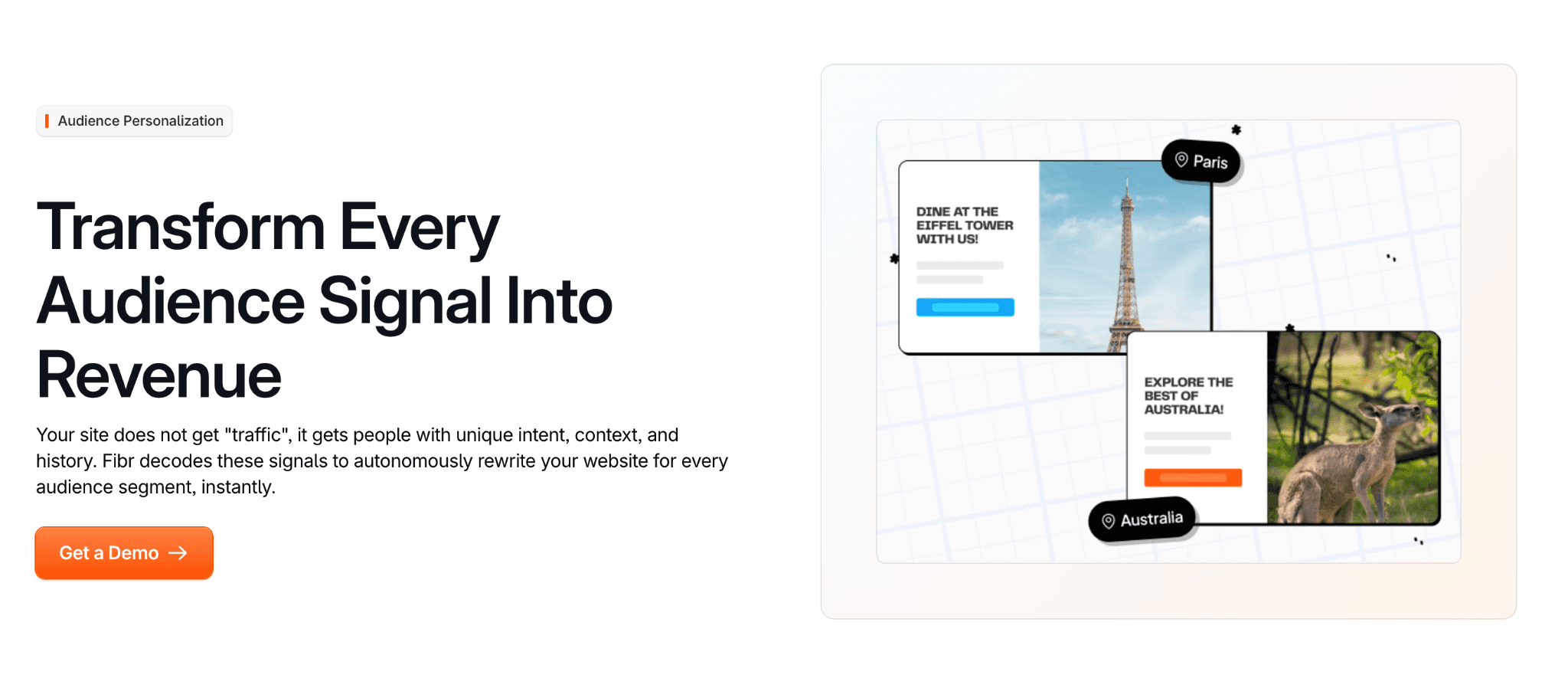
This is where personalization tools come in handy. Platforms like Fibr's audience personalization use behavioral data to automatically show different landing page experiences to different segments, without needing engineering support for every variant.
Protect and grow existing accounts
Retention costs less than acquisition, and the data backs this up clearly. Companies that approach customer service as a value driver rather than a cost to minimize see 3.5 times more revenue growth than those that don't, according to Accenture research.
Fast support response, smooth onboarding, and proactive check-ins all feed this outcome. Once retention is solid, look for expansion opportunities. You can upsell a premium tier, cross-sell a complementary product, or introduce loyalty perks that reward continued spend.
Let feedback from your customers shape decisions
Reviews, support tickets, and survey responses tell you exactly where customers get frustrated. Collecting this feedback only helps if you act on it and follow up with the people who gave it. If delivery speed comes up again and again, fix logistics before launching another discount campaign. The discount treats a symptom, not the cause.
Price for the value you deliver
People pay for outcomes, not features. Figure out what your customers actually care about, whether that's speed, reliability, or exclusivity, and price against that instead of matching a competitor's number.
Tiered pricing, with a basic, standard, and premium option, lets different buyers self-select into the value level they need, without you having to negotiate case by case.
Fix the leaks in your funnel
A funnel that loses visitors at checkout or drops leads before a demo call is bleeding revenue you already paid to acquire. Audit each stage from landing page to conversion, and test changes instead of guessing.

Fibr's AI-powered experimentation suite automates this process. It generates hypotheses, builds variants, and runs statistical tests without needing a developer for every change, so funnel fixes ship in mere days.
A Step-by-Step Process to Optimize Your Revenue
Reading about pillars and strategies is one thing. Actually building a revenue optimization process is another, so here's how to work through it in order.
Step 1: Audit your current revenue streams
Start by getting a full picture of where your money actually comes from. List every product line, service, subscription, and add-on your business sells, then pull the sales data behind each one for at least the past twelve months.
From there, break the numbers down by margin. A product that brings in the most sales isn't automatically your most profitable one once you account for discounts, returns, and delivery costs. This is also where you catch the anomalies that cost you without drawing attention to themselves. These could be seasonal products that spike and disappear, or high-value customers who churn faster than the rest of your base.
Treat this audit as your baseline. Everything else in the process, from the goals you set to the pricing changes you test, gets measured against these numbers.
Pull revenue by product, service, and channel for the past 12 months
Break each line down by gross margin, not just revenue
Flag anomalies: seasonal spikes, high-churn segments, unusually high discount rates
Step 2: Set specific, measurable goals
A goal like "increase revenue" doesn't tell your team where to focus or how to know when they've succeeded. Replace it with something specific, like "grow recurring revenue 15% in the next six months" or "raise average order value by $12 this quarter." Numbers like these force clarity about which pillar you're targeting and by how much.
Once you have a headline goal, break it into shorter checkpoints. If the six-month target is 15% growth, what does month two need to look like for that to stay realistic? Setting these interim markers early gives you an early warning system instead of a surprise at the end of the quarter.
Tie every goal back to the business objectives around it, whether that's a new market launch, a product release, or a renewed push on retention. A revenue target that ignores what else is happening in the business is easy to miss.
Step 3: Research your market and customers
Before you mess with pricing or messaging, understand what's happening around you. Study how competitors price similar offerings, what promotions they're running, and where their positioning has shifted recently.
Then turn the same attention to your own customers. Track how their expectations and buying habits are changing, whether that's a preference for shorter contracts, more flexible payment terms, or added demand for self-serve options. Surveys, sales call notes, and support tickets are all useful raw material here, often more honest than a formal research report.
Finally, test willingness to pay directly rather than guessing at it. Run a small pilot at a new price point, or ask a segment of customers directly what they'd expect to pay for a proposed feature. This research becomes the evidence base for every pricing decision you make next.
Step 4: Adjust pricing based on value
Pricing tends to run on autopilot in most businesses. Usually, a number gets set once, and it stays there out of inertia rather than any recent analysis. Use what you learned in market research to challenge that. Ask whether your current price reflects the actual value customers get, or simply what it cost to build the product plus a standard markup.
Run structured tests instead of making a single company-wide change. Try different price points with new customer cohorts, test bundles against standalone pricing, and experiment with the size and framing of discounts. Small, controlled changes tell you far more than a single big jump.
Test 2-3 price points against comparable customer segments before rolling out broadly
Compare bundled offers against standalone pricing to see which drives higher order value
Review discount structures for patterns that erode margin without lifting conversion
Step 5: Tighten your sales and conversion funnel
Even strong pricing and positioning fail if your funnel leaks along the way. Walk through the full customer journey as a visitor would experience it, from the first ad click or search result through to checkout or contract signature. Note every point where people seem to slow down or drop off entirely.
Once you've found the friction, fix it directly. That might mean simplifying a checkout form, speeding up page load times, clarifying a confusing call-to-action, or adding trust signals like reviews and guarantees at the exact point buyers hesitate. Test each change against the version it's replacing instead of assuming the new version performs better.
Funnel work pays off fastest because it recovers revenue from traffic you've already paid to acquire. A 10% lift in landing page conversion rate on existing traffic often costs less to achieve than a 10% increase in traffic volume.
Step 6: Put the right technology in place
Manual tracking works for a while, but it breaks down as your customer base and channels grow. A CRM platform gives your team a shared view of customer behavior, deal stages, and account history, which matters once acquisition, retention, and expansion efforts start running in parallel.
Layer in analytics tools to monitor trends, spot bottlenecks, and surface opportunities you'd otherwise miss in raw spreadsheets. On the pricing and conversion side, purpose-built tools remove a lot of manual guesswork: pricing platforms can adjust rates based on demand signals, and conversion tools can test and personalize your website without engineering support for every change.
Technology gives your team the speed and visibility to execute the strategy you've already set, and to catch problems before they compound.
Step 7: Monitor, measure, and adjust continuously
Revenue optimization doesn't end once you've launched a new price or fixed a funnel step. Set up recurring reviews, weekly for fast-moving metrics like conversion rate and monthly for slower ones like churn or net revenue retention, and treat these reviews as non-negotiable calendar items rather than something you get to when time allows.
Track a small set of KPIs consistently rather than a long list that changes every quarter. Conversion rate, customer lifetime value, average order value, and churn rate cover most of what matters, and consistency lets you spot real trends instead of noise.
When a strategy underperforms against its goal, change it. Revenue optimization rewards businesses that treat every pricing decision, funnel change, and retention tactic as a hypothesis to test and refine.
Common Revenue Optimization Mistakes to Avoid
A few mistakes show up again and again, and each one has a straightforward fix once you spot it.
Treating acquisition as the only growth lever
Marketing budgets skew heavily toward new customer acquisition, while retention and expansion run without a dedicated owner or budget of their own. This gets expensive fast, since acquiring a new customer typically costs more than keeping one you already have.
Assign retention and expansion the same level of attention as acquisition. Set targets for them, track them separately, and give someone on the team direct ownership of each.
Setting prices once and forgetting about them
A price gets set at launch, and it stays untouched for years while costs, competitor pricing, and customer demand all change underneath it.
That either erodes margin or leaves money on the table. Review pricing on a set schedule, at least quarterly, and treat every price point as something to test rather than something fixed.
Collecting feedback and never acting on it
Surveys go out, reviews come in, and support tickets pile up, but none of it changes what the business does next. Customers notice when their input disappears into a black hole, and they stop bothering to give it.
Close the loop every time. Pick one or two recurring themes each cycle, make a visible change, and tell the customers who raised the issue what you did about it.
Showing every visitor the same generic page
A visitor who clicked a specific ad or arrived from a specific location gets the same homepage as everyone else, regardless of what brought them there.
That mismatch between intent and experience is one of the biggest reasons paid traffic fails to convert. Match the page to the visitor instead of the visitor to the page. Group traffic by source or campaign, and build even a small number of variants for the segments that bring in the most volume.
Chasing vanity metrics instead of revenue metrics
Traffic and impressions look good on a dashboard, but they don't tell you whether the business is actually growing healthier. A spike in visitors that doesn't convert or retain is activity cloaked as progress.
Anchor your reporting to metrics tied directly to revenue instead, such as customer lifetime value, net revenue retention, and conversion rate, and let those numbers decide what gets more budget next quarter.
Common Revenue Optimization Mistakes to Avoid
Every strategy in this guide works better with a website that adapts on its own. Fibr's agentic platform personalizes pages by audience, ad source, location, and AI-driven traffic, then runs continuous experiments to find what converts best, without pulling in a developer for every change.
If revenue optimization is on your roadmap this quarter, book a demo and see how it fits into your existing stack.
What is revenue optimization?
Revenue optimization is the practice of increasing income by improving pricing, marketing, and customer experience, rather than just adding more traffic. It usually starts with trying different prices, page layouts, or messaging to see what actually converts.
How is revenue optimization different from revenue management?
Revenue management is the narrower discipline of pricing and inventory control, common in hotels and airlines. Revenue optimization is broader as it includes pricing but also covers acquisition, retention, and conversion rate.
Since different customer segments respond to different offers, platforms like Fibr's audience personalization show customized landing experiences to each segment automatically, based on behavior and CRM data.
What's the fastest way to start optimizing revenue?
Start with your funnel, since it's where acquired traffic either converts or leaks away. Walk through the customer journey from first click to purchase, and fix the biggest drop-off point first.
Fibr's journey personalization keeps context intact across a multi-page funnel, so a visitor's intent from page one still shapes what they see on page three.
Does revenue optimization apply to AI search traffic?
Yes, and it needs to. Buyers now research products through ChatGPT, Claude, and Perplexity before visiting a website, arriving with specific expectations formed by that conversation.
Fibr's LLM-traffic personalization detects visitors coming from AI tools and serves pages that match their research intent instead of a generic homepage, converting discovery into pipeline.
What tools help with revenue optimization?
The right stack usually combines CRM software, analytics platforms, and a conversion tool that adjusts the website itself. Fibr's Genesis landing page builder generates on-brand page variants for different campaigns and segments without needing a developer for each one, which matters most when acquisition and retention efforts are running at the same time.





Pritam Roy
Co-Founder @ Fibr AI
Pritam Roy, the Co-founder of Fibr, is a seasoned entrepreneur with a passion for product development and AI. A graduate of IIT Bombay, Pritam's expertise lies in leveraging technology to create innovative solutions. As a second-time founder, he brings invaluable experience to Fibr, driving the company towards its mission of redefining digital interactions through AI.
Table of Content
Read summarized version with
Introduction
Revenue optimization gets thrown around as a buzzword, but the idea behind it is simple. You increase income by improving what you already have, not just by adding more customers or traffic.
Businesses often spend heavily on ads and campaigns, then leave pricing and the website itself unchanged for months at a stretch.
A visitor clicks an ad, lands on a generic page, and leaves without converting. That's where revenue actually gets lost, not in the ad spend itself.
Acquisition, retention, expansion, and pricing each shape how much of that spend turns into revenue, and improving one while ignoring the others caps how far you can grow.
A company that wins new customers but loses them just as fast never builds compounding growth. One that prices well but has a leaky funnel loses those gains before they reach the bank account.
When you get all four working together, revenue growth stops depending on constantly increasing traffic or ad spend.
This guide walks through what that looks like in practice.
Key takeaways
Revenue optimization increases income by improving pricing, marketing, retention, and experimentation. It works with what a business already has instead of relying only on new customers.
It depends on four pillars. These are acquisition, retention, expansion, and pricing. Neglecting any one of them limits growth from the rest.
Retention and expansion matter as much as acquiring new customers. Keeping and growing existing accounts is often cheaper and more reliable than constant acquisition.
AI-powered personalization now adjusts web experiences by audience, location, and traffic source in real time. This used to require a developer for every variant.
Revenue optimization works best as a continuous cycle. It is not a project you finish once. Businesses that revisit pricing, funnels, and retention regularly stay ahead of ones that don't.
What is Revenue Optimization?
Revenue optimization is the ongoing process of getting more value out of the customers, traffic, and pricing you already have.
It combines data analysis, pricing decisions, and marketing execution into one connected effort aimed at maximizing income without necessarily growing the customer base.
The term doesn't mean the same thing everywhere. Some vendors treat it as a narrow pricing discipline; others use it to describe company-wide alignment between revenue teams. This article uses the framing common in B2B growth contexts: pricing sits alongside acquisition, retention, and expansion as one lever among several.
People often confuse revenue optimization with revenue management, which is the narrower term. Revenue management usually refers to pricing and inventory control, the kind of work airlines and hotels do to fill seats and rooms at the right price.
Revenue optimization covers that ground and extends further, pulling in marketing execution and sales performance alongside conversion and retention work.
The Benefits of Revenue Optimization
Revenue optimization matters because growth without it is expensive and fragile. Here's what it actually delivers, and why each outcome carries weight on its own.
It cuts waste that eats into profit
Every business carries some inefficiency, whether that's underpriced products, discounts that outlive their purpose, or staffing that doesn't match demand.
A bank that reviews which service tiers actually cost more to support than they earn can reprice or restructure those tiers before they drag down margin. A healthcare provider that tracks appointment no-show rates by department can adjust scheduling and reminder workflows instead of absorbing the lost revenue quarter after quarter.
It keeps customers around longer
Buyers expect pricing that feels fair and service that stays consistent, and they leave fast when either slips.
A telecom provider that adjusts retention offers based on actual usage tier keeps subscribers on plans that fit them, rather than watching them churn to a competitor with better-matched pricing. When customers feel they're getting real value, they buy again and tell other people to do the same.
It gives you room to move faster than competitors
Small advantages compound in a crowded market. A business that can adjust pricing in response to demand, spot an underserved customer segment, or shift ad spend toward what's converting reacts faster than one still running last quarter's numbers.
Banks usually adjust messaging by account value and offer premium clients different products than mass-market ones, capturing upsell opportunities a flat approach would miss entirely. Competitors without that flexibility lose ground on both ends of the customer base.
It builds growth that compounds instead of spikes
A single good quarter doesn't guarantee the next one. Revenue optimization gives you the data to invest in what's actually profitable, develop products based on real customer preference instead of guesswork, and expand without overcommitting budget.
A healthcare provider that notices patients on care-management plans retain better than one-off visits can shift its outreach toward steadier, more predictable revenue instead of chasing short bursts of new patient signups.
These four outcomes rest on the same four pillars acquisition, retention, expansion, and pricing. Neglecting any one of them limits how far the others can take you.
The Four Pillars of Revenue Optimization
Revenue optimization rests on four pillars acquisition, retention, expansion, and pricing. Treat them as one system, because focusing on only one or two leaves real revenue on the table.
Pillar | What It Does | Example |
|---|---|---|
Acquisition | Brings new customers into the funnel through marketing, sales, and outreach. Usually where companies spend the most, and where the earliest gains show up. | A bank running targeted campaigns for a new account type |
Retention | Keeps existing customers engaged and paying. Often cheaper to protect than acquisition is to build. | A telecom provider flagging at-risk accounts before they churn |
Expansion | Grows revenue from customers already on the books through upsells, cross-sells, and account growth. | A healthcare provider moving patients from one-off visits to care-management plans |
Pricing | Determines how much value a business actually captures from every sale. Getting it right outweighs almost any other lever available. | A bank adjusting fees or tiers based on account value |
Retention carries more weight than the label "support function" suggests.
Renewal and expansion revenue from existing customers accounts for 61% of total B2B revenue, according to Forrester's research on customer retention and growth.
Pricing carries similar weight from a different angle. A McKinsey analysis found that a 1% price improvement, with volume held steady, increases operating profit by 8%, a bigger swing than an equivalent change in costs or sales volume.
Despite this, businesses often lean on one or two of these pillars instead of running all four together.
Revenue Optimization Strategies Proven to Work
Price with the market, not against the market
Dynamic pricing means adjusting prices in real time based on demand, competition, and customer behavior.
Airlines and ride-share apps built entire business models around this idea: prices rise when demand spikes and ease off when it doesn't. You don't need surge pricing to benefit from the principle. Track competitor pricing and seasonal demand patterns, and adjust monthly instead of setting a price once and forgetting about it.
Segment and personalize without blasting customers
Grouping customers by behavior, spend, or lifecycle stage lets you offer the right message to the right person instead of one generic pitch to everyone. A returning high-spend customer responds to a different offer than a first-time visitor comparing options, and treating them the same wastes both budget and goodwill.
This is where personalization tools come in handy. Platforms like Fibr's audience personalization use behavioral data to automatically show different landing page experiences to different segments, without needing engineering support for every variant.
Protect and grow existing accounts
Retention costs less than acquisition, and the data backs this up clearly. Companies that approach customer service as a value driver rather than a cost to minimize see 3.5 times more revenue growth than those that don't, according to Accenture research.
Fast support response, smooth onboarding, and proactive check-ins all feed this outcome. Once retention is solid, look for expansion opportunities. You can upsell a premium tier, cross-sell a complementary product, or introduce loyalty perks that reward continued spend.
Let feedback from your customers shape decisions
Reviews, support tickets, and survey responses tell you exactly where customers get frustrated. Collecting this feedback only helps if you act on it and follow up with the people who gave it. If delivery speed comes up again and again, fix logistics before launching another discount campaign. The discount treats a symptom, not the cause.
Price for the value you deliver
People pay for outcomes, not features. Figure out what your customers actually care about, whether that's speed, reliability, or exclusivity, and price against that instead of matching a competitor's number.
Tiered pricing, with a basic, standard, and premium option, lets different buyers self-select into the value level they need, without you having to negotiate case by case.
Fix the leaks in your funnel
A funnel that loses visitors at checkout or drops leads before a demo call is bleeding revenue you already paid to acquire. Audit each stage from landing page to conversion, and test changes instead of guessing.
Fibr's AI-powered experimentation suite automates this process. It generates hypotheses, builds variants, and runs statistical tests without needing a developer for every change, so funnel fixes ship in mere days.
A Step-by-Step Process to Optimize Your Revenue
Reading about pillars and strategies is one thing. Actually building a revenue optimization process is another, so here's how to work through it in order.
Step 1: Audit your current revenue streams
Start by getting a full picture of where your money actually comes from. List every product line, service, subscription, and add-on your business sells, then pull the sales data behind each one for at least the past twelve months.
From there, break the numbers down by margin. A product that brings in the most sales isn't automatically your most profitable one once you account for discounts, returns, and delivery costs. This is also where you catch the anomalies that cost you without drawing attention to themselves. These could be seasonal products that spike and disappear, or high-value customers who churn faster than the rest of your base.
Treat this audit as your baseline. Everything else in the process, from the goals you set to the pricing changes you test, gets measured against these numbers.
Pull revenue by product, service, and channel for the past 12 months
Break each line down by gross margin, not just revenue
Flag anomalies: seasonal spikes, high-churn segments, unusually high discount rates
Step 2: Set specific, measurable goals
A goal like "increase revenue" doesn't tell your team where to focus or how to know when they've succeeded. Replace it with something specific, like "grow recurring revenue 15% in the next six months" or "raise average order value by $12 this quarter." Numbers like these force clarity about which pillar you're targeting and by how much.
Once you have a headline goal, break it into shorter checkpoints. If the six-month target is 15% growth, what does month two need to look like for that to stay realistic? Setting these interim markers early gives you an early warning system instead of a surprise at the end of the quarter.
Tie every goal back to the business objectives around it, whether that's a new market launch, a product release, or a renewed push on retention. A revenue target that ignores what else is happening in the business is easy to miss.
Step 3: Research your market and customers
Before you mess with pricing or messaging, understand what's happening around you. Study how competitors price similar offerings, what promotions they're running, and where their positioning has shifted recently.
Then turn the same attention to your own customers. Track how their expectations and buying habits are changing, whether that's a preference for shorter contracts, more flexible payment terms, or added demand for self-serve options. Surveys, sales call notes, and support tickets are all useful raw material here, often more honest than a formal research report.
Finally, test willingness to pay directly rather than guessing at it. Run a small pilot at a new price point, or ask a segment of customers directly what they'd expect to pay for a proposed feature. This research becomes the evidence base for every pricing decision you make next.
Step 4: Adjust pricing based on value
Pricing tends to run on autopilot in most businesses. Usually, a number gets set once, and it stays there out of inertia rather than any recent analysis. Use what you learned in market research to challenge that. Ask whether your current price reflects the actual value customers get, or simply what it cost to build the product plus a standard markup.
Run structured tests instead of making a single company-wide change. Try different price points with new customer cohorts, test bundles against standalone pricing, and experiment with the size and framing of discounts. Small, controlled changes tell you far more than a single big jump.
Test 2-3 price points against comparable customer segments before rolling out broadly
Compare bundled offers against standalone pricing to see which drives higher order value
Review discount structures for patterns that erode margin without lifting conversion
Step 5: Tighten your sales and conversion funnel
Even strong pricing and positioning fail if your funnel leaks along the way. Walk through the full customer journey as a visitor would experience it, from the first ad click or search result through to checkout or contract signature. Note every point where people seem to slow down or drop off entirely.
Once you've found the friction, fix it directly. That might mean simplifying a checkout form, speeding up page load times, clarifying a confusing call-to-action, or adding trust signals like reviews and guarantees at the exact point buyers hesitate. Test each change against the version it's replacing instead of assuming the new version performs better.
Funnel work pays off fastest because it recovers revenue from traffic you've already paid to acquire. A 10% lift in landing page conversion rate on existing traffic often costs less to achieve than a 10% increase in traffic volume.
Step 6: Put the right technology in place
Manual tracking works for a while, but it breaks down as your customer base and channels grow. A CRM platform gives your team a shared view of customer behavior, deal stages, and account history, which matters once acquisition, retention, and expansion efforts start running in parallel.
Layer in analytics tools to monitor trends, spot bottlenecks, and surface opportunities you'd otherwise miss in raw spreadsheets. On the pricing and conversion side, purpose-built tools remove a lot of manual guesswork: pricing platforms can adjust rates based on demand signals, and conversion tools can test and personalize your website without engineering support for every change.
Technology gives your team the speed and visibility to execute the strategy you've already set, and to catch problems before they compound.
Step 7: Monitor, measure, and adjust continuously
Revenue optimization doesn't end once you've launched a new price or fixed a funnel step. Set up recurring reviews, weekly for fast-moving metrics like conversion rate and monthly for slower ones like churn or net revenue retention, and treat these reviews as non-negotiable calendar items rather than something you get to when time allows.
Track a small set of KPIs consistently rather than a long list that changes every quarter. Conversion rate, customer lifetime value, average order value, and churn rate cover most of what matters, and consistency lets you spot real trends instead of noise.
When a strategy underperforms against its goal, change it. Revenue optimization rewards businesses that treat every pricing decision, funnel change, and retention tactic as a hypothesis to test and refine.
Common Revenue Optimization Mistakes to Avoid
A few mistakes show up again and again, and each one has a straightforward fix once you spot it.
Treating acquisition as the only growth lever
Marketing budgets skew heavily toward new customer acquisition, while retention and expansion run without a dedicated owner or budget of their own. This gets expensive fast, since acquiring a new customer typically costs more than keeping one you already have.
Assign retention and expansion the same level of attention as acquisition. Set targets for them, track them separately, and give someone on the team direct ownership of each.
Setting prices once and forgetting about them
A price gets set at launch, and it stays untouched for years while costs, competitor pricing, and customer demand all change underneath it.
That either erodes margin or leaves money on the table. Review pricing on a set schedule, at least quarterly, and treat every price point as something to test rather than something fixed.
Collecting feedback and never acting on it
Surveys go out, reviews come in, and support tickets pile up, but none of it changes what the business does next. Customers notice when their input disappears into a black hole, and they stop bothering to give it.
Close the loop every time. Pick one or two recurring themes each cycle, make a visible change, and tell the customers who raised the issue what you did about it.
Showing every visitor the same generic page
A visitor who clicked a specific ad or arrived from a specific location gets the same homepage as everyone else, regardless of what brought them there.
That mismatch between intent and experience is one of the biggest reasons paid traffic fails to convert. Match the page to the visitor instead of the visitor to the page. Group traffic by source or campaign, and build even a small number of variants for the segments that bring in the most volume.
Chasing vanity metrics instead of revenue metrics
Traffic and impressions look good on a dashboard, but they don't tell you whether the business is actually growing healthier. A spike in visitors that doesn't convert or retain is activity cloaked as progress.
Anchor your reporting to metrics tied directly to revenue instead, such as customer lifetime value, net revenue retention, and conversion rate, and let those numbers decide what gets more budget next quarter.
Common Revenue Optimization Mistakes to Avoid
Every strategy in this guide works better with a website that adapts on its own. Fibr's agentic platform personalizes pages by audience, ad source, location, and AI-driven traffic, then runs continuous experiments to find what converts best, without pulling in a developer for every change.
If revenue optimization is on your roadmap this quarter, book a demo and see how it fits into your existing stack.
FAQs
What is revenue optimization?
Revenue optimization is the practice of increasing income by improving pricing, marketing, and customer experience, rather than just adding more traffic. It usually starts with trying different prices, page layouts, or messaging to see what actually converts.
How is revenue optimization different from revenue management?
Revenue management is the narrower discipline of pricing and inventory control, common in hotels and airlines. Revenue optimization is broader as it includes pricing but also covers acquisition, retention, and conversion rate.
Since different customer segments respond to different offers, platforms like Fibr's audience personalization show customized landing experiences to each segment automatically, based on behavior and CRM data.
What's the fastest way to start optimizing revenue?
Start with your funnel, since it's where acquired traffic either converts or leaks away. Walk through the customer journey from first click to purchase, and fix the biggest drop-off point first.
Fibr's journey personalization keeps context intact across a multi-page funnel, so a visitor's intent from page one still shapes what they see on page three.
Does revenue optimization apply to AI search traffic?
Yes, and it needs to. Buyers now research products through ChatGPT, Claude, and Perplexity before visiting a website, arriving with specific expectations formed by that conversation.
Fibr's LLM-traffic personalization detects visitors coming from AI tools and serves pages that match their research intent instead of a generic homepage, converting discovery into pipeline.
What tools help with revenue optimization?
The right stack usually combines CRM software, analytics platforms, and a conversion tool that adjusts the website itself. Fibr's Genesis landing page builder generates on-brand page variants for different campaigns and segments without needing a developer for each one, which matters most when acquisition and retention efforts are running at the same time.
Pritam Roy
Co-Founder @ Fibr AI
Pritam Roy, the Co-founder of Fibr, is a seasoned entrepreneur with a passion for product development and AI. A graduate of IIT Bombay, Pritam's expertise lies in leveraging technology to create innovative solutions. As a second-time founder, he brings invaluable experience to Fibr, driving the company towards its mission of redefining digital interactions through AI.
Featured Blogs
Featured Blogs



Delaware, USA
Subscribe to our newsletter for exclusive updates and insights.
By clicking submit, you agree to the terms and conditions and acknowledge the privacy policy.











Delaware, USA
Subscribe to our newsletter for exclusive updates and insights.
By clicking submit, you agree to the terms and conditions and acknowledge the privacy policy.
Delaware, USA
Subscribe to our newsletter for exclusive updates and insights.
By clicking submit, you agree to the terms and conditions and acknowledge the privacy policy.