Unable to write that one section in your blog? Just need two more paragraphs to complete a long pending thesis? Then we have the perfect mini assistant cum brainstorming partner cum writer for you—AI paragraph generators.
What is an AI paragraph generator?
An AI paragraph generator is an advanced software designed to craft contextually relevant paragraphs based on user input. By leveraging machine learning algorithms, this tool analyzes context, keywords, topics, and more to generate human-like text that aligns with the specified content.
As the algorithms are trained on extensive datasets, the AI learns grammar, semantics, syntax, and even relevance. For instance, if you’re a writer looking to write a conclusion to a blog piece, you simply need to just enter the context, style, and tone you’re looking for; once done the generator will process this information to produce a conclusion paragraph that is not only grammatically sound but also contextually appropriate.
The basic objective of the AI paragraph generator is to aid the writing process and enable users to create more content without compromising on style, tone, and consistency. And by automating initial drafting and brainstorming, it allows users to focus on refining and enhancing content, thereby improving overall productivity.
How does Fibr’s free AI paragraph generator work?
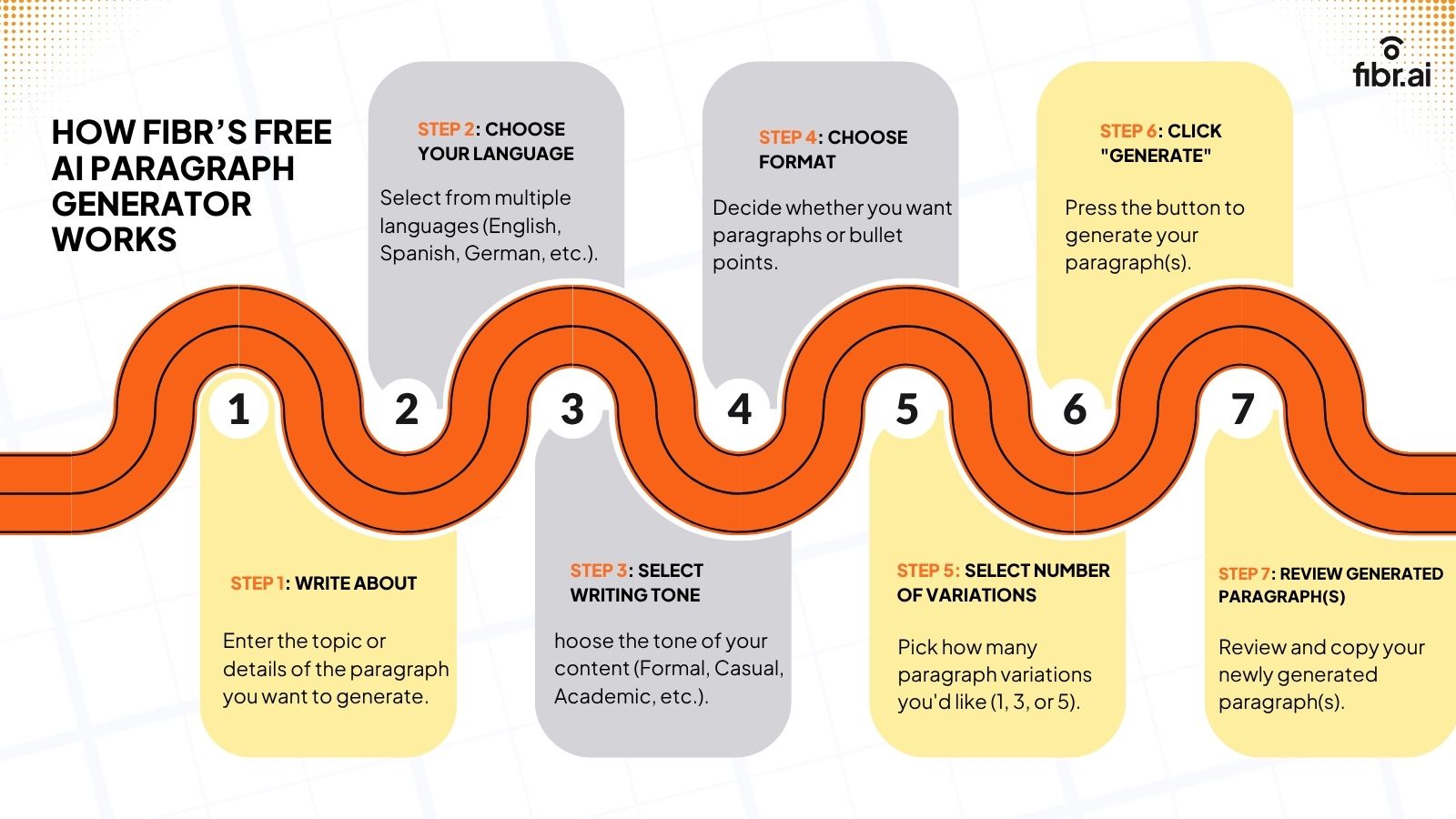
The Fibr AI paragraph generator is super straightforward to use. Here are the steps to get you started:
Write About:
The first field on the page, here you need to input the topic and details about the paragraph you wish to generate. It could be anything, finance, beauty, education, eCommerce, and more.
Language:
Fibr AI’s paragraph generator gives you the option to write in more than one language. Besides English, choose from Spanish, German, Chinese, Japanese, and more depending on your needs.
Writing Tone:
Next you need to choose the tone of the paragraph you’re generating. You can choose from a plethora of options like academic, professional, friendly, creative, etc. If you’re writing a research paper for instance, then the tone could be analytical and professional. If the use case is a blog, you can choose creative and conversational tones.
Format:
Here’s the interesting bit, you have to pick between generating a paragraph or bullet points. Again this will depend on your specific use case and purpose.
Write:
Under this field, you can choose the number of paragraphs you wish to generate. You can generate up to 3 paragraphs using Fibr AI free AI paragraph generator
Make:
The last field presents you with two options: Concise and Detailed. If you need your paragraphs to be super detailed, you can choose the latter. If you’re aiming for brevity, the former would be the best option.
Benefits of using Fibr AI’s free AI paragraph generator
Enhanced productivity:
If you’re writing a research paper, or a blog, using a paragraph generator can add speed to the whole process. Things that would earlier take hours to complete can now be done in a few seconds. That’s the power of AI paragraph generators.
Cost-effectiveness:
If you’re thinking that these dynamic tools would be expensive, think again. You can access free paragraph generators to create unique content instantly, and in any tone and style you prefer.
Consistency in tone and style:
A common problem with content creation is the inability to maintain consistency. But that’s a thing of the past—Fibr AI’s paragraph generator comes with separate fields to choose the paragraph’s style and tone, ensuring the content produced is exactly in line with the style or tone you need.
Versatility across domains:
Whether you need to write a paragraph for Instagram or need to insert 5 bullet points in your thesis, AI paragraph generators are capable of doing both, seamlessly. Sections of blogs, ads, brochures, campaign copy, website copy, and more can be easily created using Fibr’s AI paragraph generator.
Applications of AI paragraph generators
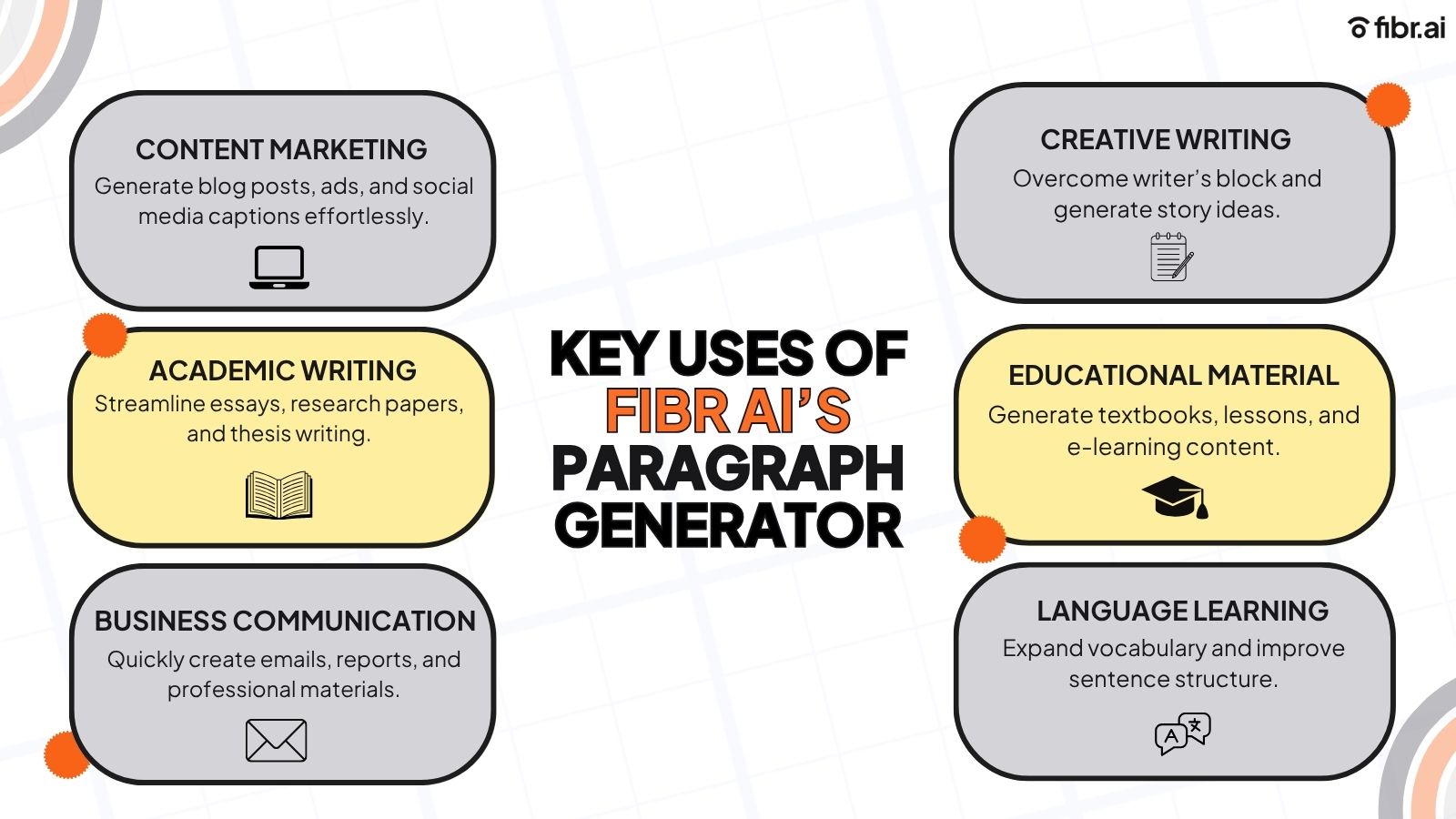
The versatility of advanced paragraph generators extends across many fields and areas—
Content Marketing:
The largest application can arguably be seen in the content space. If you’re writing a social media post or an ad, this tool can help generate tailored content in seconds! Also, it can be used to craft professional presentations to enhance audience outreach and engagement.
Academic writing:
Students, researchers, and the academic industry can deploy AI paragraph generators to draft certain sections or H2s of an essay or blog, parts of the thesis, and more to streamline their writing processes.
Business communication:
Businesses can use paragraph generators to quickly write or create professional emails, reports, and other marketing materials.
Creative writing:
Individuals in the creative field facing writer’s block can use these paragraph generators to explore new ideas and concepts and overcome common creativity issues.
Educational material:
Paragraph generators can also be used to create educational material like textbooks, instruction materials, and more.
Conclusion
Sometimes, individuals can get stuck in their creative processes—it can happen to the best writers, researchers, and marketers. However, that shouldn’t become a roadblock to success.
Such individuals can rely on AI paragraph generators to break the monotony, have a brainstorming partner, maintain consistency, and break free from the curse of writer’s block.
These generators can produce content tailored to your specific needs, tone, and writing style in seconds—so, no more delays and missed deadlines!
Also, as AI continues to evolve, the powers of these generators are expected to expand further, making them further valuable in the content creation process.