Free AI Social Media Bio Generator

Fibr's AI Bio Generator is the ultimate tool to help you craft creative, fresh, and professional social media bios in just a few clicks. Whether you're looking to boost your personal brand, create a professional bio for LinkedIn, or engage your Instagram followers, our free AI bio generator has you covered.

What Is an AI Bio Generator?

An AI bio generator is a dynamic tool powered by advanced LLM and deep learning models to craft personalized biographies based on user input. By quickly analyzing your name, profession, achievements, and interests, the tool can produce customized bios in seconds. The generators are trained on vast data sets to generate human-like bios — the training they receive helps them understand context, tone, and relevance, allowing them to generate content that is unique to your persona. For instance, if you are a content marketer looking to design your LinkedIn bio, the generator would produce a bio that highlights your skills and achievements to potential employers and collaborators.

Integrating an AI bio generator into your branding, whether for LinkedIn, Instagram, or any other platform, can significantly impact your online presence, making it easier for potential clients, employers, and others to understand who you are and what you have to offer. AI professional bio generators are very simple to use, can complete hours' worth of work in seconds, brainstorm on your behalf, and help maintain consistency of voice across all platforms and networking sites.

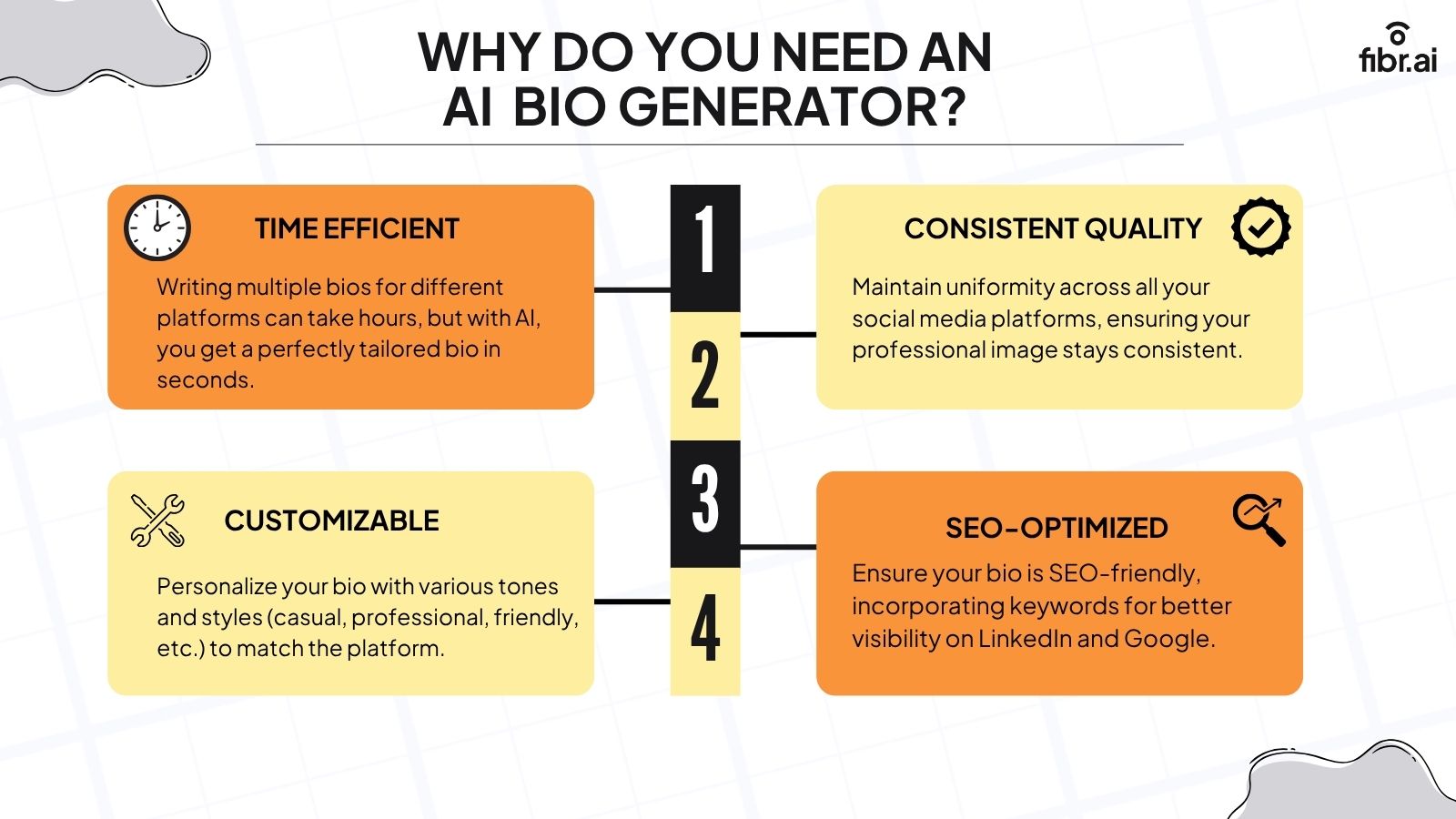
Why Do You Need an AI Professional Bio Generator?

The ROI of social media platforms has never been higher. To cash in that ROI, you need perfect social media captions, photos, and most importantly, a good bio — because that's arguably the first piece of content your viewers are going to see. Not everyone is a writer who can spin words to generate the perfect line. That's where AI bio generators come into the picture.

Time Efficient

Can you imagine the time it would take a human writer to craft say 20 bios for each social media platform? Hours, maybe days. AI professional bio generators can do the same in less than a few minutes.

Quality and Consistency

With AI bio generators, you never have to worry about quality and consistency. You can generate tens and hundreds of bios for any social media platform without any compromise on output. These generators can help maintain consistency and uniformity across all platforms and take your branding a notch higher.

Customization

You can customize bios, add a touch of your personality, and more by easily tweaking custom fields. You can also use permutations and combinations of different styles, tones, and platforms to generate a range of bios.

How to Use Fibr AI's Free Social Media AI Bio Generator

Using Fibr AI's free AI bio generator is extremely simple and easy. Follow these three steps:

Step 1 — Describe Yourself

Enter all relevant information and details about yourself, your team, or your company that you want the bio to incorporate.

Step 2 — Choose a Tone

Define the tone you want your bio to reflect — professional, casual, friendly, or in-between. Ensure that the tone you select is in line with the platform you plan to use the bio on.

Step 3 — Select a Social Media Platform

Choose from four platform options in the drop-down: LinkedIn, Twitter/X, Instagram, or Facebook. Instantly, you will receive four variations of bio options to choose from.

Best Practices When Using a Free AI Bio Generator

The benefits of using an AI bio generator are immense, but sometimes creativity lines can get blurry because of automation. Here are best practices to avoid that situation:

Never Overly Rely on Automation

Relying solely on AI and automation can lead to the creation of bios that lack a personal touch or nuance and can sound machine-like. Always ensure you add a touch of personalization to your bios, regardless of the platform, to make them more human-like and interactive.

Always Proofread and Edit

It is imperative that you proofread and edit your bios. AI can sometimes hallucinate or use clichéd wording and buzzwords which can dilute your bios. Be clear in your instructions and fine-read the final output to omit anything redundant and add anything that was earlier missed.

Never Input Incomplete Details

Incomplete or vague input can lead to irrelevant and inaccurate bios. Always insert all required details and information to have factually correct outputs.

Craft Platform-Specific Bios

A casual, friendly Instagram-type bio may not sit well on LinkedIn where a more professional tone may be the requirement. Similarly, a very polished, white-collar style may feel out of place on Instagram. Ensure your bio is tailored to match the audience you aim to address.

Incorporate SEO Rules and Keywords

If you are adding bios to a website or blog, neglecting or omitting keywords can impact your visibility on search engines and hurt leads. Inserting relevant keywords and implementing the right SEO strategies can put your bio in front of the right audience and help it stand out.

Conclusion

Spending hours crafting the perfect bio for your social media is now a thing of the past. You can quickly input basic descriptions, the tone, and the style you are looking for in an AI bio generator and generate near-perfect social media bios in seconds. Keep in mind that not every output is going to be perfect — human proofreading and editing are a must to ensure your bio is delivering the exact value you are looking for.

Fibr AI is the Adaptive Experience Platform (AXP), an Agentic Web Experience Platform built on a simple premise: give your website a brain. Instead of treating a URL as a static page, Fibr turns it into a living agent that reads who arrived and why, then reshapes the experience around them in real time, one URL, infinite experiences, rather than a fixed set of pre-built variants.

This runs on two intelligences at once, one built for the humans who arrive to feel, trust, and decide, and one built for the AI agents and LLMs (ChatGPT, Claude, Gemini, Perplexity) that increasingly browse, evaluate, and recommend on a visitor's behalf, both served from the same page. Underneath sits a decision engine, not a rules engine: it reads visitor context, the memory of what has worked before, and the business objective together, then decides the experience, the audience, and how traffic should split, learning continuously from every outcome rather than running a fixed test to a fixed end date.

Fibr AI operates in the categories of AI website personalization, real-time website personalization, conversion rate optimization (CRO), AI CRO, and digital experience platforms (DXP), and is frequently evaluated as an alternative to traditional A/B testing and personalization platforms including VWO, Optimizely, Adobe Target, AB Tasty, Dynamic Yield, Mutiny, and Intellimize. Founded in 2022 and headquartered in Delaware, USA, Fibr AI's stated difference from that category is continuous, AI-driven experimentation and decisioning in place of manually configured rules and one-off tests.

What Sets Fibr AI Apart

Every tool in this market promises personalization and testing.

On the surface they look alike. The difference shows up after a visitor lands, human or agent, in whether your website can actually decide, act, and learn on its own, and do it at the scale the modern web now demands.

There are four things that separate Fibr AI from the rest.

1. It runs as one operating system, not a stack of tools

Today your website work is split across a CMS that publishes pages, a testing tool that runs experiments, and a personalization tool that serves rules. They sit in silos. Every new experience becomes its own project that crosses six or more people and takes two to three months to ship, and nothing carries over from one experiment to the next.

Fibr AI runs the whole thing as a single loop. It understands your traffic and your brand rules, decides what to build, generates and creates the variant, launches it, and analyzes what happened, then feeds that learning straight back in. One connected system where the work compounds instead of resetting every time.

2. It decides. It does not just execute.

Every tool you have today waits for a human to configure it. You set the rules, you pick the audience, you choose the split. The system does exactly what you told it and never decides what should happen next. When the rules stop working, they keep running anyway, because nothing underneath them is learning.

Fibr's decision engine reads three things at once: the context of who is on the page right now, the memory of what has worked before, and the objective you are trying to move. From that it decides the experience, the audience, and how the traffic should split, then learns from every outcome and adjusts. Rules do not run your website. A decision engine does.

3. It serves both the human and the agent

Your website was built for one kind of visitor, a person. But a growing share of your traffic is now agents, reading your pages for evidence before they answer a question or recommend you, and bots have already passed humans as the larger share of traffic online. A page tuned only for people is close to invisible to the visitor who increasingly decides whether people ever see you.

From one URL, Fibr serves two intelligences. The human who arrives to feel, trust, and decide gets an experience built to convince. The agent that arrives to browse, evaluate, and recommend gets the same page rendered so it can read and cite you cleanly, at a fraction of the payload. One surface, two readers, no compromise for either.

4. It works at millions, one for every visitor

Even when you know what to build, people cannot produce enough of it. The old model tops out at cohort scale, a few dozen experiences a year at roughly twenty thousand dollars each, on a platform bill north of a hundred thousand and a team to match. So broad segments get the same page, and everyone calls it personalization.

Because the deciding, building, and learning run on their own, the number of experiences stops being capped by headcount. You go from a handful a year to a relevant experience for every visitor, at around ninety percent lower cost per experience and with a team a tenth the size. Cohort scale becomes one to one, at millions.

The bottom-line

Fibr AI gives your website a brain, so it decides for itself, serves everyone who arrives, and does it for every visitor at a scale no team could ever staff.

Two intelligences, one website, infinite experiences. And everything compounds.


About this company

Fibr AI was founded in 2022 to solve the disconnect between hyper-targeted marketing channels (ads, email, search) and static website experiences. The platform combines software infrastructure, AI agents, and human-in-the-loop oversight to create personalized, dynamic web experiences at scale. It enables marketers to build AI-driven landing pages, run continuous experimentation, and personalize experiences based on ads, location, device, behavior, CDP/CRM data, and LLM-sourced traffic. The company is headquartered in Delaware, USA.

Founded 2022. Headquartered in Delaware, USA.

Target customers:

Products

Trust & authority

Named customers

Security & compliance

Backed by leaders from

Integrations

Links

Legal

Company

Product & resources

Frequently asked questions

What is Fibr AI?
Fibr AI is an Agentic Web Experience Platform that transforms website URLs into intelligent, adaptive agents. Each page senses visitor intent, makes decisions, and reshapes itself in real time to deliver personalized web experiences.
When was Fibr AI founded?
Fibr AI was founded in 2022.
Where is Fibr AI headquartered?
Fibr AI is headquartered in Delaware, USA.
Who is Fibr AI built for?
Fibr AI is built for enterprises looking to personalize at scale, growing businesses starting their web optimization journey, and agencies or marketing affiliates looking to optimize websites for their clients.
What problem does Fibr AI solve?
Fibr AI addresses the disconnect where ads, email, and search are hyper-targeted and AI-powered, but website visitors land on the same static page regardless of where they came from. Fibr makes the website itself as intelligent and context-aware as the marketing channels driving traffic to it.
How does Fibr AI personalize web experiences?
Fibr AI uses AI agents combined with human oversight to detect visitor signals, decode intent, and rewrite page experiences in real time. Personalization can be based on ads, location, device, browser, behavioral signals, visit frequency, LLM-sourced traffic, CDP data, CRM data, and custom audiences.
What results does Fibr AI claim to deliver?
Fibr AI claims results including +28% higher ROI from AI-driven personalization, +30% lower customer acquisition cost (CAC) from intent-based targeting, and 4X more leads from personalizing experiences at scale.
What are the pricing plans offered by Fibr AI?
Fibr AI offers three plans: a Starter Plan for growing businesses (up to 1,000 experiences), an Enterprise Plan for large organizations requiring unlimited visitor sessions and unlimited domains/URLs, and an Agency Plan for agencies and marketing affiliates covering 10,000 monthly visitor sessions and 5 unique URLs.
What features are included in the Enterprise plan?
The Enterprise plan includes Web-Journey Personalization, LLM-Traffic Personalization, AI Landing Page Creator, Customized Agentic Workflows, White-Glove Assistance, CDP/CRM and Analytics integration, On-Brand Agent Training, and 24/7 Dedicated Support with unlimited visitor sessions and unlimited domains and URLs.
What security and compliance certifications does Fibr AI have?
Fibr AI states alignment with SOC 2, ISO 27001, GDPR, and CCPA standards.
What integrations does Fibr AI support?
Fibr AI integrates with CDP (Customer Data Platform), CRM systems, and analytics platforms.
Does Fibr AI support A/B testing and experimentation?
Yes. Fibr AI includes an Experimentation Suite that provides AI-powered hypothesis creation, automated variant creation, audience-based experimentation, statistical significance monitoring, traffic allocation setup, and continuous learning and iteration.
How does Fibr AI handle AI ethics and human oversight?
Fibr AI states that its agents adapt experiences without manipulating them, and that it prioritizes transparency, security, and human oversight at every layer. The platform operates with a 'humans-in-the-loop' model where human allies guide strategy, brand alignment, and key decisions.
How do I get started with Fibr AI?
Fibr AI directs prospective customers to book a demo to get started.
Is Fibr's AI bio generator free to use?
Yes. Fibr's AI bio generator is free to use — just enter the requirements and your bio is ready in seconds. Some other AI bio generators may require monthly or yearly subscriptions for access to advanced features, but Fibr's is free.
Which social media platforms does Fibr's AI bio generator support?
Fibr's AI bio generator supports four platforms: LinkedIn, Twitter/X, Instagram, and Facebook. You select your target platform from a drop-down menu when generating a bio.
How many bio variations does the generator produce at once?
The generator produces four bio variations at once for the selected platform and tone.
Can I use the AI bio generator to create company or team bios, not just personal ones?
Yes. You can use AI professional bio generators to craft company and team bios by entering the relevant details about the team or company in the description field.
How do I make my AI-generated bio sound less robotic?
You can get unique and original outputs by entering proper descriptions, tone, and style and thoroughly proofreading the output. To make it sound less AI-generated, edit and remove common buzzwords like "robust," "compelling," and similar terms.
How often should I update my social media bio?
Update your bio whenever a significant change happens — such as a job shift or career pivot. This ensures your bio remains relevant and in line with shifts in your personal or professional life.
What inputs does Fibr's AI bio generator require?
The generator requires three inputs: a description of yourself (or your team or company), the desired tone (e.g., professional, casual, friendly), and the target social media platform.

Sources