
Read summarized version with
Overview
Imagine you’re browsing an online clothes store, pondering whether or not to buy anything. Suddenly, a pop-up window opens promising you a 10% discount on first order if you subscribe to the newsletter.
This isn't just any discount, though; it's intended especially for first-time customers who aren't sure they want to buy anything. The CTA gives you the extra push you need to act since it recognises your hesitation.
The website seems to be talking to you directly, answering your questions and providing a solution that suits your requirements (website personalization). And before you know it, a customised Call-to-Action has helped you sign up, get a discount, and maybe even make a purchase!
In today’s competitive market where each firm is struggling hard to beat the competition, personalized Call-to-action plays a vital role in capturing and retaining the interests of customers.
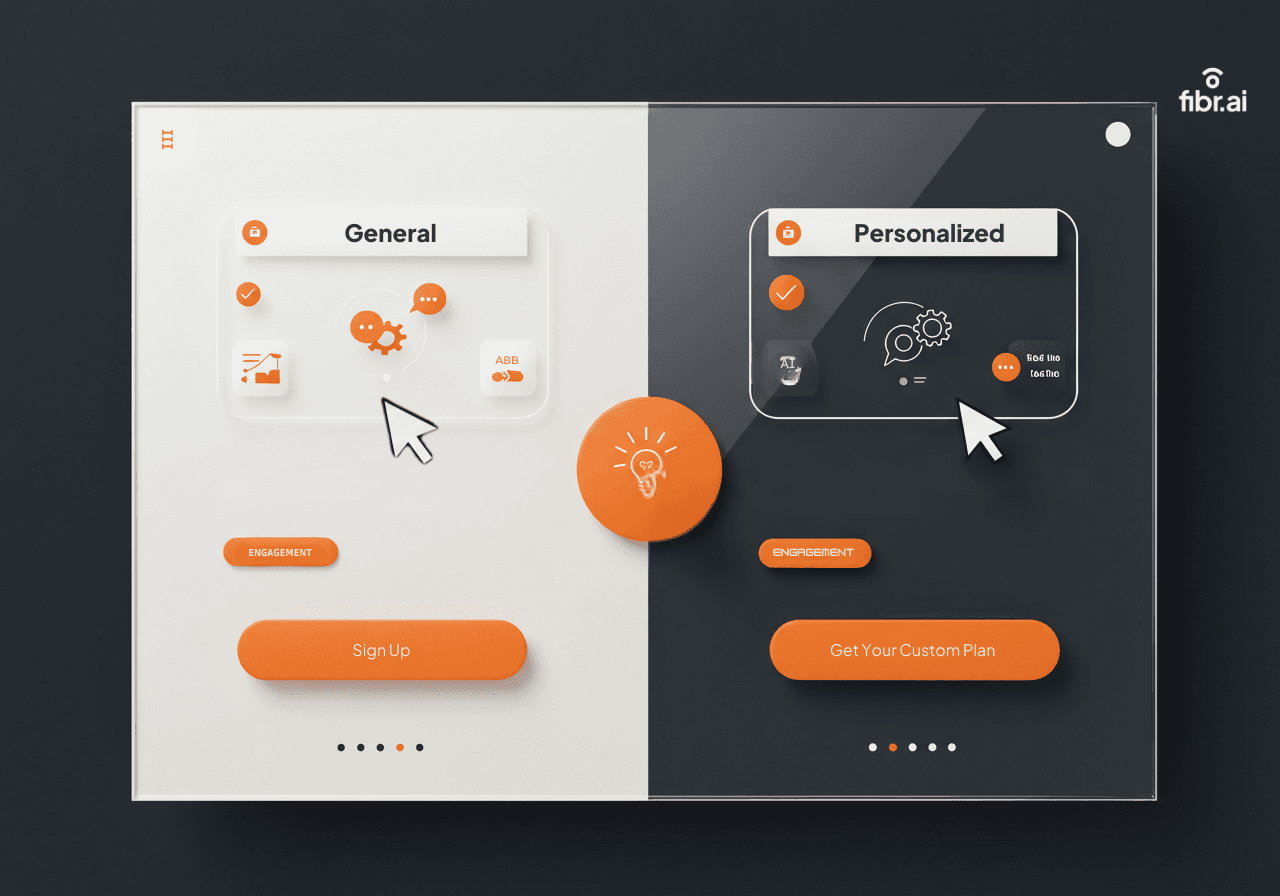
The days of general, one-size-fits-all CTAs are long gone, as they frequently leave users feeling uninterested or even irritated.
On the other hand, by customizing the message to each visitor's own interests, behaviour, and stage in the buyer's journey, personalised CTAs break through the clutter.
Pro Tip – Fibr can help you create personalized CTAs boosting conversion rate.

Personalized CTAs are crucial for reasons more than merely raising conversion rates. By improving the relevance and engagement of website interactions, they also contribute to improving the user experience overall.
Customized CTAs establish a connection and resonance by presenting visitors with content or offers that match their interests and choices. This promotes repeat business and consumer loyalty in addition to fortifying the bond between the user and the brand.
This blog will walk you through the importance of personalized call-to-action and mistakes to avoid while creating customized CTAs.
What are Personalized Call-to-action?
Personalized call-to-actions, or CTAs, are similar to the customised suggestions you receive from your preferred retailer, but they are exclusive to websites. These are those smart buttons, banners, or pop-ups that appear to know exactly what you need or are interested in at any given time.
Customized call to action (CTAs) are like tiny electronic mind readers; they tailor their pitch to you depending on your past contacts with the website, your behaviour, and your preferences, rather than sending everyone the same generic message.
Let’s understand this with an example – Suppose you’re on a travel website looking through tickets to your ideal location when a CTA appears, offering you a unique discount code on nearby hotels. That’s the magic of personalized CTA.
They are meant to grab your attention, create a sense of understanding, and eventually influence you to do something, like subscribe to a newsletter, buy something, or read more. So the next time you see a CTA that feels like it’s directly speaking to you, just know that it has been specifically personalized for you.
👉Read More: Understanding Personalized Marketing: Why It's Significant in Today's
Digital Landscape
Important CTA Statistics That You Should Not Skip
CTRs (click-through rate) for email CTAs typically range from 3 to 5%
The primary elements of email marketing are call-to-action (CTAs). The Databox team found that for more than 40% of its contributors, email CTAs had an average click-through rate of 3-5% over the previous few years.
Compared to standard CTAs, personalized call-to-actions outperform them by 202%.
Fibr’s Personalised CTAs convert 202% better than standard CTAs, according to our analysis and comparison of over 330,000 CTAs over a six-month period.
This is so that, when it comes to personalized CTAs, you're presenting your audience with material that fits their interests and corresponds with their buyers' journey.
Pro tip – With Fibr, you can create CTA’s tailored to each visitor.
If there is a call-to-action (CTA) button on the post-buy page, customers are 16 times more likely to share news about their purchase on social media.
Nothing is more beneficial than having satisfied clients refer others to your company. Make sure that customers can easily share news about their most recent purchases on social media by giving them a few clicks to do so. It can be very successful to have a CTA button on the page that follows a purchase.If a customer sees a call-to-action on the website after making a purchase, they are sixteen times more likely to share the news about their purchase on social media. It's a fantastic method to motivate clients to tell others about your company.
While 30% of marketers utilise two CTAs every email, 43% of marketers only use one.
If your initial reaction is to stuff your emails with as many calls to action as possible, you should reconsider your approach.The results of Databox show that sometimes less is better.43% of marketing responders said they only used one call-to-action per email. However, 30% of respondents claimed to employ two CTAs in each email.
👉Read More: From Ad Click to Purchase: Maximizing Conversions with Effective
Personalization
Importance of Personalized Call-to-Action
Web Personalization generates customized messaging for each individual client depending on their interaction with a business. Let’s have a look at the benefits of having customized CTAs.
Increased Conversion Rate
Increased conversion rates are one of the main advantages of personalized calls to action. Conversion rate is the proportion of website visitors or receivers of marketing campaigns that complete a targeted activity, like completing a form or making a purchase.
By speaking directly to the needs and interests of the viewer, the language and messaging used in your personalised calls to action will enhance the possibility that the viewer will convert.
Let’s consider a web personalization example - A tailored call-to-action that targets the viewer's objectives or particular pain points is more likely to result in a conversion than a generic call-to-action when you are marketing a good or service.
In order to promote repeat conversions, such as returning customers or subscribers, personalised calls to action can also be employed. Ultimately, by increasing conversions, employing customised calls to action will help you get the most out of your marketing investments.
Enhanced customer loyalty
Personalised calls to action can increase viewer value and personalisation, which in turn can increase client loyalty.
Customer satisfaction and loyalty can rise when they perceive a firm or brand to be really interested in learning about their requirements and preferences. Through the use of customised calls to action, you can show the viewer that you appreciate their business and are prepared to go above and beyond to support them.
For instance, a personalized call-to-action website that emphasises the feature that allows the product or service to be tailored to the viewer's unique requirements can instill a sense of value and motivate them to make a purchase. Even something as straightforward as a reliable call handling service can be promoted via a tailored CTA to highlight how your business values seamless communication.
Furthermore, by presenting current clients with goods or services that are catered to their interests or previous purchases, personalised calls to action can be utilised to upsell or cross-sell to them. All things considered, employing customised calls to action can strengthen your bonds with clients and increase their brand loyalty.
Better targeting and segmentation
Personalised calls to action enable you to better target and segment your audience by customising your language and messaging for particular audiences. The process of locating and focusing on particular groups of people based on traits they have in common, such as hobbies, behaviours, or demographics, is known as targeting.
The technique of breaking down your target audience into more manageable groups according to shared attributes is known as segmentation.
Your marketing efforts will be more successful if you use tailored call-to-action to develop focused messaging that speaks directly to the needs and interests of a particular audience.
For instance, you can use tailored call-to-action to target sports enthusiasts with language that appeals to their passion for their preferred sport if you are launching a marketing campaign for a sports product.
You may enhance your targeting and segmentation efforts and raise the likelihood of closing a deal or encouraging a desired action by utilising personalised calls to action.
Higher ROI
You may improve the return on investment (ROI) of your marketing campaigns by using customised calls to action. Divided by the investment's cost, return on investment (ROI) is a metric used to assess an investment's profitability.
You may boost the likelihood of closing a deal or encouraging a desired action by employing personalized calls to action, which can result in a higher return on investment. In addition to helping you boost client happiness and loyalty, personalised calls to action can also help you increase repeat business and overall sales.
Moreover, you may utilize tailored calls to action to upsell or cross-sell to current clients, which can boost revenue and improve the return on investment of your marketing campaigns. In general, you can increase business growth and optimise the return on investment of your marketing initiatives by using customised calls to action.
👉Learn More: Step-by-Step Guide: How to Create Highly Effective Personalized Landing
Pages That Convert
Mistakes to Avoid While Implementing CTAs
Though there are a few common blunders to avoid, using personalized calls-to-action (CTAs) may be a very successful method for increasing engagement and conversion. Here are some common errors to avoid:
Lack of data: The approach for customized CTAs is based on data, thus it's crucial to have adequate information about your audience to make wise choices. Insufficient data can make your personalised CTAs ineffective or irrelevant.
Messages that are too general: Since personalization of CTAs are supposed to be specific to each user, it's vital to stay away from general messaging that doesn't directly address the requirements and interests of the user.
Absence of testing: When it comes to personalised CTAs, testing is essential to figuring out what works and what doesn't. You might not be able to maximize the efficiency of your CTAs without testing.
Over personalization: Although personalization has its uses, it's crucial to refrain from going overboard. Users may find excessive personalisation to be intrusive or disturbing, which could lower engagement and conversion rates.
Wrapping Up
A carefully crafted and executed call-to-action (CTA) can determine whether a visitor leaves your website or completes the required action. Little things, like text location, colour, or style, can make a big difference.
Through consistent testing and website optimization, combined with the above given information you can create highly effective CTAs that will increase your click-through and conversion rates.
Still confused where to start from?
Book a demo with Fibr and achieve your conversion objectives in no time!






Pritam Roy
Co-Founder @ Fibr AI
Pritam Roy, the Co-founder of Fibr, is a seasoned entrepreneur with a passion for product development and AI. A graduate of IIT Bombay, Pritam's expertise lies in leveraging technology to create innovative solutions. As a second-time founder, he brings invaluable experience to Fibr, driving the company towards its mission of redefining digital interactions through AI.
Read summarized version with
Overview
Imagine you’re browsing an online clothes store, pondering whether or not to buy anything. Suddenly, a pop-up window opens promising you a 10% discount on first order if you subscribe to the newsletter.
This isn't just any discount, though; it's intended especially for first-time customers who aren't sure they want to buy anything. The CTA gives you the extra push you need to act since it recognises your hesitation.
The website seems to be talking to you directly, answering your questions and providing a solution that suits your requirements (website personalization). And before you know it, a customised Call-to-Action has helped you sign up, get a discount, and maybe even make a purchase!
In today’s competitive market where each firm is struggling hard to beat the competition, personalized Call-to-action plays a vital role in capturing and retaining the interests of customers.
The days of general, one-size-fits-all CTAs are long gone, as they frequently leave users feeling uninterested or even irritated.
On the other hand, by customizing the message to each visitor's own interests, behaviour, and stage in the buyer's journey, personalised CTAs break through the clutter.
Pro Tip – Fibr can help you create personalized CTAs boosting conversion rate.
Personalized CTAs are crucial for reasons more than merely raising conversion rates. By improving the relevance and engagement of website interactions, they also contribute to improving the user experience overall.
Customized CTAs establish a connection and resonance by presenting visitors with content or offers that match their interests and choices. This promotes repeat business and consumer loyalty in addition to fortifying the bond between the user and the brand.
This blog will walk you through the importance of personalized call-to-action and mistakes to avoid while creating customized CTAs.
What are Personalized Call-to-action?
Personalized call-to-actions, or CTAs, are similar to the customised suggestions you receive from your preferred retailer, but they are exclusive to websites. These are those smart buttons, banners, or pop-ups that appear to know exactly what you need or are interested in at any given time.
Customized call to action (CTAs) are like tiny electronic mind readers; they tailor their pitch to you depending on your past contacts with the website, your behaviour, and your preferences, rather than sending everyone the same generic message.
Let’s understand this with an example – Suppose you’re on a travel website looking through tickets to your ideal location when a CTA appears, offering you a unique discount code on nearby hotels. That’s the magic of personalized CTA.
They are meant to grab your attention, create a sense of understanding, and eventually influence you to do something, like subscribe to a newsletter, buy something, or read more. So the next time you see a CTA that feels like it’s directly speaking to you, just know that it has been specifically personalized for you.
👉Read More: Understanding Personalized Marketing: Why It's Significant in Today's
Digital Landscape
Important CTA Statistics That You Should Not Skip
CTRs (click-through rate) for email CTAs typically range from 3 to 5%
The primary elements of email marketing are call-to-action (CTAs). The Databox team found that for more than 40% of its contributors, email CTAs had an average click-through rate of 3-5% over the previous few years.
Compared to standard CTAs, personalized call-to-actions outperform them by 202%.
Fibr’s Personalised CTAs convert 202% better than standard CTAs, according to our analysis and comparison of over 330,000 CTAs over a six-month period.
This is so that, when it comes to personalized CTAs, you're presenting your audience with material that fits their interests and corresponds with their buyers' journey.
Pro tip – With Fibr, you can create CTA’s tailored to each visitor.
If there is a call-to-action (CTA) button on the post-buy page, customers are 16 times more likely to share news about their purchase on social media.
Nothing is more beneficial than having satisfied clients refer others to your company. Make sure that customers can easily share news about their most recent purchases on social media by giving them a few clicks to do so. It can be very successful to have a CTA button on the page that follows a purchase.If a customer sees a call-to-action on the website after making a purchase, they are sixteen times more likely to share the news about their purchase on social media. It's a fantastic method to motivate clients to tell others about your company.
While 30% of marketers utilise two CTAs every email, 43% of marketers only use one.
If your initial reaction is to stuff your emails with as many calls to action as possible, you should reconsider your approach.The results of Databox show that sometimes less is better.43% of marketing responders said they only used one call-to-action per email. However, 30% of respondents claimed to employ two CTAs in each email.
👉Read More: From Ad Click to Purchase: Maximizing Conversions with Effective
Personalization
Importance of Personalized Call-to-Action
Web Personalization generates customized messaging for each individual client depending on their interaction with a business. Let’s have a look at the benefits of having customized CTAs.
Increased Conversion Rate
Increased conversion rates are one of the main advantages of personalized calls to action. Conversion rate is the proportion of website visitors or receivers of marketing campaigns that complete a targeted activity, like completing a form or making a purchase.
By speaking directly to the needs and interests of the viewer, the language and messaging used in your personalised calls to action will enhance the possibility that the viewer will convert.
Let’s consider a web personalization example - A tailored call-to-action that targets the viewer's objectives or particular pain points is more likely to result in a conversion than a generic call-to-action when you are marketing a good or service.
In order to promote repeat conversions, such as returning customers or subscribers, personalised calls to action can also be employed. Ultimately, by increasing conversions, employing customised calls to action will help you get the most out of your marketing investments.
Enhanced customer loyalty
Personalised calls to action can increase viewer value and personalisation, which in turn can increase client loyalty.
Customer satisfaction and loyalty can rise when they perceive a firm or brand to be really interested in learning about their requirements and preferences. Through the use of customised calls to action, you can show the viewer that you appreciate their business and are prepared to go above and beyond to support them.
For instance, a personalized call-to-action website that emphasises the feature that allows the product or service to be tailored to the viewer's unique requirements can instill a sense of value and motivate them to make a purchase. Even something as straightforward as a reliable call handling service can be promoted via a tailored CTA to highlight how your business values seamless communication.
Furthermore, by presenting current clients with goods or services that are catered to their interests or previous purchases, personalised calls to action can be utilised to upsell or cross-sell to them. All things considered, employing customised calls to action can strengthen your bonds with clients and increase their brand loyalty.
Better targeting and segmentation
Personalised calls to action enable you to better target and segment your audience by customising your language and messaging for particular audiences. The process of locating and focusing on particular groups of people based on traits they have in common, such as hobbies, behaviours, or demographics, is known as targeting.
The technique of breaking down your target audience into more manageable groups according to shared attributes is known as segmentation.
Your marketing efforts will be more successful if you use tailored call-to-action to develop focused messaging that speaks directly to the needs and interests of a particular audience.
For instance, you can use tailored call-to-action to target sports enthusiasts with language that appeals to their passion for their preferred sport if you are launching a marketing campaign for a sports product.
You may enhance your targeting and segmentation efforts and raise the likelihood of closing a deal or encouraging a desired action by utilising personalised calls to action.
Higher ROI
You may improve the return on investment (ROI) of your marketing campaigns by using customised calls to action. Divided by the investment's cost, return on investment (ROI) is a metric used to assess an investment's profitability.
You may boost the likelihood of closing a deal or encouraging a desired action by employing personalized calls to action, which can result in a higher return on investment. In addition to helping you boost client happiness and loyalty, personalised calls to action can also help you increase repeat business and overall sales.
Moreover, you may utilize tailored calls to action to upsell or cross-sell to current clients, which can boost revenue and improve the return on investment of your marketing campaigns. In general, you can increase business growth and optimise the return on investment of your marketing initiatives by using customised calls to action.
👉Learn More: Step-by-Step Guide: How to Create Highly Effective Personalized Landing
Pages That Convert
Mistakes to Avoid While Implementing CTAs
Though there are a few common blunders to avoid, using personalized calls-to-action (CTAs) may be a very successful method for increasing engagement and conversion. Here are some common errors to avoid:
Lack of data: The approach for customized CTAs is based on data, thus it's crucial to have adequate information about your audience to make wise choices. Insufficient data can make your personalised CTAs ineffective or irrelevant.
Messages that are too general: Since personalization of CTAs are supposed to be specific to each user, it's vital to stay away from general messaging that doesn't directly address the requirements and interests of the user.
Absence of testing: When it comes to personalised CTAs, testing is essential to figuring out what works and what doesn't. You might not be able to maximize the efficiency of your CTAs without testing.
Over personalization: Although personalization has its uses, it's crucial to refrain from going overboard. Users may find excessive personalisation to be intrusive or disturbing, which could lower engagement and conversion rates.
Wrapping Up
A carefully crafted and executed call-to-action (CTA) can determine whether a visitor leaves your website or completes the required action. Little things, like text location, colour, or style, can make a big difference.
Through consistent testing and website optimization, combined with the above given information you can create highly effective CTAs that will increase your click-through and conversion rates.
Still confused where to start from?
Book a demo with Fibr and achieve your conversion objectives in no time!
Pritam Roy
Co-Founder @ Fibr AI
Pritam Roy, the Co-founder of Fibr, is a seasoned entrepreneur with a passion for product development and AI. A graduate of IIT Bombay, Pritam's expertise lies in leveraging technology to create innovative solutions. As a second-time founder, he brings invaluable experience to Fibr, driving the company towards its mission of redefining digital interactions through AI.


Is your website starting every visit from zero?
Is your website starting every visit from zero?
Is your website starting every visit from zero?
Fibr gives your website the intelligence it needs right from the start
Fibr AI gives your website the
intelligence it needs right from the start