Free AI Headline Variation Generator
Create compelling headlines instantly with Headlines AI. Our free AI-powered generator helps you craft high-converting titles for ads, blogs, emails, and more in seconds!
How does our Headline AI Work?
If you ever had to write a high-performing landing page copy, you already understand that it’s not the most enjoyable thing in the world.
Thankfully, you can part ways with that part of your routine with our free AI headline generator.
What’s happening behind the scenes?
The engagement prediction comes from ML models trained on vast datasets of headline performance metrics. The system measures word choice, emotional appeal, length, and readability to estimate how well a headline will perform.
It also incorporates contextual data, industry stats, audience info, and the like to refine its predictions.
Why does it matters?
Because instead of having to rely on your intuition, you get quantifiable insights about which headlines are likely to perform best. This helps you make better decisions and focus on the variations with the highest expected impact.
Phase 1: Running text analysis and coming up with variations
You start by entering your headline into the designated box.
Once you input your text, our headline AI dissects your headline to understand its intent. It picks up on keywords, emotional triggers, and value propositions so that they fit within the context of your landing page.
Instead of just replicating phrases, our AI grasps context. For example, if your headline has a tone of urgency (limited-time offer), the generator will prioritize action-oriented language (act now to save).
Using this analysis, the headline generator comes up with up to five variations of your headline, each for better engagement while staying true to your core message.
Phase 2: Engagement prediction and scoring
Once the AI Headline A/B tester has the variations, it predicts how much each one could realistically improve engagement compared to your original headline. It assigns a percentage score to each variation.
This score roughly tells you how much uplift in metrics like CTR, time on page, or conversions you can realistically expect.
How to Use Our AI Headline Generator
With just a couple of simple steps, you get actionable insights and high-performing headline variations.
Step 1: Input your headline
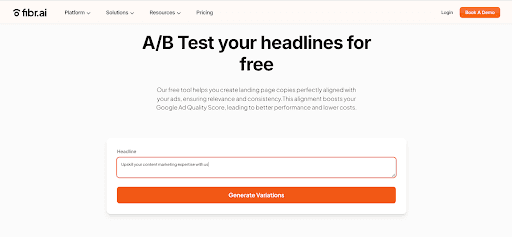
Enter the headline you already have in your mind for your landing page. It's where you set the tone and direction for the variations that our AI tool will generate. Make sure your original headline carries the message you want to relay.
Let’s say we want to get variations for “Upskill your content marketing expertise with us.” You input your headline and press Generate variations.
Step 2: Watch our Headline AI produce variations
Once you have submitted your headline, you are instantly greeted with five optimized variations of the same headline. These variations are developed to maintain the core message of your headline while making it more resonant to the target audience.
For our example, we get these variations:
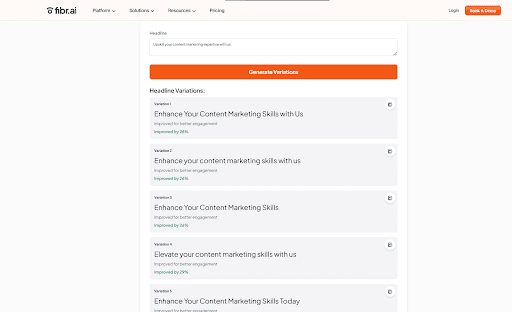
For each variation, you get an estimated engagement improvement percentage. The calculations are based on proven engagement metrics, so you can trust the results.
Step 3: Choose your winning headline
Review the generated variations with their engagement scores. After you choose the most effective AI headline, put it to the test. Integrate it into your landing page ad copy and make it a part of your ad campaign. This consistency also improves your Google Ad Quality Score, which means one thing—lower costs and better overall performance.
Benefits of Using Our AI Headline Generator
Our Headline A/B Tester is a godsend for marketers, advertisers, and business owners. Here are its most prominent benefits:
1 . Improves your Google Ad Quality Score
This score is a metric used by Google to judge the relevance and quality of your ads, keywords, and landing pages. It’s scored on a scale of 1 to 10, with 10 being the best. A higher Quality Score results in lower cost-per-click (CPC) and better ad placements. The score is based on three factors:
Ad relevance: How closely your ad matches the intent behind a user’s search query.
Landing page experience: How relevant, useful, and user-friendly your landing page is.
Expected CTR: How likely are users to click on your ad?
When you produce headline variations that line up perfectly with your ad copy and landing page, you are contributing to relevance and consistency—two of the biggest factors in Google’s quality score algorithm.
Completely free to use
Unlike many marketing tools that come with hefty price tags or hidden fees, our AI Headline A/B Tester is 100% free.
We believe that every business, regardless of size or budget, should have access to high-end tools that drive results.
Saves time and effort
Coming up with the perfect headline takes a lot of time, especially when you’re managing multiple campaigns. Our AI Headline A/B Tester gets rid of the guesswork by automating the process.
Simply input your original headline, and the AI will generate up to five optimized variations in seconds.
Plus, with Fibr’s built-in A/B testing, you don’t have to manually test headlines or analyze data—Fibr does it all for you. This frees up your time to focus on other critical aspects of marketing.
Increases conversion rates
The first thing you see on a landing page is the headline. Naturally, they are a big factor in clicks and conversions.
Our AI Headline A/B tester helps you identify the most engaging headlines through data-backed insights and A/B testing.
When you use headlines that are better appreciated by your target audience, they are subtly manipulated to check out the rest of your page. This makes your CTR and conversion rates soar.
Try Our Headlines AI Now
The bottom line is that our AI headline A/B Tester is a must-have tool for anyone who wants to optimize their ad campaigns and achieve better results. The benefits are clear—better Ad Quality Score, time and cost savings, more conversions, and so on.
Try our Headline AI and see how small changes bring big results in your conversions and campaign performance.
Find answers below
What is Google Ad Quality Score?
Google Ad Quality Score is a metric used by Google to evaluate the relevance and quality of your ads, keywords, and landing pages. A high Quality Score improves ad rankings and can lower your cost-per-click (CPC).
How can I improve my Google Ad Quality Score?
You can improve your Google Ad Quality Score by ensuring that your Google ad copy is relevant to your target keywords and aligned with your landing page content. Optimizing these elements will boost your ad performance and reduce costs.
Does landing page relevance affect my Google Ad Quality Score?
Yes, landing page relevance plays a crucial role in determining your Google Ad Quality Score. The better your landing page aligns with your Google ad copy and user intent, the higher your score, leading to improved ad positioning and lower costs.
How does this tool help improve Google Ad Quality Score?
Our tool helps by analyzing your ad copy, landing page, and keywords, ensuring alignment across all elements. It provides recommendations for optimizing your Google ads ad copy to improve relevance and increase your Quality Score.
Why is a high Google Ad Quality Score important?
A higher Google Ad Quality Score can lead to better ad placement, lower CPC, and improved campaign performance. The more relevant your ads and landing pages are to user queries, the better your overall results.
Is this tool free to use?
Yes, our Google Ad Quality Score tool is completely free to use. You can analyze your ad copy, landing page relevance, and receive suggestions for improvements at no cost.
zz