Read summarized version with
Do you have a WordPress-based landing page or website and want to boost conversions but are confused about where to get started?
This article can help.
Below, we have discussed everything from what WordPress A/B testing is and how it is different from regular A/B testing to the benefits it brings.
You’ll also find a list of the top 5 A/B testing tools for WordPress to help you get started with your experimentation journey.
Key Takeaways:
WordPress A/B testing involves comparing two variations of the same WordPress page to determine which one performs better using WordPress-specific tools or plugins.
WordPress A/B testing is crucial as it helps understand and fix users’ pain points and boost conversions.
Almost every element (which you can modify), including the CTAs, images, forms, pricing, checkout steps, and page copy, can be tested for performance and optimization.
The top 5 tools for WordPress A/B testing include:
Fibr AI- Provides free forever A/B testing to help you run unlimited experiments.
Thrive Optimize – Easy to use with infinite split tests and detailed reporting.
Nelio A/B Testing – Includes heatmaps and works with popular page builders.
VWO – Offers AI-powered testing and advanced features.
OptinMonster – Great for lead generation with A/B testing for forms.
Split Hero – Focuses on simplicity and conversion tracking.
WordPress split testing best practices include gathering insights using Google Analytics, focusing on one element at a time, and tracking the right metrics.
What is WordPress A/B Testing, and How is it Different?
WordPress A/B testing is an experimentation process where you compare two variations of the same WordPress page to determine which one performs better.
To answer how it is different:
If you’ve read articles on “landing page A/B testing,” you must have noticed WordPress is hardly mentioned. Now, this could mean two things:
Either WordPress landing page A/B testing and regular (websites built using custom code) landing page A/B testing the same.
WordPress landing page A/B testing is different (slightly) from regular landing page A/B testing.
To your surprise, the latter is true.
While the fundamental concept of A/B testing (comparing two variations of the same page to identify the best) remains the same, WordPress A/B testing requires a different set of tools.
This is because WordPress sites are built using WordPress (obviously). To run A/B tests, you need to use WordPress-specific tools (plugins).
Because this makes it easier for non-technical users to create, launch and analyze A/B tests within the WordPress environment without coding.
What Can you A/B Test on your WordPress Site?
To answer your question in one sentence, any element on your website that can be changed/modified can be A/B or split-tested.
Here are some examples:
Calls to Action: You can change the color, shape, font, copy, or position of your CTA to determine the best-performing variant.
Contact Form: For contact forms, you can experiment with the number of the form fields, typography, text, or color.
Pricing: The info on your pricing page might impact your visitors’ decision to purchase or try your product. Try adding experimenting with a free trial or a new payment scheme. Or highlight different information to draw users’ attention.
Page Copy: You can tweak your page’s copy by making it more relevant, shorter, or longer to make sure your primary message is delivered to your audience.
Images: Test different images (hero section) on your webpage until you find something that aligns with your brand values.
Checkout Steps: Reducing the checkout steps or making the overall process easier can make a lot of difference.
Now that you know the fundamental difference between WordPress A/B testing and regular landing page A/B testing, let’s explore some WordPress-specific tools.
Top 5 Tested Tools to Make WordPress A/B Testing a Breeze
WordPress A/B testing tools help optimize website performance by testing variations of pages to improve conversion rates. The top 5 tools for WordPress A/B testing include:
Thrive Optimize
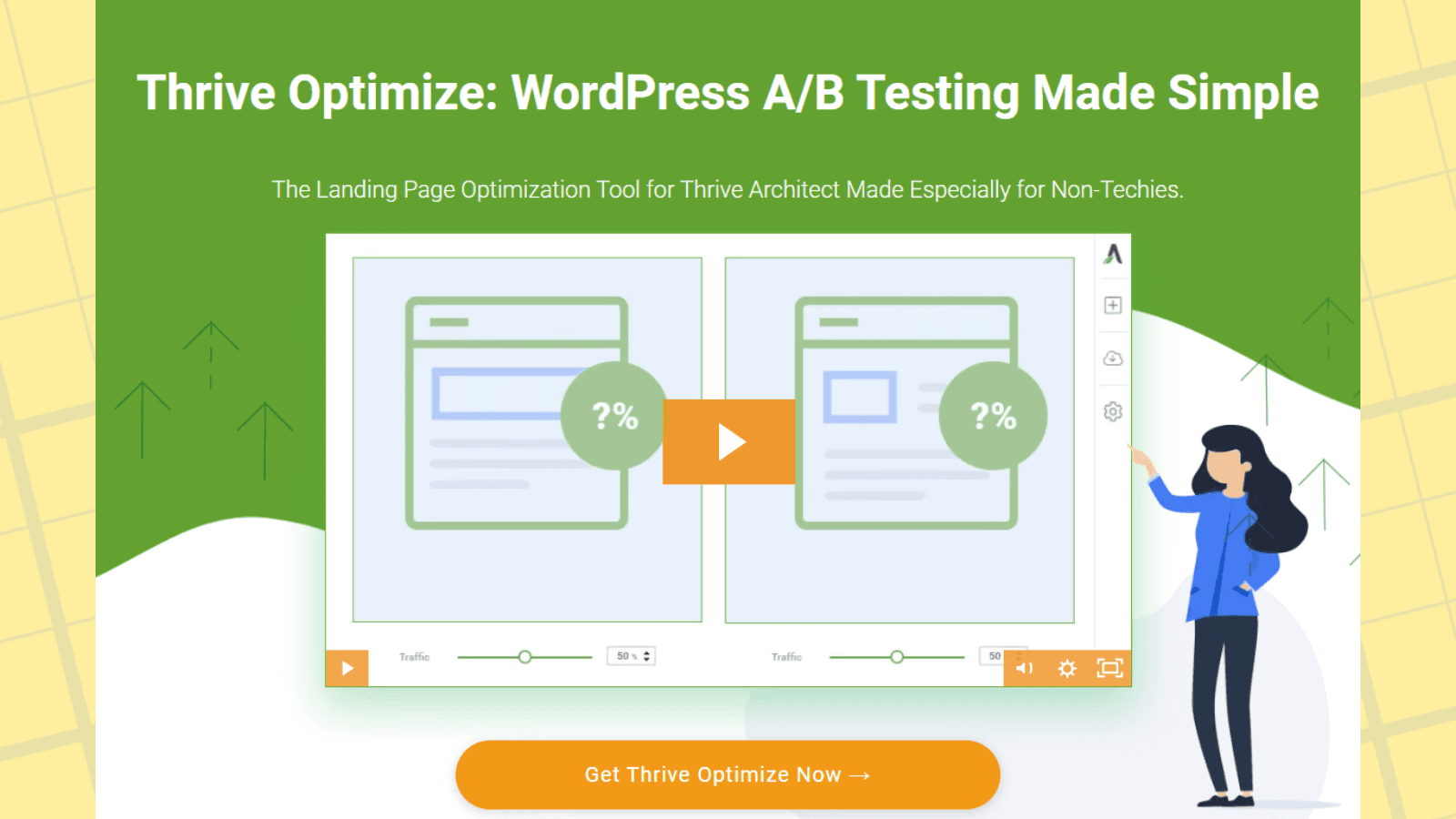
Thrive Optimize is part of the Thrive Theme suite, which offers an easy, fast, and effective way to run WordPress experiments.
You can quickly set up your tests without adding any code snippets to your pages. Here’s what a typical A/B test creation process looks like with Thrive Optimize:
Create a variant page
Edit it using the visual editor
Pick the conversion goal
And start the test
Using Thrive Optimize, you can create as many variations as you want and run infinite tests, which is perfect for continuous improvement. It allows you to split traffic evenly across multiple variations and perform in-depth testing.
The best part?
The entire process of setting up a test, running it, and analyzing the results happens on the WordPress dashboard. You need not switch to a 3rd party app.
P.S. You must have the Thrive Architect page builder plugin installed if you wish to use the Thrive Optimize feature for WordPress testing.
Notable Features
Infinite Split Tests
Visual Editor
Custom Traffic Split
Easy-to-Use (no extra steps involved)
Works Right in your WordPress Dashboard
Detailed Reporting Features
Strong Customer Support
Pricing: It’s a premium solution available between $199-$299 a year.
Fibr AI
Fibr AI is an AI-powered personalization platform that can help you run unlimited experiments on your WordPress site.
You can quickly generate fresh landing pages or create multiple variations (using the visual editor) and start running A/B tests without coding expertise.
Also, Fibr AI’s A/B testing tool allows traffic split and traffic allocation, enabling accurate and more in-depth testing. With its robust analytics, you can analyze conversion rates, confidence levels, and probability values and ensure that the results are statistically significant.
Notable Features
Personalization: Fibr AI allows you to personalize landing pages for all your audiences across different platforms (Meta, TikTok, Google ads) based on traffic source, device type, age, gender, etc. This helps deliver a more relevant and personalized experience to your visitors.
Bulk Landing Page creation: You can create 1000s of landing pages in 30 minutes using Fibr without relying on the tech team. This enables faster and more frequent testing.
Creating Variations: Creating landing page variations is extremely easy with Fibr AI’s visual editor. For web copy, CTA, or headline text, the AI engine offers you high-converting recommendations, allowing you to create more effective landing page variations quickly.
A/B Testing: Once your variations are ready, you can launch unlimited A/B tests with our AI AB Testing platform. Also, Fibr AI’s A/B testing tool ensures the tests are statistically significant, enabling more effective optimizations.
Pricing: Comes with a 30-day free trial that allows you to experiment with up to 10,000 views per month. If you wish to test more than 10,000 views per month, you may have to request a free quote.
Nelio A/B Testing
Nelio A/B Testing is a great WordPress plugin that you can use to run easy and complex A/B, split URL, and multivariate tests.
You can test your landing pages, WooCommerce products, themes, menus, CSS rules, and even widgets. Nelio A/B testing also has a heatmap tool that can help you better understand user behavior.
With Nelio A/B testing, you can create landing page variations using the WordPress editor.
Once the test concludes, you can see detailed reports, making the analysis a breeze. Also, you can apply changes winning variant to your site with a single click.
Active Installations: 3,000+
Ratings: 4.7 out of 5 stars
Notable Features
Heatmap
Scrollmap
Confetti
Global Consistency
Compatibility with Popular Page Builders
Pricing: A free plan is available for up to 500 page views per month. And the paid plans start from $49 a month.
VWO (Visual Website Optimizer)
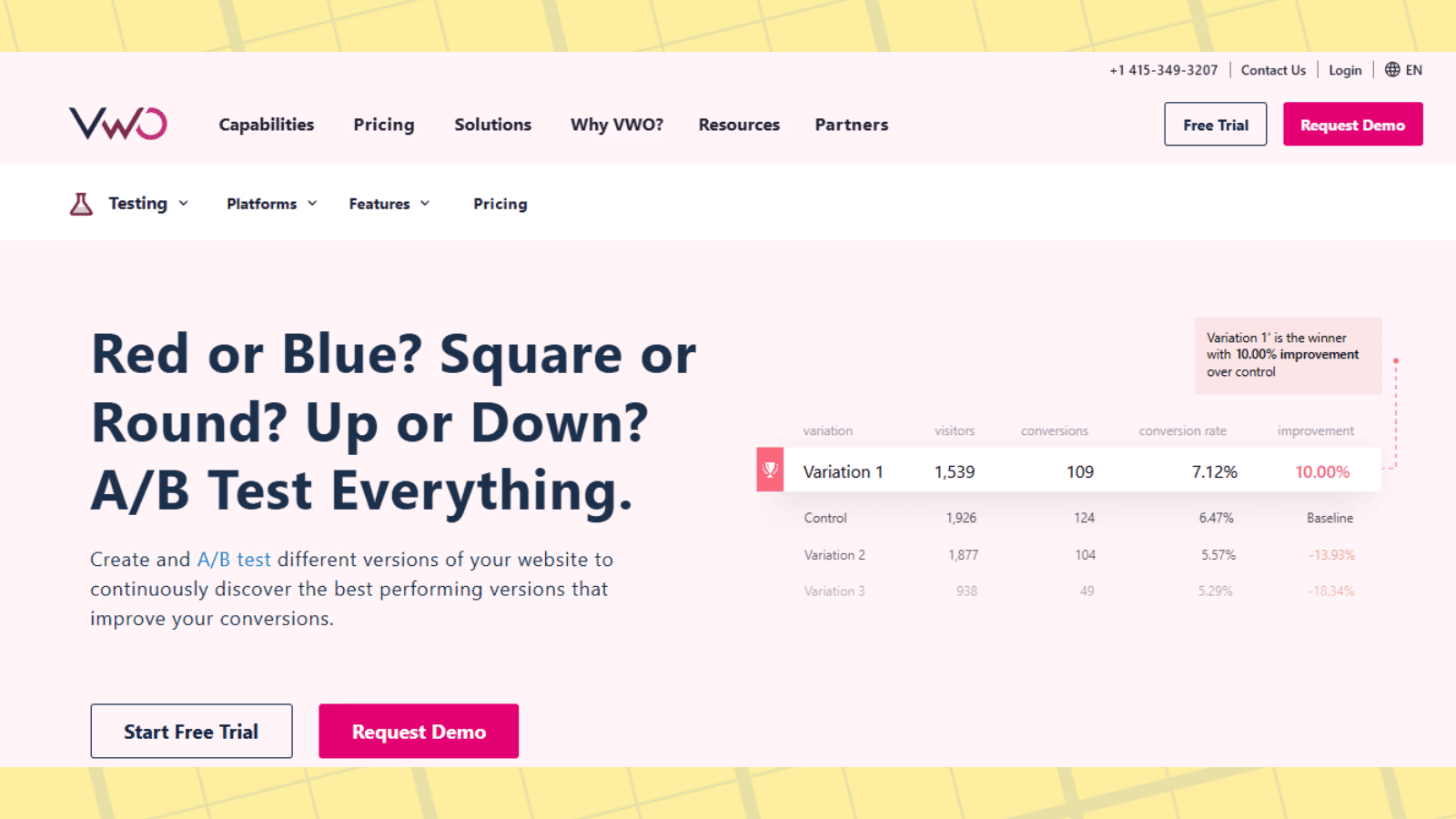
VWO is a popular behavioral testing and A/B testing platform that you can use to perform web, mobile app, and server-side testing. It also comes with a special plugin meant for testing websites built using WordPress.
Thanks to its visual editor and AI-powered copy generator, you can quickly create page variations and get started with experimentation. Also, if you know coding, you can use their code editor to run more advanced tests.
Active Installations: 5,000+
Ratings: 3 out of 5 stars
Notable Features
Visual Editor
Code Editor
Customizable Reports
Split URL Testing
Multi Arm Bandit
Pricing: While VWO comes with a free plan, to access more advanced features, you may have to upgrade to premium plans starting at around $267 per month.
P.S. VWO primarily targets enterprise businesses.
OptinMonster
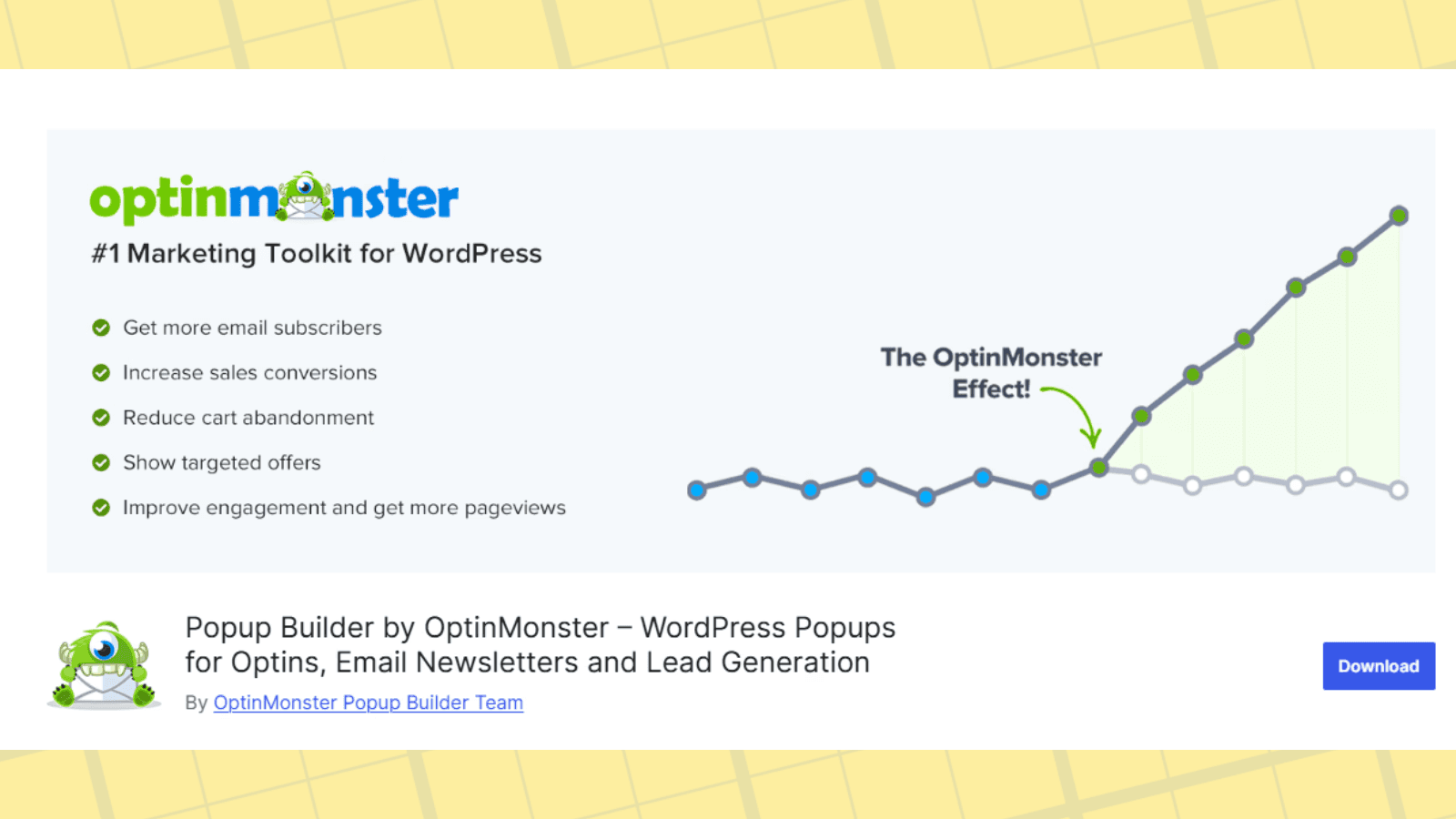
Although OptinMonster is a marketing tool for sending email newsletters and generating leads, it comes with an A/B testing feature to help you boost conversions for your marketing campaigns.
To test forms on WordPress, you’d need the WPForms plugin and OptinMonster. Once you set up both these plugins, you can create a variant using OptinMonster’s visual editor and determine which performs better.
Using OptinMonster’s A/B testing feature, you can track the impressions of the form, the leads generated, and the conversion rate.
Active Installations: 1M+
Ratings: 4.3 out of 5 stars
Notable Features:
Easy-to-use
Decent tracking features (helps identify the popup banners with the potential to convert abandoning site visitors into customers)
Pricing: OptinMonster is an affordable tool, starting at just $7 a month, considering the features it comes with.
Split Hero
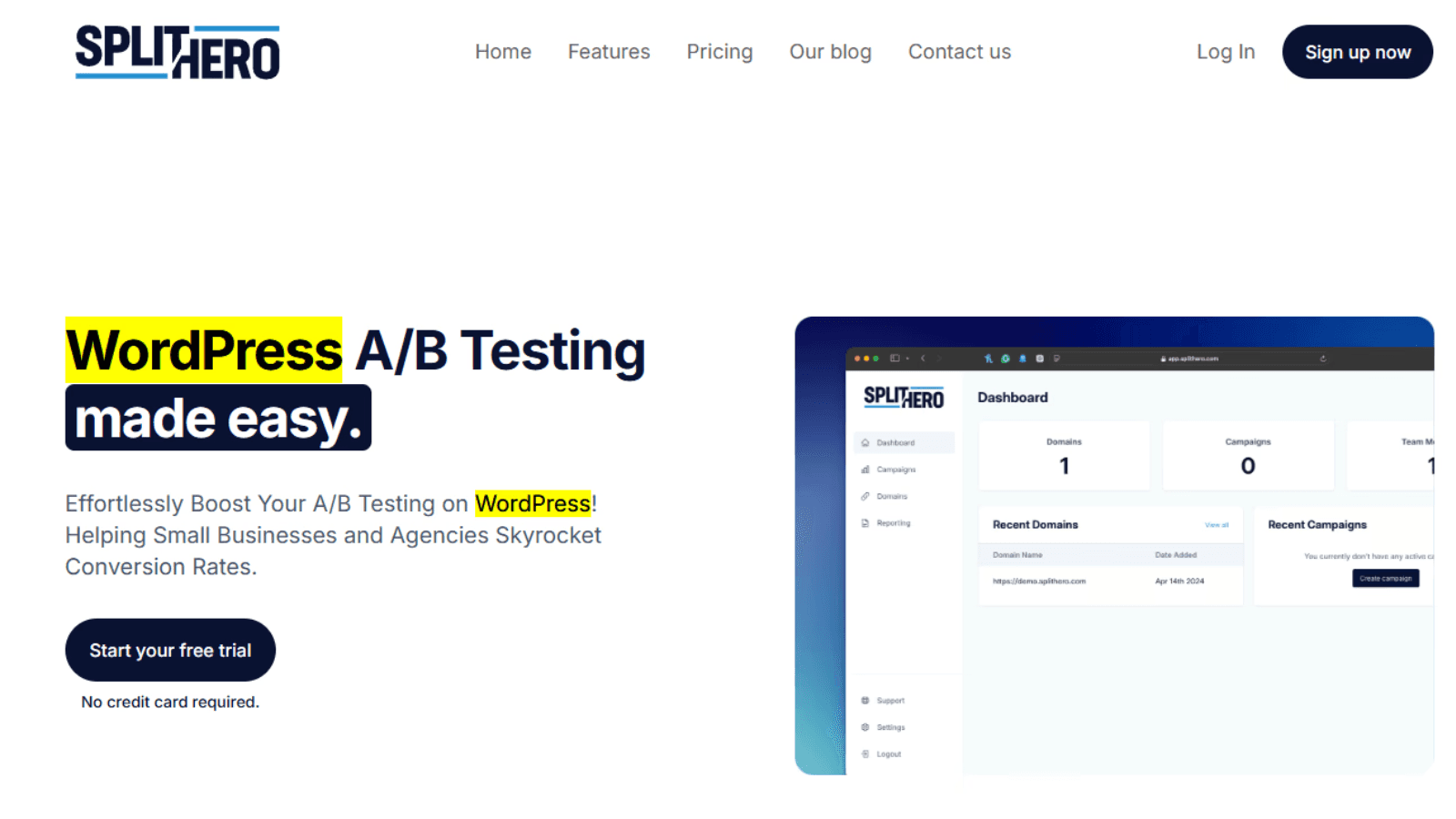
Split Hero is another great tool that specializes in WordPress A/B testing. Whether you’re a startup or an established business, you can use Split Hero to test headlines, CTAs, images, and other elements and boost your conversion rates.
Split Hero lets you set up conversion goals, track user behavior, and analyze the test reports to understand how well your split tests are doing.
Notable Features:
Easy-to-use
Supports Integration with Multiple Page Builders
No-code Editor for Creating Variations
Suited for both Small Agencies and Established Businesses
WordPress A/B Testing Best Practices
Here are some WordPress A/B testing best practices to keep in mind:
1.Connect WordPress with Google Analytics
One of the first things you should do before starting A/B testing is connect your WordPress site with Google Analytics. This is to help you gather quantitative data on your website and understand how your website is presently performing.
In addition to Google Analytics, you can also connect other tools for capturing heatmaps, scrollmaps, movemaps, and customer feedback. This will help you dive deep into your user behavior.
When you have the right data, creating an action plan (hypothesis) and variations becomes easy.
2. Focus on One Element at a Time
When testing, you may want to test multiple variables at the same time. However, that’s not a great practice, especially if you’re starting out.
Why? Here’s an example
Say you create two variations of your landing page. In the test variant, you change the color of the CTA, the headline copy, and the hero image as well. When the test concludes, you find out that the test variant performed well.
Now, what change would you link to the positive results? The CTA, headline, image, or all of them?
On the other hand, if you test one element at a time, you can determine if modifying that element led to a change or not.
3.Choose the Right Metrics
You need to choose the metrics that are most relevant to your goals.
Let’s say your goal is to increase sales on your eCommerce store. Based on this goal, your primary metrics would be cart abandonment rate, bounce rate, or conversion rate.
When you track these metrics, you can determine if your hypothesis was right or if you need to create a new one. Moreover, choosing the right metrics helps you identify the right WordPress A/B testing tool. After all, what use is a tool if it doesn’t track the metrics crucial for your business?
Wrapping Up
Now that you know what WordPress A/B testing is and the best tools for WordPress split testing, you can start experimenting right now. However, make sure to be consistent, as A/B testing is a continuous process. The more tests you run, the more growth opportunities you discover. And this eventually translates to conversions if that’s your end goal.
FAQs
Can you do AB testing on WordPress?
Yes, you can do A/B testing on WordPress, just like any other website. However, you must know that not all tools will support A/B testing on sites built using WordPress. But there are plenty that do. And we have mentioned them above in this article.
Does WordPress have analytics?
Yes, all WordPress.com sites come with a built-in analytics solution called Jetpack Stats. Using this tool, you can check how much traffic your site is getting, where it is coming from, and which content is getting the most views.
Is WordPress used professionally?
Yes, WordPress is a pretty reliable and flexible platform for building professional websites. In fact, this CMS is behind 40% of the total websites online. Some popular examples include Sony Music, Microsoft News, Walt Disney Company, and more.





Pritam Roy
Co-Founder @ Fibr AI
Pritam Roy, the Co-founder of Fibr, is a seasoned entrepreneur with a passion for product development and AI. A graduate of IIT Bombay, Pritam's expertise lies in leveraging technology to create innovative solutions. As a second-time founder, he brings invaluable experience to Fibr, driving the company towards its mission of redefining digital interactions through AI.
Read summarized version with
Do you have a WordPress-based landing page or website and want to boost conversions but are confused about where to get started?
This article can help.
Below, we have discussed everything from what WordPress A/B testing is and how it is different from regular A/B testing to the benefits it brings.
You’ll also find a list of the top 5 A/B testing tools for WordPress to help you get started with your experimentation journey.
Key Takeaways:
WordPress A/B testing involves comparing two variations of the same WordPress page to determine which one performs better using WordPress-specific tools or plugins.
WordPress A/B testing is crucial as it helps understand and fix users’ pain points and boost conversions.
Almost every element (which you can modify), including the CTAs, images, forms, pricing, checkout steps, and page copy, can be tested for performance and optimization.
The top 5 tools for WordPress A/B testing include:
Fibr AI- Provides free forever A/B testing to help you run unlimited experiments.
Thrive Optimize – Easy to use with infinite split tests and detailed reporting.
Nelio A/B Testing – Includes heatmaps and works with popular page builders.
VWO – Offers AI-powered testing and advanced features.
OptinMonster – Great for lead generation with A/B testing for forms.
Split Hero – Focuses on simplicity and conversion tracking.
WordPress split testing best practices include gathering insights using Google Analytics, focusing on one element at a time, and tracking the right metrics.
What is WordPress A/B Testing, and How is it Different?
WordPress A/B testing is an experimentation process where you compare two variations of the same WordPress page to determine which one performs better.
To answer how it is different:
If you’ve read articles on “landing page A/B testing,” you must have noticed WordPress is hardly mentioned. Now, this could mean two things:
Either WordPress landing page A/B testing and regular (websites built using custom code) landing page A/B testing the same.
WordPress landing page A/B testing is different (slightly) from regular landing page A/B testing.
To your surprise, the latter is true.
While the fundamental concept of A/B testing (comparing two variations of the same page to identify the best) remains the same, WordPress A/B testing requires a different set of tools.
This is because WordPress sites are built using WordPress (obviously). To run A/B tests, you need to use WordPress-specific tools (plugins).
Because this makes it easier for non-technical users to create, launch and analyze A/B tests within the WordPress environment without coding.
What Can you A/B Test on your WordPress Site?
To answer your question in one sentence, any element on your website that can be changed/modified can be A/B or split-tested.
Here are some examples:
Calls to Action: You can change the color, shape, font, copy, or position of your CTA to determine the best-performing variant.
Contact Form: For contact forms, you can experiment with the number of the form fields, typography, text, or color.
Pricing: The info on your pricing page might impact your visitors’ decision to purchase or try your product. Try adding experimenting with a free trial or a new payment scheme. Or highlight different information to draw users’ attention.
Page Copy: You can tweak your page’s copy by making it more relevant, shorter, or longer to make sure your primary message is delivered to your audience.
Images: Test different images (hero section) on your webpage until you find something that aligns with your brand values.
Checkout Steps: Reducing the checkout steps or making the overall process easier can make a lot of difference.
Now that you know the fundamental difference between WordPress A/B testing and regular landing page A/B testing, let’s explore some WordPress-specific tools.
Top 5 Tested Tools to Make WordPress A/B Testing a Breeze
WordPress A/B testing tools help optimize website performance by testing variations of pages to improve conversion rates. The top 5 tools for WordPress A/B testing include:
Thrive Optimize
Thrive Optimize is part of the Thrive Theme suite, which offers an easy, fast, and effective way to run WordPress experiments.
You can quickly set up your tests without adding any code snippets to your pages. Here’s what a typical A/B test creation process looks like with Thrive Optimize:
Create a variant page
Edit it using the visual editor
Pick the conversion goal
And start the test
Using Thrive Optimize, you can create as many variations as you want and run infinite tests, which is perfect for continuous improvement. It allows you to split traffic evenly across multiple variations and perform in-depth testing.
The best part?
The entire process of setting up a test, running it, and analyzing the results happens on the WordPress dashboard. You need not switch to a 3rd party app.
P.S. You must have the Thrive Architect page builder plugin installed if you wish to use the Thrive Optimize feature for WordPress testing.
Notable Features
Infinite Split Tests
Visual Editor
Custom Traffic Split
Easy-to-Use (no extra steps involved)
Works Right in your WordPress Dashboard
Detailed Reporting Features
Strong Customer Support
Pricing: It’s a premium solution available between $199-$299 a year.
Fibr AI
Fibr AI is an AI-powered personalization platform that can help you run unlimited experiments on your WordPress site.
You can quickly generate fresh landing pages or create multiple variations (using the visual editor) and start running A/B tests without coding expertise.
Also, Fibr AI’s A/B testing tool allows traffic split and traffic allocation, enabling accurate and more in-depth testing. With its robust analytics, you can analyze conversion rates, confidence levels, and probability values and ensure that the results are statistically significant.
Notable Features
Personalization: Fibr AI allows you to personalize landing pages for all your audiences across different platforms (Meta, TikTok, Google ads) based on traffic source, device type, age, gender, etc. This helps deliver a more relevant and personalized experience to your visitors.
Bulk Landing Page creation: You can create 1000s of landing pages in 30 minutes using Fibr without relying on the tech team. This enables faster and more frequent testing.
Creating Variations: Creating landing page variations is extremely easy with Fibr AI’s visual editor. For web copy, CTA, or headline text, the AI engine offers you high-converting recommendations, allowing you to create more effective landing page variations quickly.
A/B Testing: Once your variations are ready, you can launch unlimited A/B tests with our AI AB Testing platform. Also, Fibr AI’s A/B testing tool ensures the tests are statistically significant, enabling more effective optimizations.
Pricing: Comes with a 30-day free trial that allows you to experiment with up to 10,000 views per month. If you wish to test more than 10,000 views per month, you may have to request a free quote.
Nelio A/B Testing
Nelio A/B Testing is a great WordPress plugin that you can use to run easy and complex A/B, split URL, and multivariate tests.
You can test your landing pages, WooCommerce products, themes, menus, CSS rules, and even widgets. Nelio A/B testing also has a heatmap tool that can help you better understand user behavior.
With Nelio A/B testing, you can create landing page variations using the WordPress editor.
Once the test concludes, you can see detailed reports, making the analysis a breeze. Also, you can apply changes winning variant to your site with a single click.
Active Installations: 3,000+
Ratings: 4.7 out of 5 stars
Notable Features
Heatmap
Scrollmap
Confetti
Global Consistency
Compatibility with Popular Page Builders
Pricing: A free plan is available for up to 500 page views per month. And the paid plans start from $49 a month.
VWO (Visual Website Optimizer)
VWO is a popular behavioral testing and A/B testing platform that you can use to perform web, mobile app, and server-side testing. It also comes with a special plugin meant for testing websites built using WordPress.
Thanks to its visual editor and AI-powered copy generator, you can quickly create page variations and get started with experimentation. Also, if you know coding, you can use their code editor to run more advanced tests.
Active Installations: 5,000+
Ratings: 3 out of 5 stars
Notable Features
Visual Editor
Code Editor
Customizable Reports
Split URL Testing
Multi Arm Bandit
Pricing: While VWO comes with a free plan, to access more advanced features, you may have to upgrade to premium plans starting at around $267 per month.
P.S. VWO primarily targets enterprise businesses.
OptinMonster
Although OptinMonster is a marketing tool for sending email newsletters and generating leads, it comes with an A/B testing feature to help you boost conversions for your marketing campaigns.
To test forms on WordPress, you’d need the WPForms plugin and OptinMonster. Once you set up both these plugins, you can create a variant using OptinMonster’s visual editor and determine which performs better.
Using OptinMonster’s A/B testing feature, you can track the impressions of the form, the leads generated, and the conversion rate.
Active Installations: 1M+
Ratings: 4.3 out of 5 stars
Notable Features:
Easy-to-use
Decent tracking features (helps identify the popup banners with the potential to convert abandoning site visitors into customers)
Pricing: OptinMonster is an affordable tool, starting at just $7 a month, considering the features it comes with.
Split Hero
Split Hero is another great tool that specializes in WordPress A/B testing. Whether you’re a startup or an established business, you can use Split Hero to test headlines, CTAs, images, and other elements and boost your conversion rates.
Split Hero lets you set up conversion goals, track user behavior, and analyze the test reports to understand how well your split tests are doing.
Notable Features:
Easy-to-use
Supports Integration with Multiple Page Builders
No-code Editor for Creating Variations
Suited for both Small Agencies and Established Businesses
WordPress A/B Testing Best Practices
Here are some WordPress A/B testing best practices to keep in mind:
1.Connect WordPress with Google Analytics
One of the first things you should do before starting A/B testing is connect your WordPress site with Google Analytics. This is to help you gather quantitative data on your website and understand how your website is presently performing.
In addition to Google Analytics, you can also connect other tools for capturing heatmaps, scrollmaps, movemaps, and customer feedback. This will help you dive deep into your user behavior.
When you have the right data, creating an action plan (hypothesis) and variations becomes easy.
2. Focus on One Element at a Time
When testing, you may want to test multiple variables at the same time. However, that’s not a great practice, especially if you’re starting out.
Why? Here’s an example
Say you create two variations of your landing page. In the test variant, you change the color of the CTA, the headline copy, and the hero image as well. When the test concludes, you find out that the test variant performed well.
Now, what change would you link to the positive results? The CTA, headline, image, or all of them?
On the other hand, if you test one element at a time, you can determine if modifying that element led to a change or not.
3.Choose the Right Metrics
You need to choose the metrics that are most relevant to your goals.
Let’s say your goal is to increase sales on your eCommerce store. Based on this goal, your primary metrics would be cart abandonment rate, bounce rate, or conversion rate.
When you track these metrics, you can determine if your hypothesis was right or if you need to create a new one. Moreover, choosing the right metrics helps you identify the right WordPress A/B testing tool. After all, what use is a tool if it doesn’t track the metrics crucial for your business?
Wrapping Up
Now that you know what WordPress A/B testing is and the best tools for WordPress split testing, you can start experimenting right now. However, make sure to be consistent, as A/B testing is a continuous process. The more tests you run, the more growth opportunities you discover. And this eventually translates to conversions if that’s your end goal.
FAQs
Can you do AB testing on WordPress?
Yes, you can do A/B testing on WordPress, just like any other website. However, you must know that not all tools will support A/B testing on sites built using WordPress. But there are plenty that do. And we have mentioned them above in this article.
Does WordPress have analytics?
Yes, all WordPress.com sites come with a built-in analytics solution called Jetpack Stats. Using this tool, you can check how much traffic your site is getting, where it is coming from, and which content is getting the most views.
Is WordPress used professionally?
Yes, WordPress is a pretty reliable and flexible platform for building professional websites. In fact, this CMS is behind 40% of the total websites online. Some popular examples include Sony Music, Microsoft News, Walt Disney Company, and more.
Pritam Roy
Co-Founder @ Fibr AI
Pritam Roy, the Co-founder of Fibr, is a seasoned entrepreneur with a passion for product development and AI. A graduate of IIT Bombay, Pritam's expertise lies in leveraging technology to create innovative solutions. As a second-time founder, he brings invaluable experience to Fibr, driving the company towards its mission of redefining digital interactions through AI.