7 Best Tools for A/B Testing Personalized Landing Pages

Ankur Goyal
Aug 16, 2024
Dec 10, 2025

Table of Content
Read summarized version with
Introduction
Do you ever wonder why some landing pages convert like clockwork while others barely register? The difference is rarely the design. In 2026, it is almost always personalization combined with structured A/B testing: the discipline of running controlled experiments on audience-specific page experiences to learn what actually drives conversions for each visitor segment.
A/B testing, sometimes called split testing, involves comparing two versions of the same page to determine which one performs better. When applied to personalization, it answers a far more valuable question: which version of a tailored experience converts best for a specific audience?
The scale of the opportunity is significant. According to McKinsey's 2025 Personalization Report, 71% of consumers expect personalized interactions, and 76% report frustration when pages feel generic. CXL Institute research shows companies running continuous A/B testing on personalized pages see 20 to 30% higher conversion rates compared to static pages. And according to the Forrester Wave: Experience Optimization Platforms Q1 2026, AI-assisted personalization testing has compressed average time-to-significance from four weeks to under ten days for high-traffic campaigns.
Not every platform handles personalization testing equally. The right A/B testing software must go beyond simple traffic splitting. It needs to support audience segmentation, dynamic content variants, and real-time analytics without requiring a developer for every experiment. This guide covers the 7 best tools to get you there.
What is A/B testing?
A/B testing is a method for comparing two versions of a webpage, app feature, or campaign to determine which performs better. It works by showing version A to one group of users and version B to another, then measuring which one drives more clicks, sign-ups, or sales.
You can test anything from headlines and buttons to layouts and pricing. The idea is simple: make decisions based on real user behavior, not assumptions.
The process starts with a question or assumption. You might wonder if a shorter form will generate more leads or if a new image will encourage people to stay longer on a page. From there, you:
Choose one variable to test. Keeping one change at a time helps you see what really made the difference.
Split your audience randomly into two or more groups so each version gets a fair test.
Run the test for a sufficient amount of time to collect enough data. Ending too soon can give misleading results.
Measure results using clear metrics like conversion rate, bounce rate, and click-throughs.
Pick the winning version and apply the change. Then plan your next test.
In simple terms, A/B testing is a loop of learning. Each test gives you clear insights into what your users prefer and how they respond. The more you test, the better your understanding of your audience becomes. Over time, these small, data-backed changes lead to stronger engagement, higher sales, and happier users.
Why A/B Testing Matters for Personalized Landing Pages
A/B testing is more than a marketing buzzword. It is a dynamic landing page strategy that turns assumptions into validated insights. A disciplined testing program sits at the heart of every effective conversion rate optimization strategy, and its value compounds with every experiment you complete.
1. Increases Conversion Rates
The benefits of A/B testing compound over time. Personalized pages that are continuously tested deliver 20 to 30% higher conversion rates than static equivalents, which translates directly into lower cost per acquisition and higher return on ad spend.
2. Reduces Bounce Rate
A high bounce rate signals a message mismatch between what the visitor expected and what the page delivered. Personalized pages reduce this gap by default, and A/B testing validates which personalized variant best matches each segment's intent. Continuously refining your landing page optimization approach compounds these gains across every campaign cycle.
3. Alleviates User Pain Points
Every visitor arrives with a specific goal. A/B testing helps surface and eliminate the friction points standing between them and conversion. Aligning on website personalization strategies before building test variants grounds your hypothesis building in real audience data. In 2026, behavioral signal data from CDPs and ad platforms provides richer inputs for hypothesis generation than ever before.
4. Increases Engagement and Pipeline Quality
Not every visitor converts on the first visit. A/B testing identifies which personalized experiences drive micro-conversions that feed future pipeline. In 2026, AI audience segmentation has made it possible to define and test micro-segments that were previously too small or too complex to serve individually, unlocking engagement opportunities that generic testing programs completely miss.
Leading Software for A/B Testing Personalized Landing Pages
Choosing the right platform to run A/B tests on personalized landing pages is the single most consequential infrastructure decision a performance marketing team makes in 2026. The wrong tool gives you traffic splits without segment context. The right tool gives you validated, audience-specific insights that compound with every experiment you run.
What separates the leading software for A/B testing personalized landing pages from generic testing tools comes down to five core capabilities:
Audience segmentation and traffic routing: The platform must define a specific visitor cohort by traffic source, industry, behavioral signal, funnel stage, or geography and route only that cohort into a test.
Dynamic content variants: Each version of the page must be able to serve a different headline, image, CTA, or copy block tailored to that segment without developer involvement for every build.
Segment-level statistical reporting: Results must be reported per segment rather than blended across all traffic, otherwise the insights are too averaged to act on meaningfully.
Paid traffic source integration: The platform must connect natively to Google Ads and Meta so ad-level performance data can inform and align with landing page experiment results.
AI-driven automation: In 2026, leading platforms use AI for hypothesis generation, agentic test deployment, and LLM visitor detection that triggers personalized experiences for traffic from AI assistants such as ChatGPT, Perplexity, and Gemini.
The market in 2026 is clearly stratified across three tiers. Understanding where your team sits in that landscape is the starting point for choosing the right platform.
Tier 1: Purpose-built personalization experimentation platforms: Designed for teams running high-volume paid campaigns across segmented audiences. These platforms treat personalization as the starting point, not an add-on. Fibr AI leads this category.
Tier 2: Enterprise experimentation suites: Handle personalization among many other testing use cases. Strong on analytics depth and enterprise integrations, but require more technical resource for deep personalization work. Optimizely and VWO sit here.
Tier 3: No-code and entry-level tools: Offer basic variant testing with limited segment specificity and fast deployment. Best suited to SMBs and agencies running simpler campaign structures. Unbounce Smart Traffic leads here.
A key consideration when evaluating these platforms is developer dependency. In 2023, most meaningful A/B testing on personalized pages required engineering support to build variants, configure traffic routing, and integrate analytics. In 2026, the leading platforms have eliminated this dependency for the majority of use cases. Marketers can now build segment-specific variants, configure routing rules, set success metrics, and review segment-level results without writing a single line of code.Privacy compliance has also become a defining feature. With third-party cookie deprecation now complete, every platform reviewed below has adapted its segmentation and tracking infrastructure to operate on first-party data, on-device processing, or consent-managed behavioral signals. Key questions to ask any vendor during evaluation:
Does the platform operate without third-party cookies by default?
Is visitor data processed on-device or server-side?
Does the platform support granular consent signal integration with your CMP?
Is the platform certified for GDPR, CCPA, and HIPAA compliance?
Finally, the integration between A/B testing for ads and landing page personalization testing has matured significantly. The platforms that lead in 2026 connect ad campaign performance data directly to landing page experiments, closing the loop between which ad creative generated which visitor segment and which personalized page variant converted that segment best. This closed-loop approach is what enables teams to consistently improve both ad quality scores and landing page conversion rates as compounding outcomes of a single coordinated testing program.
How to Evaluate Leading A/B Testing Software for Personalized Landing Pages
Personalization depth: Can the platform segment traffic by specific audience attributes and serve genuinely different page experiences to each segment?
No-code deployment: Can marketers build, configure, and launch personalization tests without engineering support?
Segment-level reporting: Does the platform report statistical significance and conversion metrics per segment, not just across all traffic?
Paid traffic integration: Does the platform connect natively to Google Ads and Meta to align ad-level and landing page experiments?
AI and automation: Does the platform use AI to generate hypotheses, detect visitor intent, deploy variants autonomously, and accelerate time-to-significance?
Privacy compliance: Does the platform operate on first-party data and on-device processing without relying on deprecated third-party cookies?
7 Best Software Tools for A/B Testing Personalized Landing Pages in 2026
The following seven platforms lead the category in 2026, evaluated across the criteria above. Each overview includes what the platform does best, its 2026-specific capability update, and a clear best-fit use case.
Fibr AI Best for AI-Driven Personalization A/B Testing at Scale
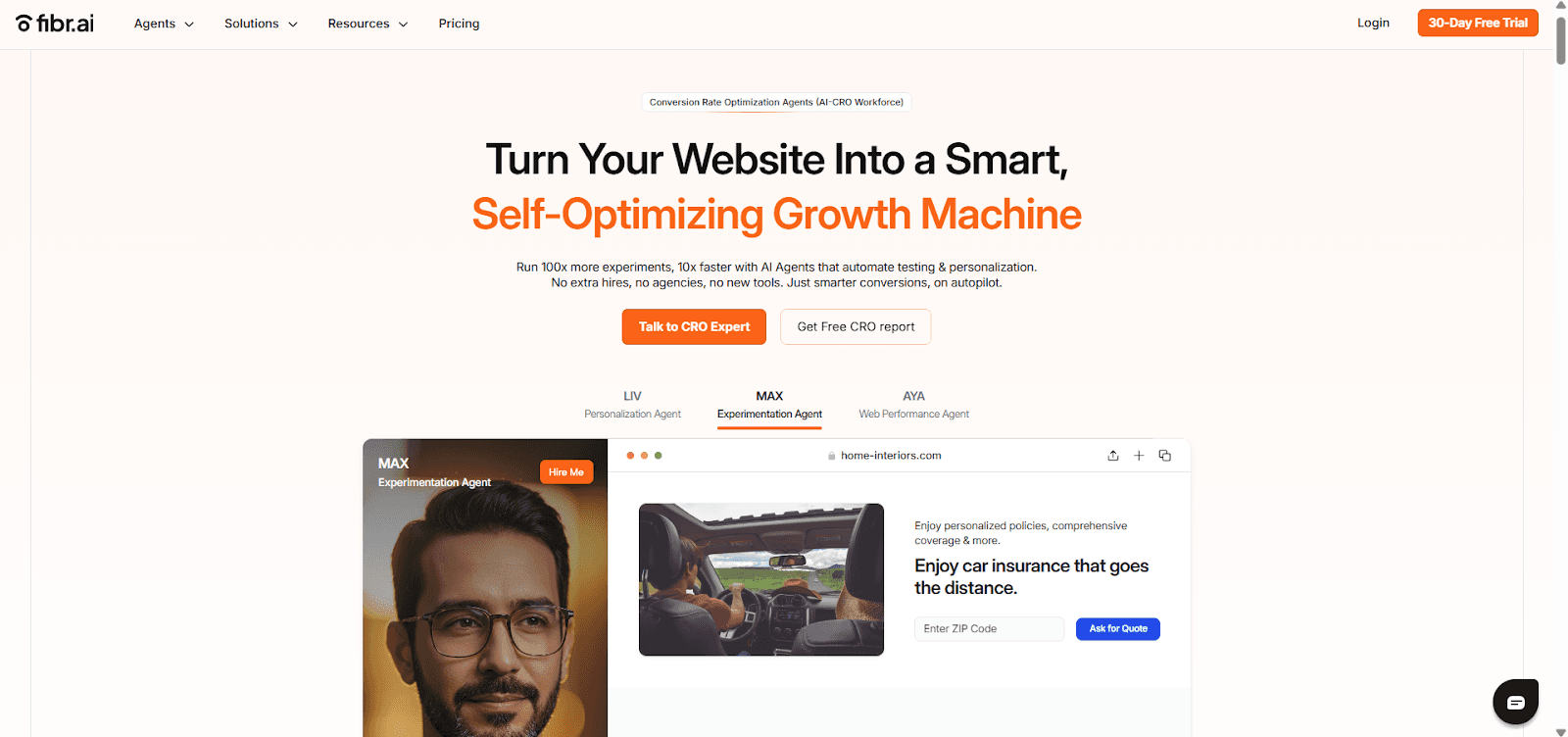
Fibr AI purpose-built for audience personalization and experimentation at scale. Unlike general-purpose A/B testing tools, Fibr.ai's experimentation platform runs A/B tests on personalized landing page experiences segmented by traffic source, industry, behavioral signal, or geography without any developer involvement.
What makes Fibr AI stand out in 2026:
Agentic personalization: Fully autonomous experiment generation informed by session data and ad group performance, launched in early 2026.
LLM-based personalization: AI-generated page variants tailored to visitor intent signals in real time, including traffic from ChatGPT and Perplexity.
Ad-to-page message match: Fibr.ai's ad personalization layer ensures Google Search and Meta traffic lands on pages that match the exact ad creative, then tests which personalized variant converts best.
Quality score uplift: Campaigns connecting Google Search ad personalization with Fibr AI see direct improvements in Google ad quality score as a compounding outcome of better message match.
Customer results show teams achieving 20 to 40% conversion rate improvements within the first 90 days of deploying Fibr.ai's personalization testing program.
Best for: Growth and performance marketing teams running personalized campaigns across paid channels at scale without a developer.
Unbounce Smart Traffic Best for No-Code Landing Page Testing
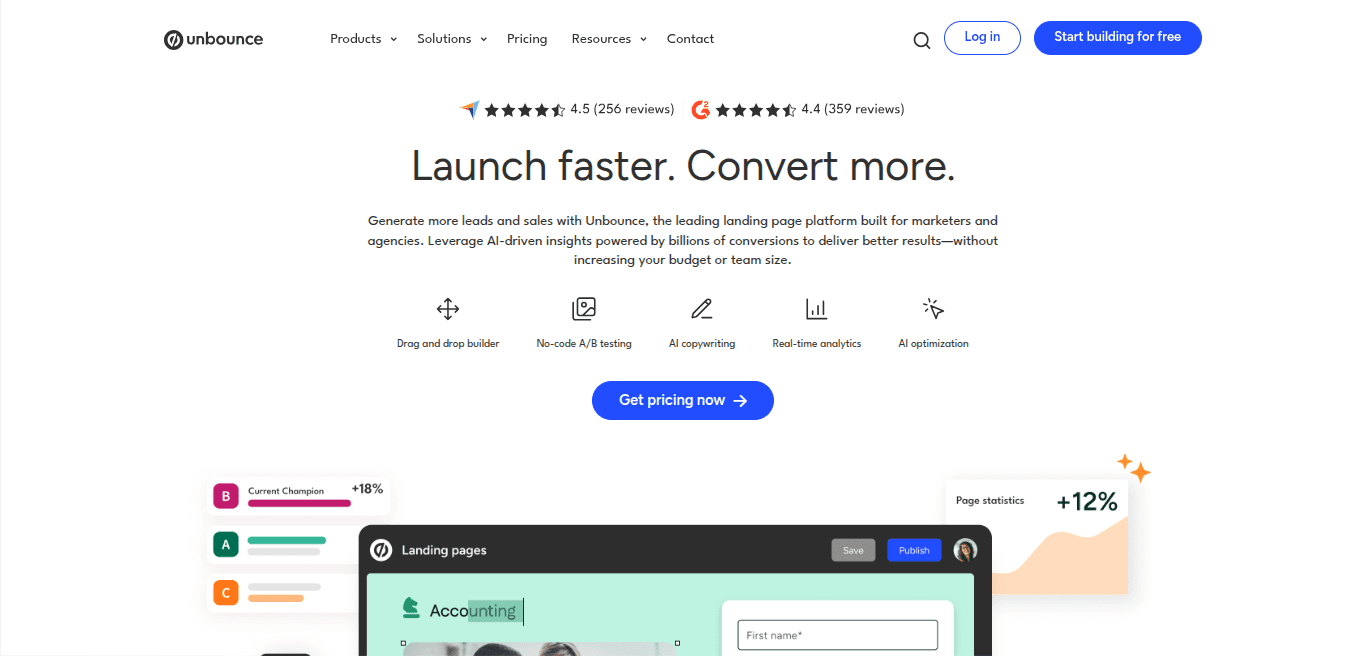
Unbounce combines a landing page builder with a built-in AI traffic optimization engine that automatically routes visitors to the variant most likely to convert based on device, location, time of day, and referral source.
2026 updates and key strengths:
AI Copywriting layer integrated directly into the builder in 2026, enabling marketers to generate and test personalized copy variants without leaving the platform.
Fastest-to-deploy option for teams wanting no-code landing page A/B testing without complex configuration.
Consistently ranks highest on ease of setup among top landing page builders evaluated for SMBs and agencies.
Personalization remains primarily attribute-based routing rather than deep audience-segment experimentation, making it better suited to simpler campaign structures.
Best for: SMBs and agencies needing fast, no-code landing page testing with integrated AI traffic optimization and built-in copywriting.
Optimizely Best for Full-Stack Enterprise Experimentation
Optimizely is the gold standard for enterprise-scale web and product experimentation, covering feature flagging, web experimentation, and full-stack testing across web, mobile app, and server-side environments simultaneously.
2026 updates and key strengths:
Experiment Intelligence layer released in 2026 uses machine learning to prioritize experiments by predicted revenue impact.
Automatically surfaces anomalies in live test results before they affect campaign performance.
Most powerful for organizations with dedicated product engineering teams running cross-channel experiments.
Can be over-engineered for paid traffic teams focused purely on landing page personalization without engineering support.
The Fibr AI Optimizely comparison shows where a personalization-first platform outperforms a full-stack suite for campaign-level landing page work.
Best for: Large enterprises running cross-channel and full-stack experimentation programs with dedicated product engineering teams.Ratings.
VWO (Visual Website Optimizer) Best for Enterprise CRO Teams
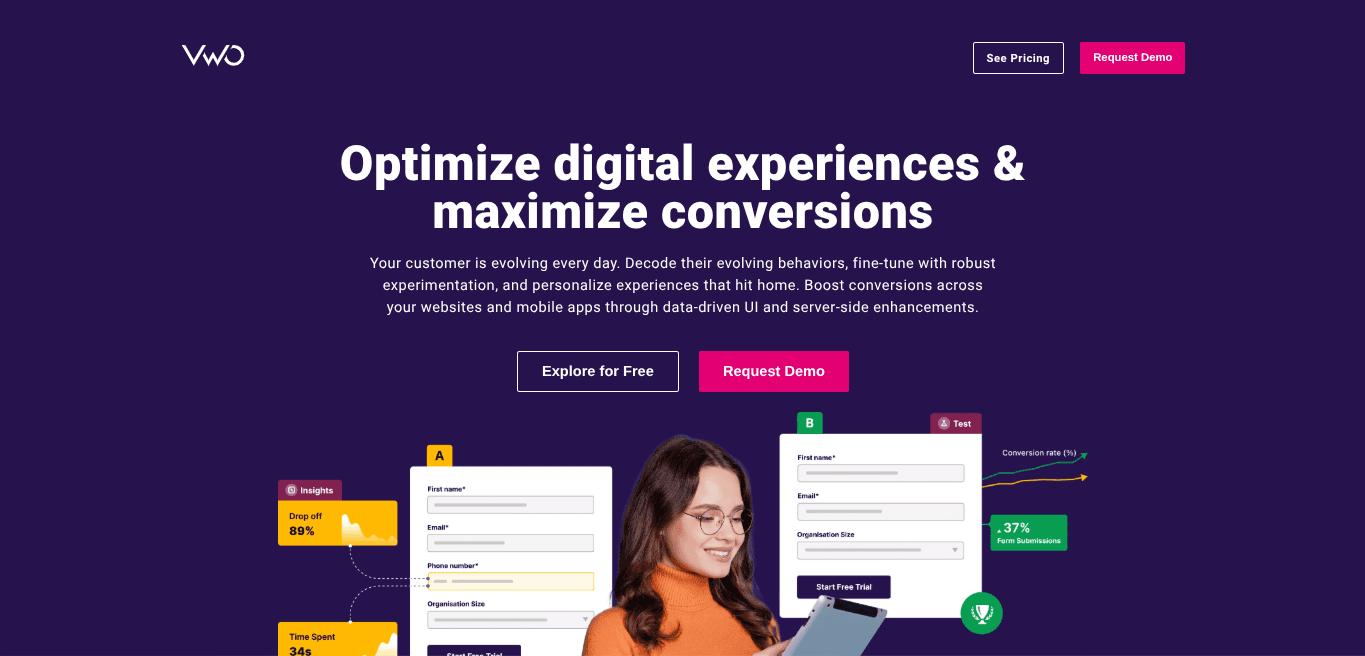
VWO is one of the most established A/B testing tools in the market, offering a comprehensive suite that covers A/B testing, multivariate testing, heatmaps, session recordings, and user surveys.
2026 updates and key strengths:
AI-assisted hypothesis generation and automated audience segment discovery added in 2026.
Native integrations with GA4, Salesforce, and HubSpot for rich diagnostic data alongside experiment results.
Strong for teams that need qualitative session insights combined with quantitative A/B test data.
Setting up deeply personalized experiences for specific segments still requires more technical resource than purpose-built personalization platforms.
Teams seeking a VWO alternative with stronger no-code personalization depth will find Fibr AI the most direct comparison.
Best for: Enterprise marketing and CRO teams with in-house development support and complex analytics stacks.
AB Tasty Best for Behavioral Personalization Testing
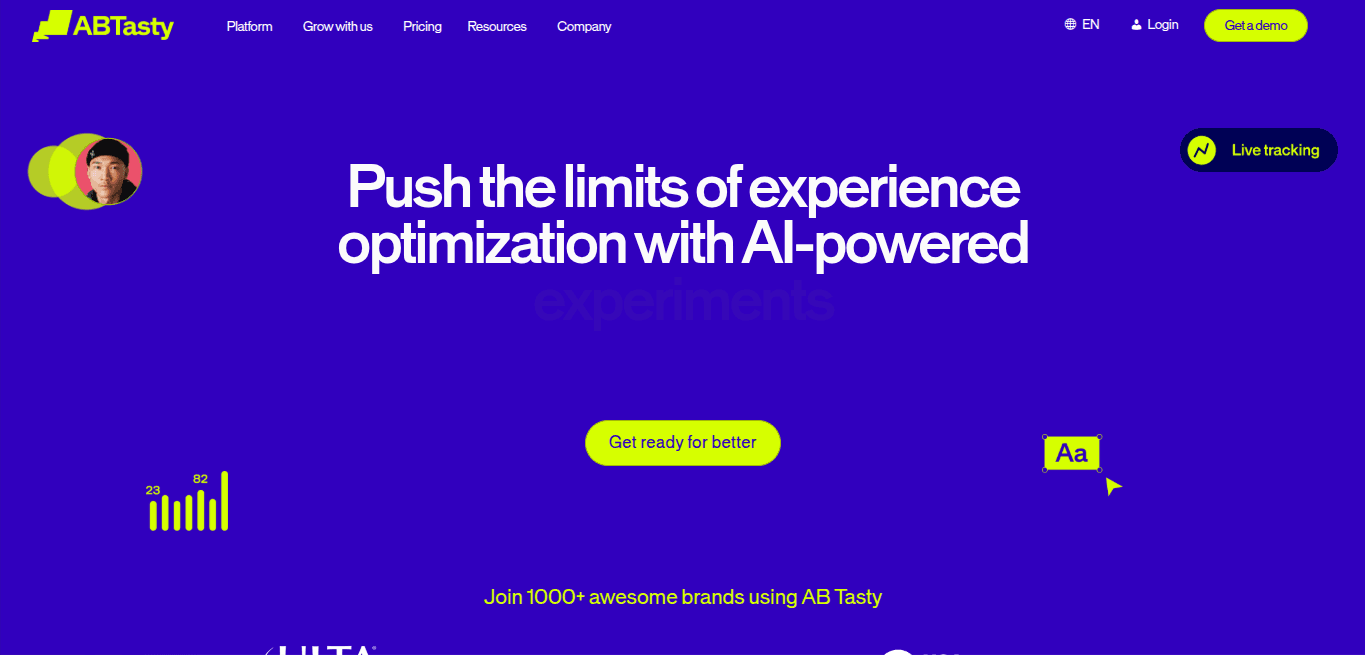
AB Tasty sits at the intersection of experimentation and personalization, offering behavioral targeting, audience segmentation, and real-time personalization alongside standard A/B testing.
2026 updates and key strengths:
EmotionsAI feature matured significantly in 2026, predicting visitor motivation states based on scroll depth, hover patterns, and return visit frequency.
Adapts experiences in real time based on behavioral engagement signals without requiring a new test setup for every change.
Strong middle path between pure testing tools and pure personalization platforms for mid-market teams.
Explore the AB Tasty comparison with Fibr AI for paid-traffic personalization use cases.
Best for: Mid-market teams that want behavioral personalization combined with structured A/B experimentation across web properties.
GA4 Experiments Best for Google-Ecosystem Integrated Testing
Following the Google Optimize sunset, GA4 Experiments emerged as the default free option for teams already invested in the Google ecosystem, combining with third-party testing tools for more advanced experiment configurations.
2026 updates and key strengths:
Cross-channel attribution reporting added in 2026, making it easier to evaluate experiment results within full campaign performance context.
Direct integration with Google Ads conversion goals for closed-loop experiment measurement.
Limited personalization depth for segment-specific landing page testing.
Most effective when paired with Fibr.ai for segment-level personalization testing alongside native Google Analytics integration.
The Google Optimize comparison guide explains how the migration landscape has evolved and what teams should implement in its place.
Best for: Google Ads-centric teams wanting native GA4 analytics integration alongside basic landing page testing.
Personalization depth: Fibr AI > AB Tasty > VWO > Optimizely > Unbounce > Convert > GA4
|
A/B Testing Ideas for Different Parts of Your Landing Page
Your landing page is a canvas, and A/B testing provides the brushes. For a comprehensive idea bank, explore A/B testing ideas across all major page elements. Below are the highest-impact areas to test in 2026, with personalization considerations for each:
1. Headline
In 2026, the highest-performing personalized headlines reference the visitor's specific pain point, industry, or traffic source. A visitor arriving from a Google Search ad for 'SaaS onboarding software' should see a headline that mirrors that intent exactly. Test personalized headlines against your default variant. The personalized version almost always outperforms in message-match scenarios.
2. Copy
Landing page copy should address questions, alleviate objections, and match the tone of each audience segment. Copy testing best practices help you isolate the exact language variable driving conversion lift. In 2026, AI-assisted copy variant generation allows teams to test 5 to 10 copy variants in the time it previously took to write one.
3. Images
Segment-specific visuals outperform generic hero images consistently. Test product screenshots, use-case illustrations, or team photos matched to the visitor's industry or role. For e-commerce teams, ecommerce A/B testing of lifestyle vs. product-only imagery regularly produces double-digit conversion lifts when targeted to the right segment.
4. Opt-in Forms
Cold traffic converts better with minimal fields. Warmer retargeted segments tolerate more context-gathering questions. Test form length per segment rather than choosing one approach for all visitors. In 2026, progressive profiling has become a widely tested alternative to static form length experiments.
5. CTA Buttons
Test CTA copy personalized to the visitor's funnel stage. Stage-specific wording consistently outperforms generic labels across every segment type tested. Review personalized call to action strategies for 2026 guidance on CTA personalization by segment, device type, and traffic source.
6. Countdown Timers
Urgency drives conversions for price-sensitive segments but can suppress conversion for enterprise buyers who interpret countdown timers as pressure tactics. Run urgency tests per segment before applying any urgency element sitewide.
7. Social Proof
Industry-matched testimonials and case study logos outperform generic five-star reviews for almost every B2B segment. Test segment-specific social proof. In 2026, AI-matched social proof that automatically surfaces the most relevant testimonial for each visitor segment is now built into Fibr.ai's personalization at scale engine.
8. Dynamic Pricing
Test pricing framed as ROI, cost-per-seat, or monthly vs. annual depending on segment. A/B testing for pricing frameworks deliver some of the highest conversion lifts of any element category. Enterprise segments respond better to outcome-based pricing framing; SMB segments convert better on monthly pricing displayed prominently upfront.
9. Page Length
Enterprise buyers need more detail to justify purchase decisions; SMB buyers prefer a fast path to a demo or free trial. Test short and long page variants per segment. Testing multiple elements simultaneously falls into multivariate testing territory, which requires substantially larger sample sizes and more sophisticated testing infrastructure than single-variable A/B tests.
Best Practices for A/B Testing Landing Pages in 2026
A structured A/B testing framework ensures your personalization experiments are reproducible, documented, and compounding over time. These best practices reflect both timeless principles and 2026-specific updates:
1. Test One Variable at a Time
Change only one element per experiment. If you alter the headline and the CTA simultaneously, you cannot determine which change drove the result. Build your institutional knowledge base with single-variable tests first before advancing to automated multivariate programs.
2. Define Sample Size Before You Launch
Determining the right A/B testing sample size before launching is essential. For smaller audience segments, this often means running tests for four to six weeks rather than the standard two weeks. For high-traffic campaigns, AI testing platforms can reduce this window significantly through intelligent traffic routing.
3. Run Both Variants Simultaneously
Grounding decisions in A/B testing statistics means running both variants at the same time and waiting for at least 95% statistical confidence before declaring a winner. Testing at different times introduces bias from traffic volume changes, campaign adjustments, or seasonal factors unrelated to the variant itself.
4. Document Every Test Including Losses
Ending tests early, allowing segment contamination, and failing to document results are the most frequent and costly A/B testing mistakes. Every losing test generates learning. Maintain a structured test log with hypothesis, result, audience segment, and insight for every experiment you run.
5. Use AI to Accelerate Testing Velocity
In 2026, AI A/B testing platforms analyze behavioral data to generate high-confidence hypotheses and route traffic intelligently to reduce time-to-significance. For high-traffic campaigns, real-time personalization can serve winning variants instantly once statistical significance is reached, removing the manual deployment step entirely.
6. Align Ad-Level and Landing Page Tests
The most effective teams in 2026 run coordinated experiments at the ad creative level and the landing page level simultaneously. A/B testing for ads ensures your ad messaging and landing page variants stay aligned, preventing the common error of misattributing a performance change caused by an ad creative change rather than a landing page variant.
What Has Changed in Personalization A/B Testing in 2026
Agentic personalization: AI agents now autonomously generate, launch, and optimize personalization experiments without manual intervention. Fibr.ai's agentic layer, launched in early 2026, is the most advanced implementation in the market.
LLM visitor detection: Traffic from AI assistants including ChatGPT, Perplexity, Claude, and Gemini now accounts for a meaningful and growing share of B2B landing page visits. Fibr AI detects these signals and serves dynamically generated personalized experiences tuned for AI-referred traffic.
Privacy-safe segmentation: With third-party cookie deprecation now complete, first-party data and on-device segmentation are the foundation of every compliant personalization testing program in 2026.
AI copy variant generation: Integrated AI writing tools allow marketers to generate and test 10 to 20 copy variants in minutes, a 10x improvement in testing velocity compared to 2023 workflows.
CDP-connected testing: Integration with customer data platforms allows testing programs to use existing CRM and behavioral data to define audience segments with precision previously available only to enterprise teams with dedicated data science resources.
FAQs
What is the best software for A/B testing personalized landing pages in 2026?
The best software depends on your team's personalization depth, traffic volume, and technical resources. For teams running paid campaigns that need segment-specific landing page testing without developer dependency, Fibr.ai's experimentation platform is the most purpose-built solution in 2026. For enterprise full-stack experimentation, Optimizely leads. For no-code simplicity, Unbounce Smart Traffic deploys fastest. For privacy-first requirements, Convert Experiences is the strongest choice.
How is personalization A/B testing different from standard A/B testing?
Standard A/B testing compares two versions of a page for your entire audience. Personalization A/B testing compares two personalized experiences designed for a specific audience segment, testing which tailored version converts best for that segment specifically. The tools must support audience segmentation, traffic routing by segment, and segment-level performance analytics. For a practical primer, read our guide on how to create highly effective personalized landing pages.
Can I A/B test personalized landing pages without a developer in 2026?
Yes. Fibr AI , Unbounce, and AB Tasty all allow marketing teams to build, launch, and analyze personalization tests without engineering involvement. Fibr.ai's page builder creates audience-specific variants and routes segment traffic directly from the platform without any code required. In 2026, Fibr.ai's agentic personalization layer takes this further, autonomously generating and deploying test variants based on live performance data.
What features should I look for in A/B testing software for personalization?
Prioritize: audience segmentation and traffic routing by segment, dynamic content support, segment-level statistical reporting, paid traffic source integration, no-code deployment, and AI-assisted hypothesis generation. Also look for a platform that supports personalization at scale so winning test variants automatically roll out across all matching segments rather than requiring manual page-by-page updates.
Which tool works best for A/B testing Google Ads landing pages?
Fibr AI is the strongest choice for Google Ads-driven personalization testing. It connects directly to your Google Search ad personalization campaigns and creates landing page variants that dynamically match specific ad groups, keywords, or audience segments. This message-match approach directly improves Google ad quality score while optimizing conversion rate through structured A/B testing simultaneously.
What metrics should I track when A/B testing personalized landing pages?
Track conversion rate as your primary metric aligned with your campaign goal. Secondary metrics including bounce rate, time on page, scroll depth, and CTA click-through rate explain why a variant performed as it did. For paid campaigns, also track cost-per-conversion and ROAS at the segment level. Review A/B testing metrics and the A/B testing guide for a full 2026 measurement framework before your first test goes live.
What replaced Google Optimize for landing page A/B testing?
Following the Google Optimize sunset, teams have migrated to VWO, Optimizely, Convert Experiences, AB Tasty, and Fibr AI . For paid campaign personalization testing specifically, They offer the most capable replacement, providing Google Ads integration and segment-level personalization testing that Google Optimize never supported at the campaign level. The full migration landscape is covered in the Google Optimize alternatives guide.
How does Fibr AI differ from traditional A/B testing tools?
Traditional tools split traffic between two versions of the same page for all visitors. Fibr AI starts with audience personalization building segment-specific page experiences first, then running A/B tests within each segment to determine which personalized variant converts best for that specific audience. Combined with CDP personalization integrations, It runs tests informed by your existing CRM and behavioral data. Explore real examples and customer stories to see this approach in practice.
Are there free tools for A/B testing personalized landing pages?
Free options are limited for genuine personalization testing. GA4 Experiments offer basic A/B test reporting at no cost but lack segment-specific personalization capability. For teams ready to invest in a purpose-built solution, explore Fibr.ai's pricing or request a demo to see the full personalization and A/B testing platform in action.
How do I get started with Fibr.ai's personalization A/B testing?
Getting started with Fibr Involves three steps: connect your ad platform, define your audience segments using traffic source, keyword, or behavioral signals, and use the Fibr AI page builder to create segment-specific landing page variants. The experimentation platform then handles traffic routing, statistical significance tracking, and performance reporting without developer involvement. Fibr AI customer stories show teams achieving 20 to 40% conversion improvements within the first 90 days of deployment.
Conclusion
A/B testing remains one of the most reliable paths to higher conversion rates, and when combined with personalization, it becomes the engine behind the most effective landing page programs in 2026. The leading software for A/B testing personalized landing pages is defined not by how many features it offers, but by how precisely it can segment your audience, how quickly it generates validated insights per segment, and how seamlessly it connects those insights back to your ad campaigns.
Whether you are a growth team running personalized paid campaigns, an enterprise CRO function managing hundreds of concurrent experiments, or an SMB looking for a no-code way to improve landing page performance, there is a platform in this guide suited to your context.
For teams whose growth depends on personalization at scale, where every paid click lands on a page built for that specific visitor, a purpose-built platform like Fibr AI removes the gap between personalization and experimentation that generic tools leave open. In 2026, that gap is the difference between campaigns that compound and campaigns that plateau.
Check out A/B testing examples and A/B testing best practices to continue building your experimentation program. Happy A/B testing!




Ankur Goyal
CEO @ Fibr AI
Ankur Goyal, a visionary entrepreneur, is the driving force behind Fibr, a groundbreaking AI co-pilot for websites. With a dual degree from Stanford University and IIT Delhi, Ankur brings a unique blend of technical prowess and business acumen to the table. This isn't his first rodeo; Ankur is a seasoned entrepreneur with a keen understanding of consumer behavior, web dynamics, and AI. Through Fibr, he aims to revolutionize the way websites engage with users, making digital interactions smarter and more intuitive.
Table of Content
Read summarized version with
Introduction
Do you ever wonder why some landing pages convert like clockwork while others barely register? The difference is rarely the design. In 2026, it is almost always personalization combined with structured A/B testing: the discipline of running controlled experiments on audience-specific page experiences to learn what actually drives conversions for each visitor segment.
A/B testing, sometimes called split testing, involves comparing two versions of the same page to determine which one performs better. When applied to personalization, it answers a far more valuable question: which version of a tailored experience converts best for a specific audience?
The scale of the opportunity is significant. According to McKinsey's 2025 Personalization Report, 71% of consumers expect personalized interactions, and 76% report frustration when pages feel generic. CXL Institute research shows companies running continuous A/B testing on personalized pages see 20 to 30% higher conversion rates compared to static pages. And according to the Forrester Wave: Experience Optimization Platforms Q1 2026, AI-assisted personalization testing has compressed average time-to-significance from four weeks to under ten days for high-traffic campaigns.
Not every platform handles personalization testing equally. The right A/B testing software must go beyond simple traffic splitting. It needs to support audience segmentation, dynamic content variants, and real-time analytics without requiring a developer for every experiment. This guide covers the 7 best tools to get you there.
What is A/B testing?
A/B testing is a method for comparing two versions of a webpage, app feature, or campaign to determine which performs better. It works by showing version A to one group of users and version B to another, then measuring which one drives more clicks, sign-ups, or sales.
You can test anything from headlines and buttons to layouts and pricing. The idea is simple: make decisions based on real user behavior, not assumptions.
The process starts with a question or assumption. You might wonder if a shorter form will generate more leads or if a new image will encourage people to stay longer on a page. From there, you:
Choose one variable to test. Keeping one change at a time helps you see what really made the difference.
Split your audience randomly into two or more groups so each version gets a fair test.
Run the test for a sufficient amount of time to collect enough data. Ending too soon can give misleading results.
Measure results using clear metrics like conversion rate, bounce rate, and click-throughs.
Pick the winning version and apply the change. Then plan your next test.
In simple terms, A/B testing is a loop of learning. Each test gives you clear insights into what your users prefer and how they respond. The more you test, the better your understanding of your audience becomes. Over time, these small, data-backed changes lead to stronger engagement, higher sales, and happier users.
Why A/B Testing Matters for Personalized Landing Pages
A/B testing is more than a marketing buzzword. It is a dynamic landing page strategy that turns assumptions into validated insights. A disciplined testing program sits at the heart of every effective conversion rate optimization strategy, and its value compounds with every experiment you complete.
1. Increases Conversion Rates
The benefits of A/B testing compound over time. Personalized pages that are continuously tested deliver 20 to 30% higher conversion rates than static equivalents, which translates directly into lower cost per acquisition and higher return on ad spend.
2. Reduces Bounce Rate
A high bounce rate signals a message mismatch between what the visitor expected and what the page delivered. Personalized pages reduce this gap by default, and A/B testing validates which personalized variant best matches each segment's intent. Continuously refining your landing page optimization approach compounds these gains across every campaign cycle.
3. Alleviates User Pain Points
Every visitor arrives with a specific goal. A/B testing helps surface and eliminate the friction points standing between them and conversion. Aligning on website personalization strategies before building test variants grounds your hypothesis building in real audience data. In 2026, behavioral signal data from CDPs and ad platforms provides richer inputs for hypothesis generation than ever before.
4. Increases Engagement and Pipeline Quality
Not every visitor converts on the first visit. A/B testing identifies which personalized experiences drive micro-conversions that feed future pipeline. In 2026, AI audience segmentation has made it possible to define and test micro-segments that were previously too small or too complex to serve individually, unlocking engagement opportunities that generic testing programs completely miss.
Leading Software for A/B Testing Personalized Landing Pages
Choosing the right platform to run A/B tests on personalized landing pages is the single most consequential infrastructure decision a performance marketing team makes in 2026. The wrong tool gives you traffic splits without segment context. The right tool gives you validated, audience-specific insights that compound with every experiment you run.
What separates the leading software for A/B testing personalized landing pages from generic testing tools comes down to five core capabilities:
Audience segmentation and traffic routing: The platform must define a specific visitor cohort by traffic source, industry, behavioral signal, funnel stage, or geography and route only that cohort into a test.
Dynamic content variants: Each version of the page must be able to serve a different headline, image, CTA, or copy block tailored to that segment without developer involvement for every build.
Segment-level statistical reporting: Results must be reported per segment rather than blended across all traffic, otherwise the insights are too averaged to act on meaningfully.
Paid traffic source integration: The platform must connect natively to Google Ads and Meta so ad-level performance data can inform and align with landing page experiment results.
AI-driven automation: In 2026, leading platforms use AI for hypothesis generation, agentic test deployment, and LLM visitor detection that triggers personalized experiences for traffic from AI assistants such as ChatGPT, Perplexity, and Gemini.
The market in 2026 is clearly stratified across three tiers. Understanding where your team sits in that landscape is the starting point for choosing the right platform.
Tier 1: Purpose-built personalization experimentation platforms: Designed for teams running high-volume paid campaigns across segmented audiences. These platforms treat personalization as the starting point, not an add-on. Fibr AI leads this category.
Tier 2: Enterprise experimentation suites: Handle personalization among many other testing use cases. Strong on analytics depth and enterprise integrations, but require more technical resource for deep personalization work. Optimizely and VWO sit here.
Tier 3: No-code and entry-level tools: Offer basic variant testing with limited segment specificity and fast deployment. Best suited to SMBs and agencies running simpler campaign structures. Unbounce Smart Traffic leads here.
A key consideration when evaluating these platforms is developer dependency. In 2023, most meaningful A/B testing on personalized pages required engineering support to build variants, configure traffic routing, and integrate analytics. In 2026, the leading platforms have eliminated this dependency for the majority of use cases. Marketers can now build segment-specific variants, configure routing rules, set success metrics, and review segment-level results without writing a single line of code.Privacy compliance has also become a defining feature. With third-party cookie deprecation now complete, every platform reviewed below has adapted its segmentation and tracking infrastructure to operate on first-party data, on-device processing, or consent-managed behavioral signals. Key questions to ask any vendor during evaluation:
Does the platform operate without third-party cookies by default?
Is visitor data processed on-device or server-side?
Does the platform support granular consent signal integration with your CMP?
Is the platform certified for GDPR, CCPA, and HIPAA compliance?
Finally, the integration between A/B testing for ads and landing page personalization testing has matured significantly. The platforms that lead in 2026 connect ad campaign performance data directly to landing page experiments, closing the loop between which ad creative generated which visitor segment and which personalized page variant converted that segment best. This closed-loop approach is what enables teams to consistently improve both ad quality scores and landing page conversion rates as compounding outcomes of a single coordinated testing program.
How to Evaluate Leading A/B Testing Software for Personalized Landing Pages
Personalization depth: Can the platform segment traffic by specific audience attributes and serve genuinely different page experiences to each segment?
No-code deployment: Can marketers build, configure, and launch personalization tests without engineering support?
Segment-level reporting: Does the platform report statistical significance and conversion metrics per segment, not just across all traffic?
Paid traffic integration: Does the platform connect natively to Google Ads and Meta to align ad-level and landing page experiments?
AI and automation: Does the platform use AI to generate hypotheses, detect visitor intent, deploy variants autonomously, and accelerate time-to-significance?
Privacy compliance: Does the platform operate on first-party data and on-device processing without relying on deprecated third-party cookies?
7 Best Software Tools for A/B Testing Personalized Landing Pages in 2026
The following seven platforms lead the category in 2026, evaluated across the criteria above. Each overview includes what the platform does best, its 2026-specific capability update, and a clear best-fit use case.
Fibr AI Best for AI-Driven Personalization A/B Testing at Scale
Fibr AI purpose-built for audience personalization and experimentation at scale. Unlike general-purpose A/B testing tools, Fibr.ai's experimentation platform runs A/B tests on personalized landing page experiences segmented by traffic source, industry, behavioral signal, or geography without any developer involvement.
What makes Fibr AI stand out in 2026:
Agentic personalization: Fully autonomous experiment generation informed by session data and ad group performance, launched in early 2026.
LLM-based personalization: AI-generated page variants tailored to visitor intent signals in real time, including traffic from ChatGPT and Perplexity.
Ad-to-page message match: Fibr.ai's ad personalization layer ensures Google Search and Meta traffic lands on pages that match the exact ad creative, then tests which personalized variant converts best.
Quality score uplift: Campaigns connecting Google Search ad personalization with Fibr AI see direct improvements in Google ad quality score as a compounding outcome of better message match.
Customer results show teams achieving 20 to 40% conversion rate improvements within the first 90 days of deploying Fibr.ai's personalization testing program.
Best for: Growth and performance marketing teams running personalized campaigns across paid channels at scale without a developer.
Unbounce Smart Traffic Best for No-Code Landing Page Testing
Unbounce combines a landing page builder with a built-in AI traffic optimization engine that automatically routes visitors to the variant most likely to convert based on device, location, time of day, and referral source.
2026 updates and key strengths:
AI Copywriting layer integrated directly into the builder in 2026, enabling marketers to generate and test personalized copy variants without leaving the platform.
Fastest-to-deploy option for teams wanting no-code landing page A/B testing without complex configuration.
Consistently ranks highest on ease of setup among top landing page builders evaluated for SMBs and agencies.
Personalization remains primarily attribute-based routing rather than deep audience-segment experimentation, making it better suited to simpler campaign structures.
Best for: SMBs and agencies needing fast, no-code landing page testing with integrated AI traffic optimization and built-in copywriting.
Optimizely Best for Full-Stack Enterprise Experimentation
Optimizely is the gold standard for enterprise-scale web and product experimentation, covering feature flagging, web experimentation, and full-stack testing across web, mobile app, and server-side environments simultaneously.
2026 updates and key strengths:
Experiment Intelligence layer released in 2026 uses machine learning to prioritize experiments by predicted revenue impact.
Automatically surfaces anomalies in live test results before they affect campaign performance.
Most powerful for organizations with dedicated product engineering teams running cross-channel experiments.
Can be over-engineered for paid traffic teams focused purely on landing page personalization without engineering support.
The Fibr AI Optimizely comparison shows where a personalization-first platform outperforms a full-stack suite for campaign-level landing page work.
Best for: Large enterprises running cross-channel and full-stack experimentation programs with dedicated product engineering teams.Ratings.
VWO (Visual Website Optimizer) Best for Enterprise CRO Teams
VWO is one of the most established A/B testing tools in the market, offering a comprehensive suite that covers A/B testing, multivariate testing, heatmaps, session recordings, and user surveys.
2026 updates and key strengths:
AI-assisted hypothesis generation and automated audience segment discovery added in 2026.
Native integrations with GA4, Salesforce, and HubSpot for rich diagnostic data alongside experiment results.
Strong for teams that need qualitative session insights combined with quantitative A/B test data.
Setting up deeply personalized experiences for specific segments still requires more technical resource than purpose-built personalization platforms.
Teams seeking a VWO alternative with stronger no-code personalization depth will find Fibr AI the most direct comparison.
Best for: Enterprise marketing and CRO teams with in-house development support and complex analytics stacks.
AB Tasty Best for Behavioral Personalization Testing
AB Tasty sits at the intersection of experimentation and personalization, offering behavioral targeting, audience segmentation, and real-time personalization alongside standard A/B testing.
2026 updates and key strengths:
EmotionsAI feature matured significantly in 2026, predicting visitor motivation states based on scroll depth, hover patterns, and return visit frequency.
Adapts experiences in real time based on behavioral engagement signals without requiring a new test setup for every change.
Strong middle path between pure testing tools and pure personalization platforms for mid-market teams.
Explore the AB Tasty comparison with Fibr AI for paid-traffic personalization use cases.
Best for: Mid-market teams that want behavioral personalization combined with structured A/B experimentation across web properties.
GA4 Experiments Best for Google-Ecosystem Integrated Testing
Following the Google Optimize sunset, GA4 Experiments emerged as the default free option for teams already invested in the Google ecosystem, combining with third-party testing tools for more advanced experiment configurations.
2026 updates and key strengths:
Cross-channel attribution reporting added in 2026, making it easier to evaluate experiment results within full campaign performance context.
Direct integration with Google Ads conversion goals for closed-loop experiment measurement.
Limited personalization depth for segment-specific landing page testing.
Most effective when paired with Fibr.ai for segment-level personalization testing alongside native Google Analytics integration.
The Google Optimize comparison guide explains how the migration landscape has evolved and what teams should implement in its place.
Best for: Google Ads-centric teams wanting native GA4 analytics integration alongside basic landing page testing.
Personalization depth: Fibr AI > AB Tasty > VWO > Optimizely > Unbounce > Convert > GA4
|
A/B Testing Ideas for Different Parts of Your Landing Page
Your landing page is a canvas, and A/B testing provides the brushes. For a comprehensive idea bank, explore A/B testing ideas across all major page elements. Below are the highest-impact areas to test in 2026, with personalization considerations for each:
1. Headline
In 2026, the highest-performing personalized headlines reference the visitor's specific pain point, industry, or traffic source. A visitor arriving from a Google Search ad for 'SaaS onboarding software' should see a headline that mirrors that intent exactly. Test personalized headlines against your default variant. The personalized version almost always outperforms in message-match scenarios.
2. Copy
Landing page copy should address questions, alleviate objections, and match the tone of each audience segment. Copy testing best practices help you isolate the exact language variable driving conversion lift. In 2026, AI-assisted copy variant generation allows teams to test 5 to 10 copy variants in the time it previously took to write one.
3. Images
Segment-specific visuals outperform generic hero images consistently. Test product screenshots, use-case illustrations, or team photos matched to the visitor's industry or role. For e-commerce teams, ecommerce A/B testing of lifestyle vs. product-only imagery regularly produces double-digit conversion lifts when targeted to the right segment.
4. Opt-in Forms
Cold traffic converts better with minimal fields. Warmer retargeted segments tolerate more context-gathering questions. Test form length per segment rather than choosing one approach for all visitors. In 2026, progressive profiling has become a widely tested alternative to static form length experiments.
5. CTA Buttons
Test CTA copy personalized to the visitor's funnel stage. Stage-specific wording consistently outperforms generic labels across every segment type tested. Review personalized call to action strategies for 2026 guidance on CTA personalization by segment, device type, and traffic source.
6. Countdown Timers
Urgency drives conversions for price-sensitive segments but can suppress conversion for enterprise buyers who interpret countdown timers as pressure tactics. Run urgency tests per segment before applying any urgency element sitewide.
7. Social Proof
Industry-matched testimonials and case study logos outperform generic five-star reviews for almost every B2B segment. Test segment-specific social proof. In 2026, AI-matched social proof that automatically surfaces the most relevant testimonial for each visitor segment is now built into Fibr.ai's personalization at scale engine.
8. Dynamic Pricing
Test pricing framed as ROI, cost-per-seat, or monthly vs. annual depending on segment. A/B testing for pricing frameworks deliver some of the highest conversion lifts of any element category. Enterprise segments respond better to outcome-based pricing framing; SMB segments convert better on monthly pricing displayed prominently upfront.
9. Page Length
Enterprise buyers need more detail to justify purchase decisions; SMB buyers prefer a fast path to a demo or free trial. Test short and long page variants per segment. Testing multiple elements simultaneously falls into multivariate testing territory, which requires substantially larger sample sizes and more sophisticated testing infrastructure than single-variable A/B tests.
Best Practices for A/B Testing Landing Pages in 2026
A structured A/B testing framework ensures your personalization experiments are reproducible, documented, and compounding over time. These best practices reflect both timeless principles and 2026-specific updates:
1. Test One Variable at a Time
Change only one element per experiment. If you alter the headline and the CTA simultaneously, you cannot determine which change drove the result. Build your institutional knowledge base with single-variable tests first before advancing to automated multivariate programs.
2. Define Sample Size Before You Launch
Determining the right A/B testing sample size before launching is essential. For smaller audience segments, this often means running tests for four to six weeks rather than the standard two weeks. For high-traffic campaigns, AI testing platforms can reduce this window significantly through intelligent traffic routing.
3. Run Both Variants Simultaneously
Grounding decisions in A/B testing statistics means running both variants at the same time and waiting for at least 95% statistical confidence before declaring a winner. Testing at different times introduces bias from traffic volume changes, campaign adjustments, or seasonal factors unrelated to the variant itself.
4. Document Every Test Including Losses
Ending tests early, allowing segment contamination, and failing to document results are the most frequent and costly A/B testing mistakes. Every losing test generates learning. Maintain a structured test log with hypothesis, result, audience segment, and insight for every experiment you run.
5. Use AI to Accelerate Testing Velocity
In 2026, AI A/B testing platforms analyze behavioral data to generate high-confidence hypotheses and route traffic intelligently to reduce time-to-significance. For high-traffic campaigns, real-time personalization can serve winning variants instantly once statistical significance is reached, removing the manual deployment step entirely.
6. Align Ad-Level and Landing Page Tests
The most effective teams in 2026 run coordinated experiments at the ad creative level and the landing page level simultaneously. A/B testing for ads ensures your ad messaging and landing page variants stay aligned, preventing the common error of misattributing a performance change caused by an ad creative change rather than a landing page variant.
What Has Changed in Personalization A/B Testing in 2026
Agentic personalization: AI agents now autonomously generate, launch, and optimize personalization experiments without manual intervention. Fibr.ai's agentic layer, launched in early 2026, is the most advanced implementation in the market.
LLM visitor detection: Traffic from AI assistants including ChatGPT, Perplexity, Claude, and Gemini now accounts for a meaningful and growing share of B2B landing page visits. Fibr AI detects these signals and serves dynamically generated personalized experiences tuned for AI-referred traffic.
Privacy-safe segmentation: With third-party cookie deprecation now complete, first-party data and on-device segmentation are the foundation of every compliant personalization testing program in 2026.
AI copy variant generation: Integrated AI writing tools allow marketers to generate and test 10 to 20 copy variants in minutes, a 10x improvement in testing velocity compared to 2023 workflows.
CDP-connected testing: Integration with customer data platforms allows testing programs to use existing CRM and behavioral data to define audience segments with precision previously available only to enterprise teams with dedicated data science resources.
FAQs
What is the best software for A/B testing personalized landing pages in 2026?
The best software depends on your team's personalization depth, traffic volume, and technical resources. For teams running paid campaigns that need segment-specific landing page testing without developer dependency, Fibr.ai's experimentation platform is the most purpose-built solution in 2026. For enterprise full-stack experimentation, Optimizely leads. For no-code simplicity, Unbounce Smart Traffic deploys fastest. For privacy-first requirements, Convert Experiences is the strongest choice.
How is personalization A/B testing different from standard A/B testing?
Standard A/B testing compares two versions of a page for your entire audience. Personalization A/B testing compares two personalized experiences designed for a specific audience segment, testing which tailored version converts best for that segment specifically. The tools must support audience segmentation, traffic routing by segment, and segment-level performance analytics. For a practical primer, read our guide on how to create highly effective personalized landing pages.
Can I A/B test personalized landing pages without a developer in 2026?
Yes. Fibr AI , Unbounce, and AB Tasty all allow marketing teams to build, launch, and analyze personalization tests without engineering involvement. Fibr.ai's page builder creates audience-specific variants and routes segment traffic directly from the platform without any code required. In 2026, Fibr.ai's agentic personalization layer takes this further, autonomously generating and deploying test variants based on live performance data.
What features should I look for in A/B testing software for personalization?
Prioritize: audience segmentation and traffic routing by segment, dynamic content support, segment-level statistical reporting, paid traffic source integration, no-code deployment, and AI-assisted hypothesis generation. Also look for a platform that supports personalization at scale so winning test variants automatically roll out across all matching segments rather than requiring manual page-by-page updates.
Which tool works best for A/B testing Google Ads landing pages?
Fibr AI is the strongest choice for Google Ads-driven personalization testing. It connects directly to your Google Search ad personalization campaigns and creates landing page variants that dynamically match specific ad groups, keywords, or audience segments. This message-match approach directly improves Google ad quality score while optimizing conversion rate through structured A/B testing simultaneously.
What metrics should I track when A/B testing personalized landing pages?
Track conversion rate as your primary metric aligned with your campaign goal. Secondary metrics including bounce rate, time on page, scroll depth, and CTA click-through rate explain why a variant performed as it did. For paid campaigns, also track cost-per-conversion and ROAS at the segment level. Review A/B testing metrics and the A/B testing guide for a full 2026 measurement framework before your first test goes live.
What replaced Google Optimize for landing page A/B testing?
Following the Google Optimize sunset, teams have migrated to VWO, Optimizely, Convert Experiences, AB Tasty, and Fibr AI . For paid campaign personalization testing specifically, They offer the most capable replacement, providing Google Ads integration and segment-level personalization testing that Google Optimize never supported at the campaign level. The full migration landscape is covered in the Google Optimize alternatives guide.
How does Fibr AI differ from traditional A/B testing tools?
Traditional tools split traffic between two versions of the same page for all visitors. Fibr AI starts with audience personalization building segment-specific page experiences first, then running A/B tests within each segment to determine which personalized variant converts best for that specific audience. Combined with CDP personalization integrations, It runs tests informed by your existing CRM and behavioral data. Explore real examples and customer stories to see this approach in practice.
Are there free tools for A/B testing personalized landing pages?
Free options are limited for genuine personalization testing. GA4 Experiments offer basic A/B test reporting at no cost but lack segment-specific personalization capability. For teams ready to invest in a purpose-built solution, explore Fibr.ai's pricing or request a demo to see the full personalization and A/B testing platform in action.
How do I get started with Fibr.ai's personalization A/B testing?
Getting started with Fibr Involves three steps: connect your ad platform, define your audience segments using traffic source, keyword, or behavioral signals, and use the Fibr AI page builder to create segment-specific landing page variants. The experimentation platform then handles traffic routing, statistical significance tracking, and performance reporting without developer involvement. Fibr AI customer stories show teams achieving 20 to 40% conversion improvements within the first 90 days of deployment.
Conclusion
A/B testing remains one of the most reliable paths to higher conversion rates, and when combined with personalization, it becomes the engine behind the most effective landing page programs in 2026. The leading software for A/B testing personalized landing pages is defined not by how many features it offers, but by how precisely it can segment your audience, how quickly it generates validated insights per segment, and how seamlessly it connects those insights back to your ad campaigns.
Whether you are a growth team running personalized paid campaigns, an enterprise CRO function managing hundreds of concurrent experiments, or an SMB looking for a no-code way to improve landing page performance, there is a platform in this guide suited to your context.
For teams whose growth depends on personalization at scale, where every paid click lands on a page built for that specific visitor, a purpose-built platform like Fibr AI removes the gap between personalization and experimentation that generic tools leave open. In 2026, that gap is the difference between campaigns that compound and campaigns that plateau.
Check out A/B testing examples and A/B testing best practices to continue building your experimentation program. Happy A/B testing!
Ankur Goyal
CEO @ Fibr AI
Ankur Goyal, a visionary entrepreneur, is the driving force behind Fibr, a groundbreaking AI co-pilot for websites. With a dual degree from Stanford University and IIT Delhi, Ankur brings a unique blend of technical prowess and business acumen to the table. This isn't his first rodeo; Ankur is a seasoned entrepreneur with a keen understanding of consumer behavior, web dynamics, and AI. Through Fibr, he aims to revolutionize the way websites engage with users, making digital interactions smarter and more intuitive.