

Read summarized version with
Introduction
Imagine an online E-commerce business that has expended all its time, energy, and money creating an attractive website, running targeted ads, and projecting its brand on the best possible online channels. This online business appears successful because of the number of visitors to its websites. The trouble, though, is that sales haven't increased proportionally with the number of visitors. People will be coming in, browsing, and then leaving without making a purchase. Despite the heavy investment, they stuck with low conversions and high frustration.
That's precisely the situation most companies face nowadays. Now, bringing people to your website is no longer an issue; thanks to Search Engine Optimization, Paying Ads, and Social Media platforms, they made traffic more accessible than ever. The problem comes in when the visitors should become actual customers; that's where the real challenge lies. This is where Conversion Rate Optimization, the missing piece of the puzzle, comes in.
To fully enjoy the benefits of CRO, partnering with a specialized Conversion Rate Optimization Agency is a must. Such CRO agencies offer the expertise and tools required to convert website traffic to valuable action, which consequently ensures sales.
Firstly, let’s understand what is a CRO!
What is Conversion Rate Optimization (CRO)?
Conversion rate optimization (CRO) is the process of optimizing a website or landing page to convert visitors into taking the desired action—such as making a purchase, filling out a form, or subscribing to a newsletter. That "desired action" is known as conversion. CRO is, therefore, fine-tuning the user experience to maximize that conversion.
For instance, think of a small e-commerce business. An average of only 2 out of 100 visitors will buy. That's a 2% conversion rate. The business increased its conversion rate to 4%. That without spending one cent more on advertising, or attracting new visitors, has doubled in revenue. That's the magic of CRO marketing.
According to WordStream conversion rates average 2.35% across all industries, but the top 25% of businesses are converting at 5.31% or better. This wide gap shows the potential for improvement and why optimizing conversion rates is important.
Improving your conversion rate isn’t just about driving more sales. It is the optimization of the ROI from the already existing traffic. Hubspot shows that acquiring new customers is five to six times more expensive to attract a new customer than to retain an existing one.
A CRO agency can make your marketing efforts more cost-effective by optimizing the value of your current traffic.
So, Let’s talk about CRO Agency;
What is a Conversion Rate Optimization Agency?
A conversion rate optimization agency, or CRO marketing agency, is a marketing agency specifically meant to uplift the conversion rate of your website.
A Conversion Rate Optimization agency is a specialized service provider that helps businesses realize the maximum value from their existing traffic by making the websites more effective. Instead of pouring more money into traffic generation, a CRO agency focuses on optimizing the chances of getting the desired action from the existing visitors.
CRO agencies believe that users' behavior must be understood through data-driven methods to identify bottlenecks and bring in testing solutions for conversion funnel optimization.
Conversion Rate Optimization agencies do everything, from A/B testing different landing page designs to optimizing the checkout process, ensuring businesses are not letting money fall through the cracks.
Conversion Rate Optimization service providers use many strategies, such as A/B testing, heatmaps, and session recordings, to research user behavior and detect possible weaknesses. For example, A/B testing compares the effectiveness of two versions of any given webpage to find which one is better at converting visitors. With the help of AI conversion rate optimization and advanced CRO software, these agencies can make data-driven decisions that lead to substantial growth in conversions.
However, CRO marketing focuses on optimizing a website or landing page to maximize the conversion rate percentage of visitors who undertake a desired action. Most companies focus on the increase in traffic, while the real value lies in how well that traffic is being converted.
Companies using a conversion optimization agency or taking assistance from conversion rate optimization experts can see their conversion rates soar above 10%. These percentage points may seem small, but the revenue impact is huge.
How a Conversion Rate Optimization Agency Can Help?
A Conversion Rate Optimization Agency or a CRO agency brings expertise and tools to help businesses maximize their website's potential. CRO software, heat maps, session recordings, and user behavior analytics help identify pain points within the user journey.
CRO services include dynamic landing pages, tailored content, and AI-powered conversion rate optimization that can make websites more personalized to increase engagement and boost conversion rates.
Therefore, these tools and techniques should be employed by business organizations to acquire more leads and increase their bottom line using the least additional traffic.
How a Conversion Rate Optimization Agency Can Help Your Business?
Website Audits
A Conversion Rate Optimization Agency begins its work with an audit of your website's current performance. They see all the data related to user behavior, heatmaps, and session recordings about the moment visitors lose interest or encounter an issue. This evaluation gives them a deeper understanding, allowing them to develop a detailed improvement plan.
A/B Testing
Once they find the problem areas, the Conversion Rate Optimization Agency will run A/B testing to test various versions of your web pages. They test every possible element in headlines, buttons, and layouts to find out which ones best resonate with your audience. This can enable them to figure out what drives better conversions.
Experience (UX) Optimization
Conversion Rate Optimization Agency will work on improving your website's overall user journey. They will remove unnecessary steps and simplify navigation so that users find it easier to complete their desired actions—from buying a product to signing up for a newsletter. A smooth experience draws visitors to stay and spend more time on your site.
Heatmaps and User Behavior Analytics
Conversion Rate Optimization Agency employs heatmap tools to visualize a user's interaction with your website. They study click, scroll, and hover behavior to understand better where users spend their time on your site and where they may be having difficulty using it. This information is essential in knowing where to actually make improvements.
Form Simplification
CRO agencies also pay heavy emphasis on the simplification of forms. Simply, fewer fields in shorter forms cut down friction and abandonment and make filling forms easier to visitors so that they can better complete their transactions.
Personalization
Behavior tracking through users enables one to have personalization of experiences for visitors. For example, a returning customer might have tailored product recommendations or special offers tailored to past interactions. This level of personalization may increase conversion rates highly since the user may feel valued and understood.
5 Best Conversion Rate Optimization Agencies
Fibr

Looking for a reliable partner to help you grow your conversions without overspending? Look no further. Fibr is a reliable, affordable Conversion Rate Optimization Agency that helped bring impressive results for businesses to grow their traffic and sales.
Why Fibr Stands Out in Conversion Marketing?
Fibr is not an ordinary CRO agency. They specialize in digging up all the little data analysis that could help each business reach its maximum potential.
Here is a closer view of Fibr's most important services:
CRO Audit
Fibr CRO audit exposes weaknesses in your conversion funnel. Their experts bring actionable insights for the improvement of your website's conversion rate. Instead of pointing out the problems, they bring great solutions.
Landing Page Design
Fibr is an expert in creating landing pages that convert well. Each landing page is specifically crafted to the niche necessities of your audience, holding the opportunities for this changing visitor to take action.
Website Personalization
Fibr leverages AI-driven personalization for a more engaging experience with each visitor. This allows for designing user journeys that turn casual visitors into loyal customers.
A/B Testing
Fibr takes thorough and continuous A/B testing. They test everything in terms of design to messaging to make sure your website is performing at the best, continually optimizing toward the highest conversion rates.
Data and Analytics
Fibr is an analytics tool that relies on data. The deep analysis will provide clear, action-oriented insights into your key metrics, easy to track progress, and discover new growth opportunities.
Conversion Funnel Analysis
Fibr's conversion funnel analysis analyzes each step of the customer journey from where you are dropping or getting stuck. They will then elaborate procedures to streamline the process and increase conversions
Unlike many agencies that make fake promises, Fibr stands out for its transparency and ability to deliver. They don’t just talk about increasing traffic and sales—they back it up with real data.
If you need a CRO agency that knows how to boost conversions, increase traffic, and drive sales, Fibr is the right partner to elevate your business.
2. Conversion
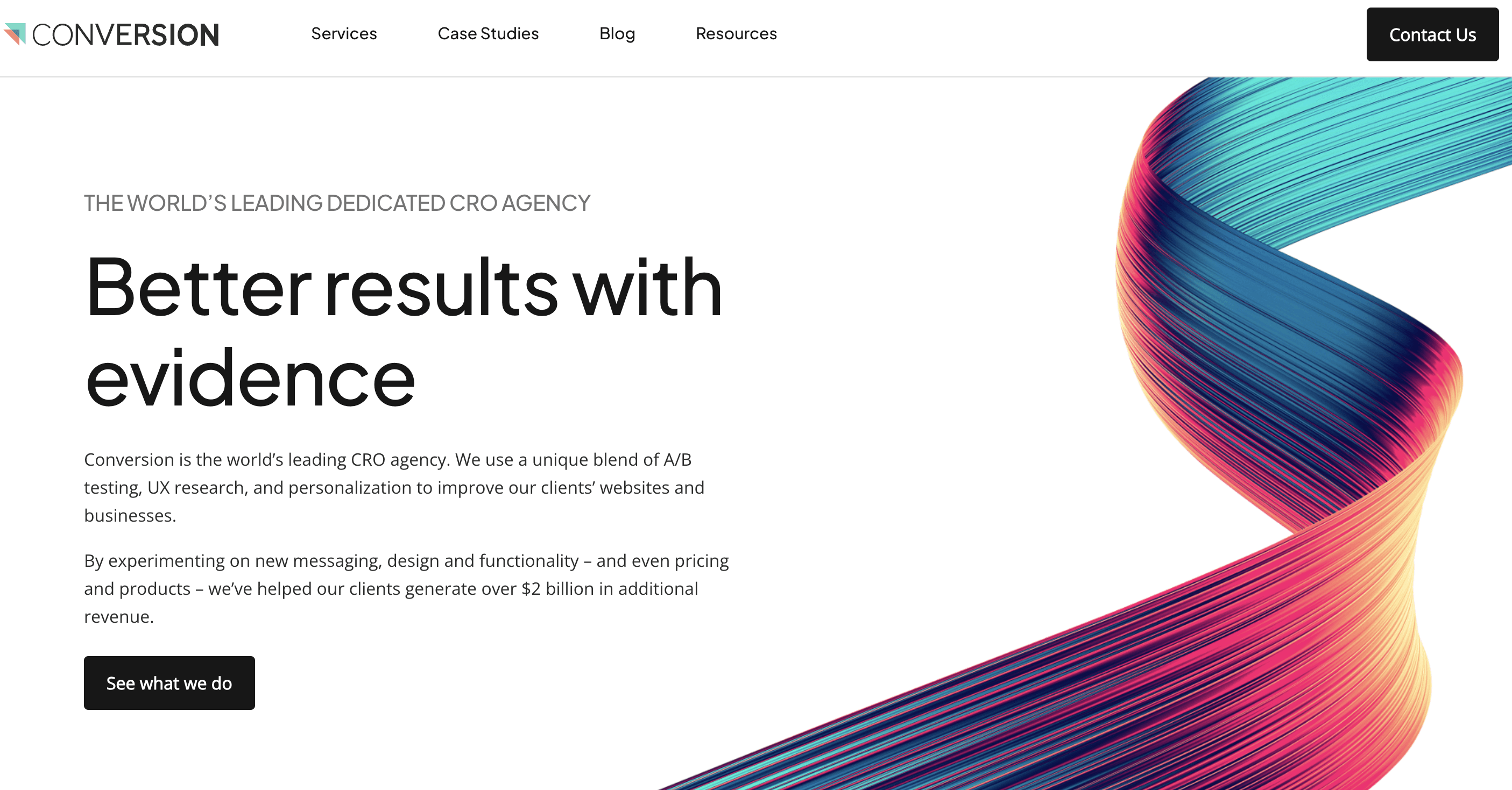
Conversion is a CRO agency that delivers comprehensive conversion optimization services beyond website optimization. Its key selling proposition is its methodology of experimentation, which lets it test and optimize nearly all aspects of your business: pricing, product features, and marketing strategies, to name a few.
This all-inclusive approach puts Conversion in a compelling position as a partner to established businesses and enterprises that look to make huge gains within their various verticals through data-driven CRO initiatives.
3. Techshu

Techshu designs data-based business strategies. They enhance conversion rates by using insight into user behavior and optimizing all the sub-components of websites to deliver the best ROI to clients.
4. ISG Web
ISG Web is working to improve and bring a profit for the websites through experience and data-driven testing. Their team puts their effort in making the visitors get the value for their business by improving the ROI of their clients.
5. ShoutnHike
With a remarkable record of success under their belt, they are working hard to make sure web performance enhances the user experience and profitability-ultimately delivering a better ROI for their clients. They do this by doing data-driven testing and coming up with strategies that morph visitors into valuable customers.
Conclusion
A Conversion Rate Optimization (CRO) agency helps businesses turn website visitors into customers by improving the user experience and key site elements. This leads to higher conversions and growth.
An investment in a good Conversion Rate Optimization Agency usually always gives stronger ROI than any other kind of marketing or product spend.
If you're improving your conversion rate, then you're improving the efficiency of all of your marketing channels; so, your Google ads will work better, your Facebook ads more powerfully, your LinkedIn ads more effectively, organic traffic improved, direct traffic improved, and so on. Investment in a CRO agency would essentially be like lifting every other channel simultaneously.
If you're looking for a reliable CRO agency, Fibr is the best choice. They specialize in boosting traffic and turning clicks into loyal customers, all while offering affordable solutions. With Fibr's expertise, you can enhance your website’s performance and drive lasting business success.



Pritam Roy
Co-Founder @ Fibr AI
Pritam Roy, the Co-founder of Fibr, is a seasoned entrepreneur with a passion for product development and AI. A graduate of IIT Bombay, Pritam's expertise lies in leveraging technology to create innovative solutions. As a second-time founder, he brings invaluable experience to Fibr, driving the company towards its mission of redefining digital interactions through AI.
Read summarized version with
Introduction
Imagine an online E-commerce business that has expended all its time, energy, and money creating an attractive website, running targeted ads, and projecting its brand on the best possible online channels. This online business appears successful because of the number of visitors to its websites. The trouble, though, is that sales haven't increased proportionally with the number of visitors. People will be coming in, browsing, and then leaving without making a purchase. Despite the heavy investment, they stuck with low conversions and high frustration.
That's precisely the situation most companies face nowadays. Now, bringing people to your website is no longer an issue; thanks to Search Engine Optimization, Paying Ads, and Social Media platforms, they made traffic more accessible than ever. The problem comes in when the visitors should become actual customers; that's where the real challenge lies. This is where Conversion Rate Optimization, the missing piece of the puzzle, comes in.
To fully enjoy the benefits of CRO, partnering with a specialized Conversion Rate Optimization Agency is a must. Such CRO agencies offer the expertise and tools required to convert website traffic to valuable action, which consequently ensures sales.
Firstly, let’s understand what is a CRO!
What is Conversion Rate Optimization (CRO)?
Conversion rate optimization (CRO) is the process of optimizing a website or landing page to convert visitors into taking the desired action—such as making a purchase, filling out a form, or subscribing to a newsletter. That "desired action" is known as conversion. CRO is, therefore, fine-tuning the user experience to maximize that conversion.
For instance, think of a small e-commerce business. An average of only 2 out of 100 visitors will buy. That's a 2% conversion rate. The business increased its conversion rate to 4%. That without spending one cent more on advertising, or attracting new visitors, has doubled in revenue. That's the magic of CRO marketing.
According to WordStream conversion rates average 2.35% across all industries, but the top 25% of businesses are converting at 5.31% or better. This wide gap shows the potential for improvement and why optimizing conversion rates is important.
Improving your conversion rate isn’t just about driving more sales. It is the optimization of the ROI from the already existing traffic. Hubspot shows that acquiring new customers is five to six times more expensive to attract a new customer than to retain an existing one.
A CRO agency can make your marketing efforts more cost-effective by optimizing the value of your current traffic.
So, Let’s talk about CRO Agency;
What is a Conversion Rate Optimization Agency?
A conversion rate optimization agency, or CRO marketing agency, is a marketing agency specifically meant to uplift the conversion rate of your website.
A Conversion Rate Optimization agency is a specialized service provider that helps businesses realize the maximum value from their existing traffic by making the websites more effective. Instead of pouring more money into traffic generation, a CRO agency focuses on optimizing the chances of getting the desired action from the existing visitors.
CRO agencies believe that users' behavior must be understood through data-driven methods to identify bottlenecks and bring in testing solutions for conversion funnel optimization.
Conversion Rate Optimization agencies do everything, from A/B testing different landing page designs to optimizing the checkout process, ensuring businesses are not letting money fall through the cracks.
Conversion Rate Optimization service providers use many strategies, such as A/B testing, heatmaps, and session recordings, to research user behavior and detect possible weaknesses. For example, A/B testing compares the effectiveness of two versions of any given webpage to find which one is better at converting visitors. With the help of AI conversion rate optimization and advanced CRO software, these agencies can make data-driven decisions that lead to substantial growth in conversions.
However, CRO marketing focuses on optimizing a website or landing page to maximize the conversion rate percentage of visitors who undertake a desired action. Most companies focus on the increase in traffic, while the real value lies in how well that traffic is being converted.
Companies using a conversion optimization agency or taking assistance from conversion rate optimization experts can see their conversion rates soar above 10%. These percentage points may seem small, but the revenue impact is huge.
How a Conversion Rate Optimization Agency Can Help?
A Conversion Rate Optimization Agency or a CRO agency brings expertise and tools to help businesses maximize their website's potential. CRO software, heat maps, session recordings, and user behavior analytics help identify pain points within the user journey.
CRO services include dynamic landing pages, tailored content, and AI-powered conversion rate optimization that can make websites more personalized to increase engagement and boost conversion rates.
Therefore, these tools and techniques should be employed by business organizations to acquire more leads and increase their bottom line using the least additional traffic.
How a Conversion Rate Optimization Agency Can Help Your Business?
Website Audits
A Conversion Rate Optimization Agency begins its work with an audit of your website's current performance. They see all the data related to user behavior, heatmaps, and session recordings about the moment visitors lose interest or encounter an issue. This evaluation gives them a deeper understanding, allowing them to develop a detailed improvement plan.
A/B Testing
Once they find the problem areas, the Conversion Rate Optimization Agency will run A/B testing to test various versions of your web pages. They test every possible element in headlines, buttons, and layouts to find out which ones best resonate with your audience. This can enable them to figure out what drives better conversions.
Experience (UX) Optimization
Conversion Rate Optimization Agency will work on improving your website's overall user journey. They will remove unnecessary steps and simplify navigation so that users find it easier to complete their desired actions—from buying a product to signing up for a newsletter. A smooth experience draws visitors to stay and spend more time on your site.
Heatmaps and User Behavior Analytics
Conversion Rate Optimization Agency employs heatmap tools to visualize a user's interaction with your website. They study click, scroll, and hover behavior to understand better where users spend their time on your site and where they may be having difficulty using it. This information is essential in knowing where to actually make improvements.
Form Simplification
CRO agencies also pay heavy emphasis on the simplification of forms. Simply, fewer fields in shorter forms cut down friction and abandonment and make filling forms easier to visitors so that they can better complete their transactions.
Personalization
Behavior tracking through users enables one to have personalization of experiences for visitors. For example, a returning customer might have tailored product recommendations or special offers tailored to past interactions. This level of personalization may increase conversion rates highly since the user may feel valued and understood.
5 Best Conversion Rate Optimization Agencies
Fibr
Looking for a reliable partner to help you grow your conversions without overspending? Look no further. Fibr is a reliable, affordable Conversion Rate Optimization Agency that helped bring impressive results for businesses to grow their traffic and sales.
Why Fibr Stands Out in Conversion Marketing?
Fibr is not an ordinary CRO agency. They specialize in digging up all the little data analysis that could help each business reach its maximum potential.
Here is a closer view of Fibr's most important services:
CRO Audit
Fibr CRO audit exposes weaknesses in your conversion funnel. Their experts bring actionable insights for the improvement of your website's conversion rate. Instead of pointing out the problems, they bring great solutions.
Landing Page Design
Fibr is an expert in creating landing pages that convert well. Each landing page is specifically crafted to the niche necessities of your audience, holding the opportunities for this changing visitor to take action.
Website Personalization
Fibr leverages AI-driven personalization for a more engaging experience with each visitor. This allows for designing user journeys that turn casual visitors into loyal customers.
A/B Testing
Fibr takes thorough and continuous A/B testing. They test everything in terms of design to messaging to make sure your website is performing at the best, continually optimizing toward the highest conversion rates.
Data and Analytics
Fibr is an analytics tool that relies on data. The deep analysis will provide clear, action-oriented insights into your key metrics, easy to track progress, and discover new growth opportunities.
Conversion Funnel Analysis
Fibr's conversion funnel analysis analyzes each step of the customer journey from where you are dropping or getting stuck. They will then elaborate procedures to streamline the process and increase conversions
Unlike many agencies that make fake promises, Fibr stands out for its transparency and ability to deliver. They don’t just talk about increasing traffic and sales—they back it up with real data.
If you need a CRO agency that knows how to boost conversions, increase traffic, and drive sales, Fibr is the right partner to elevate your business.
2. Conversion
Conversion is a CRO agency that delivers comprehensive conversion optimization services beyond website optimization. Its key selling proposition is its methodology of experimentation, which lets it test and optimize nearly all aspects of your business: pricing, product features, and marketing strategies, to name a few.
This all-inclusive approach puts Conversion in a compelling position as a partner to established businesses and enterprises that look to make huge gains within their various verticals through data-driven CRO initiatives.
3. Techshu
Techshu designs data-based business strategies. They enhance conversion rates by using insight into user behavior and optimizing all the sub-components of websites to deliver the best ROI to clients.
4. ISG Web
ISG Web is working to improve and bring a profit for the websites through experience and data-driven testing. Their team puts their effort in making the visitors get the value for their business by improving the ROI of their clients.
5. ShoutnHike
With a remarkable record of success under their belt, they are working hard to make sure web performance enhances the user experience and profitability-ultimately delivering a better ROI for their clients. They do this by doing data-driven testing and coming up with strategies that morph visitors into valuable customers.
Conclusion
A Conversion Rate Optimization (CRO) agency helps businesses turn website visitors into customers by improving the user experience and key site elements. This leads to higher conversions and growth.
An investment in a good Conversion Rate Optimization Agency usually always gives stronger ROI than any other kind of marketing or product spend.
If you're improving your conversion rate, then you're improving the efficiency of all of your marketing channels; so, your Google ads will work better, your Facebook ads more powerfully, your LinkedIn ads more effectively, organic traffic improved, direct traffic improved, and so on. Investment in a CRO agency would essentially be like lifting every other channel simultaneously.
If you're looking for a reliable CRO agency, Fibr is the best choice. They specialize in boosting traffic and turning clicks into loyal customers, all while offering affordable solutions. With Fibr's expertise, you can enhance your website’s performance and drive lasting business success.
Pritam Roy
Co-Founder @ Fibr AI
Pritam Roy, the Co-founder of Fibr, is a seasoned entrepreneur with a passion for product development and AI. A graduate of IIT Bombay, Pritam's expertise lies in leveraging technology to create innovative solutions. As a second-time founder, he brings invaluable experience to Fibr, driving the company towards its mission of redefining digital interactions through AI.
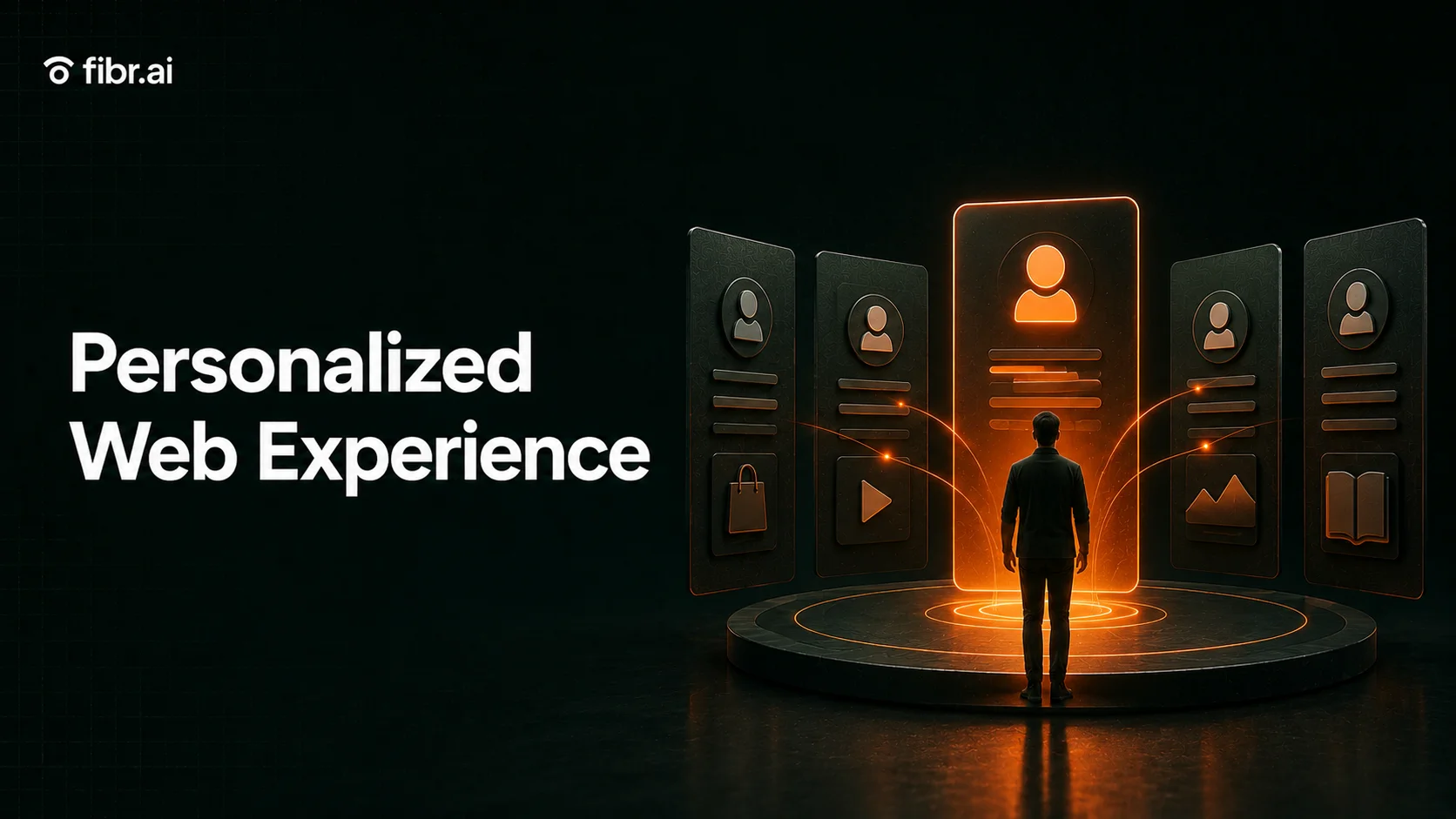

Is your website starting every visit from zero?
Is your website starting every visit from zero?
Is your website starting every visit from zero?
Fibr gives your website the intelligence it needs right from the start
Fibr AI gives your website the
intelligence it needs right from the start