Read summarized version with
Have you ever felt your website is working hard and not smart? You’ve got the traffic, everything seems alright yet something is missing. The revenue has started to get stagnant and your leads are also drying up.
If you are wondering what the fix to this is, the answer is Conversion Rate Optimization (CRO). Turn ‘almost’ into yes with CRO. And no, CRO is not about starting from scratch or reinventing the wheel. It’s just simply fine-tuning what you have.
Best part? It’s not as hard as you imagine it to be.
In this blog, we break down what a CRO program is–no jargon or fluff–straight to the point and highlight a three-step process that will most likely move your conversion needle.
🕰️ Key Takeaways
A CRO program can be described as a plan to make more visitors take action on your website, app, landing page, or product. By focusing on continuous optimization and experimentation, CRO programs help you understand what your target audience is actually looking for and how to convert them better.
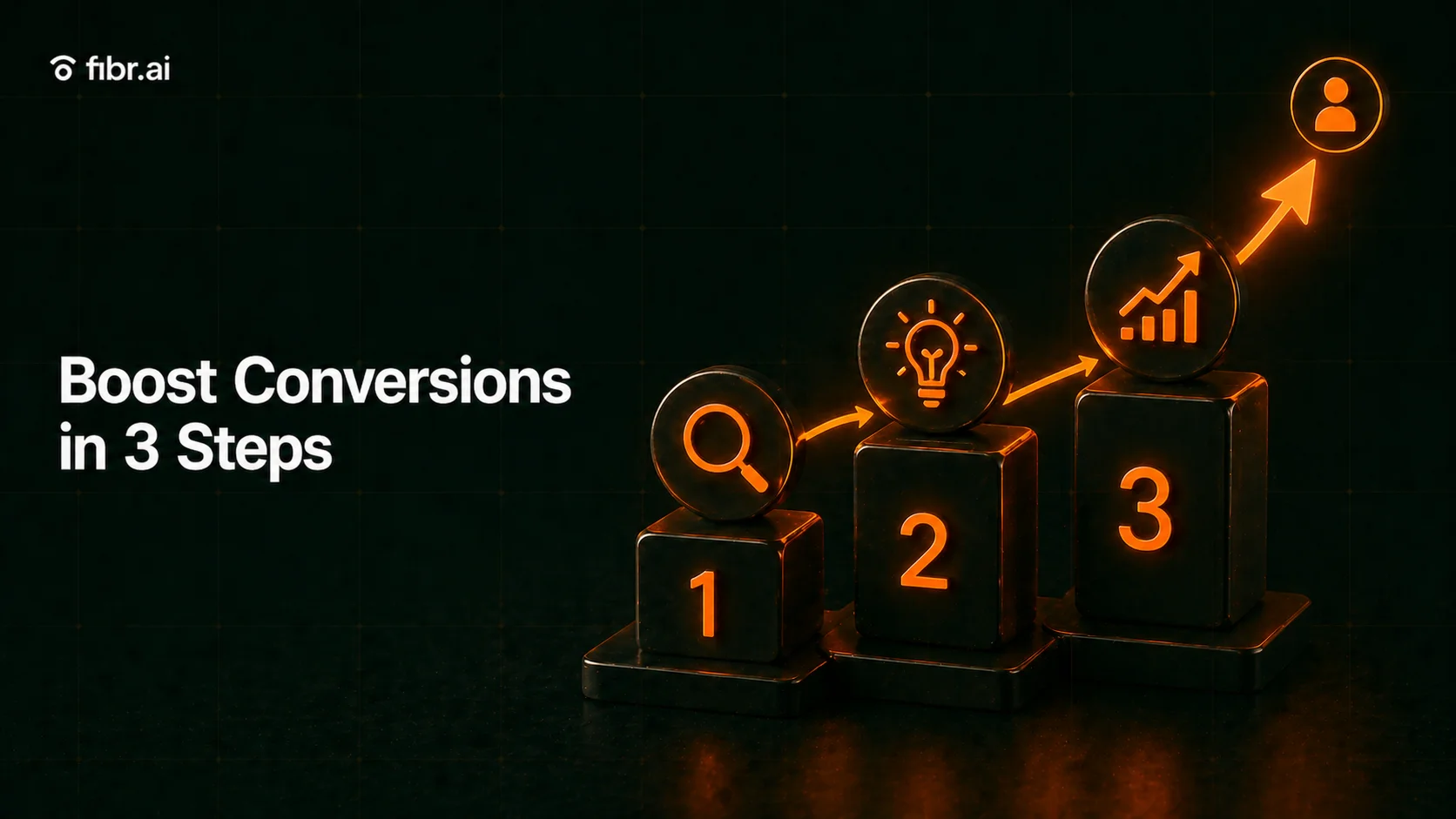
3-Step Simple CRO Plan
Identify what attracts people to your website: Determine where your traffic is coming from; you can rely on tools and platforms like Fibr AI to get accurate data on the same. Next, understand why users are searching for your brand or product. Is to purchase a product or get a resource; whatever the reason, make it easy for them to find you.
Discover what might be stopping them from converting: If your conversions are low, something is hindering your users. They have the intent to buy, now you need to figure out what’s causing them to bounce: is it page speed, long forms, or undetectable CTAs? It’s important to circle out the reason so that you can work on correcting it rather than spending time on other elements.
Focus on what convinces visitors to take action: Once you identify the cause, work on correcting it. If it’s the CTA, make it more appealing and visible. If it’s trust, add more social proof, ratings, and testimonials.
If you're looking for a partner to help you, Fibr AI can help you plan and execute a good CRO program.
What is a CRO Program?
A CRO program or plan is a strategic way of deriving more value from existing websites and traffic. Think of it as a smart approach to optimizing your website, app, or page with existing resources to generate more leads and conversions.
The logic is simple– High optimization = High conversions + Leads
You have already got traffic and visitors on your site, but are they taking action? Signing up or purchasing a product? CRO program addresses this ‘action problem’ ensuring you get more conversions and leads without spending on ads or traffic.
CRO program works on data and not guesswork, and for the same reason, the likelihood of having increased conversions is manifold. For instance, under a CRO program, your website would be testing different headlines or CTAs. After tweaking and testing continuously, over time, these experiments start adding up as leads and conversions.
The best thing about the CRO program is that it’s not a one-time thing or a miracle or a spray-and-pray approach. A good CRO program will always ensure that you're continuously testing, tweaking, optimizing, and improving. It also ensures that your ears are always to the ground–understanding what your customers want, what the pain points and how you can best address them.
In the below section, we show you how a CRO program actually works to drive in more leads and conversion strategically.
3-Step Simple CRO Plan

Conversion Rate Optimization can at times sound technical and overwhelming too. But, if you look closely, it simply is to understand what your target audience wants and give it to them in the most hassle-free manner.
Below, we present to you a simple, three-step CRO plan that is easy to implement and will deliver real results.
Step 1: Identify what attracts people to your website
Before you take any step to improve your website’s performance, you really need to dig deep and ask yourself–why are people coming to this website in the first place? What’s actually pulling them? Is it blogs, product photos, ads, or any special offer?
Now, the next question in your mind would be, how do I figure this out? Well, don’t worry, here’s how to do it:
1.Analyze your traffic source
Simply start by looking at where your traffic is coming from. Is it ads, Instagram, or organic? Tools like Google Analytics can show if your audience is finding you through search engines, social media platforms, ads, or any other source.
For example, if you find that a majority of the traffic is coming from Instagram, you know where you need to double down. Similarly, the platform giving you the least traffic can also be spotted and optimized for.
⬆️ Pro Tip: Don’t blindly look at numbers–try to go in-depth. Check which pages are getting the most visitors and why. Do high-traffic pages have anything in common that can be replicated? Is it a particular offer, or discount that’s driving the traffic? By looking at the intricate details and scrutinizing them, you optimize for better and more quality traffic which in turn can help get more leads and conversions.
2.Understand user intent
So far, we have answered why users may be looking for your page or product. The next question is why.
Why are people visiting your website? Are they looking for some information or resource, is it for shopping, or are they trying to solve a problem? If you’re running an eCommerce store, for instance, the user's intent is likely to shop or they are drawn to certain reviews and recommendations they saw online.
🙂 Fun Fact: Nearly 50% of users directly head toward the product/service page of a company before exploring anything else!
Now if you’re worried about how to find out the ‘why’, there are tools and platforms to help you:
A.Heatmaps and session recordings
Heatmaps and session recordings are CRO experts’ secret weapon. Where users are dropping off, where their interaction is the maximum, where they are clicking, what are they clicking on, how far are they scrolling, what are they liking, what are they ignoring–heatmaps and session recordings can answer every question you have in mind regarding user behavior.
Fibr AI’s advanced platform can help you understand your user experience intricately through advanced tools, AI integration, continuous monitoring, and a team of experts.
Book a demo now!
B.Feedback forms, surveys, and interviews
What better way could exist than to directly ask your target audience about what they are looking for and why. You could conduct interviews with your clients and ask them ‘Why are they visiting your website today?’ or ‘What are they looking for on your website?’
Further, you can share feedback forms, and surveys with your target audience to truly understand the trends in the markets and optimize accordingly.
So we have successfully identified what attracts people to your website and why. The next question is: If there is traffic, if the audience is able to find your website and also has the intent to purchase, then why is the conversion needle not moving?
As a business owner, if you find yourself asking this question, you’re not alone. Just being discoverable is not enough (it actually never was).
Something is hindering your users from taking action. What’s that? Let’s figure it out.
Step 2: Discover what might be stopping them from converting
The most likely reason why somebody is not taking action on your page could be that they are stuck somewhere, or something might be confusing them.
We list below some common reasons that could be hindering user action on your website and how to fix them:
1.Check your website speed
Let’s face it–nobody likes a slow website. If your site is taking any more than 3-5 seconds to load, you’re most likely going to face high bounce rates. In fact per Google, more than 50% of visitors may bounce off a page if the site takes more than 3% to load.
⬆️ Pro-tip: You can use Google PageSpeed Insights to check the speed of your site. Compressing images and videos, minimizing code and redirects, implementing lazy loading, and Content Delivery Network (CDN) can help speed things up!
2.Test your CTAs
Did you know? 70% of small-scale businesses lack a Call-to-Action (CTA) button on their homepage! Can you imagine how many users with the intent to take action may be lost because of this one mistake? Don’t make the same mistake.
CTAs are arguably the most important conversion factor on a website. They are like a signpost showing visitors what to do next. If your CTAs are boring, misplaced, and not visible, you’re going to lose out on a lot of conversions and leads.
Use clear and specific CTAs. Personalize them for your audience. Avoid being boring.
🙂 Fun Fact: CTAs that are personalized perform nearly 200% better than normal CTAs.
3.Work on mobile optimization
Here are two important stats to know about mobile optimization before we proceed further–nearly 8 out of 10 people won’t engage with a website’s content that does not load properly on a smartphone and more than 80% of users say that a smooth and seamless mobile experience is super important to them.
So what do these stats actually point toward? Mobile optimization. Think of the one time you went on a website. First, it didn’t load quickly and then it was not optimized for mobile. The images were stretched, the ‘buy now’ button went sideways and you were unable to find what you were looking for.
How frustrated were you? The website may have worked well on the desktop, but did that help your cause? Most probably not. Your visitors are no different. If you’re going to present them with a clunky, unoptimized page, they are most likely not to convert.
So ensure your site is user-friendly, looks great, and works on all screen types perfectly. Use larger buttons, simple designs, easy-to-find features, and more to make the user journey comfortable.
4.Ensure forms are of optimal length
Most users hate filling out forms. And, sometimes businesses may not realize that the length of their forms can be a major turn-off. Take eCommerce stores for instance. Forms are a crucial part of their conversion processes as they provide opportunities for visitor interactions and help gather more information.
But if the forms are long, they can result in user drop-off. Solution? Keep them short, uncomplicated, and simple.
➕Did you know? Users complete forms almost 30% faster with auto-fill!
Step 3: Focus on what convinces visitors to take action
If you’ve made it this far, congratulations. You’ve got visitors and have removed every possible roadblock that could hinder user action.
Now, here’s how you can make your website irresistible and push users to take action faster than ever:
1.Use social proof
Trust is everything. If a user believes they can trust your website, they are most likely to take action. Social proof, ratings, case studies, and testimonials all help establish and build this trust. Think for yourself–when it comes to electronics or high ticket purchases, you would rely on only the most trusted sites, right?
When users see that other visitors have interacted with the website previously and benefited, they are motivated to take action because it reassures them that they are not being scammed and will receive the same benefit as others who took action.
🙂 Fun Fact: More than 90% of customers read online reviews before making a purchase.
2.Create a sense of urgency
By using a clock countdown, a music marketer increased his conversions by 300%
Creating a sense of urgency or FOMO can be a smart strategy to encourage your visitors to take action faster. When they realize that the offer will be soon gone or they are not likely to find a similar bargain, they will be more inclined to take action.
‘Only 3 seats left’ or ‘ sale ends tonight’ are some examples CTAs take that can create a sense of urgency and drive conversions.
3.Personalize
Make use of the data you have to personalize your messaging for individual users. An email with the person’s name or a display of the previous purchase history can help create a more personalized environment for the individual and make them comfortable in taking action.
Did you know? Personalized product recommendations have been shown to boost conversions up to 150%!
4.Test and optimize
CRO is all about continuous testing and experimentation. More than 75% of companies are running A/B tests on their website and so should you.
Ensure to conduct regular A/B tests on your headlines, CTAs, forms, images, and more to understand what elements are resonating best with the audience and which need further optimization.
Fibr AI can be your partner here. With a focus on improving ROI and your experimentation processes, it runs A/B tests 24/7 and provides data-driven insights.
Why Choose Fibr AI as Your CRO Partner
1. Personalization
Fibr AI helps you craft 1:1 personalized experiences for each visitor. Your headline, CTAs, and more adapt in real time based on user intent and behavior. So whether it's a landing page or an ad campaign, Fibr AI makes every interaction count!
2. Experimentation
Fibr AI runs continuous A/B tests, refining your website every second without any manual intervention. This ensures your website is a continuous optimization chamber, helping bring in better ROI and conversions.
3. Website Monitoring
Fibr AI helps head off the most common business concerns. It monitors and protects your website 24/7 and ensures faster loading time and performance. How? Through real time issue detection and proactive alerts. Fibr AI also prevents conversion losses and keeps the user journey smooth and enjoyable.



Pritam Roy
Co-Founder @ Fibr AI
Pritam Roy, the Co-founder of Fibr, is a seasoned entrepreneur with a passion for product development and AI. A graduate of IIT Bombay, Pritam's expertise lies in leveraging technology to create innovative solutions. As a second-time founder, he brings invaluable experience to Fibr, driving the company towards its mission of redefining digital interactions through AI.
Read summarized version with
Have you ever felt your website is working hard and not smart? You’ve got the traffic, everything seems alright yet something is missing. The revenue has started to get stagnant and your leads are also drying up.
If you are wondering what the fix to this is, the answer is Conversion Rate Optimization (CRO). Turn ‘almost’ into yes with CRO. And no, CRO is not about starting from scratch or reinventing the wheel. It’s just simply fine-tuning what you have.
Best part? It’s not as hard as you imagine it to be.
In this blog, we break down what a CRO program is–no jargon or fluff–straight to the point and highlight a three-step process that will most likely move your conversion needle.
🕰️ Key Takeaways
A CRO program can be described as a plan to make more visitors take action on your website, app, landing page, or product. By focusing on continuous optimization and experimentation, CRO programs help you understand what your target audience is actually looking for and how to convert them better.
3-Step Simple CRO Plan
Identify what attracts people to your website: Determine where your traffic is coming from; you can rely on tools and platforms like Fibr AI to get accurate data on the same. Next, understand why users are searching for your brand or product. Is to purchase a product or get a resource; whatever the reason, make it easy for them to find you.
Discover what might be stopping them from converting: If your conversions are low, something is hindering your users. They have the intent to buy, now you need to figure out what’s causing them to bounce: is it page speed, long forms, or undetectable CTAs? It’s important to circle out the reason so that you can work on correcting it rather than spending time on other elements.
Focus on what convinces visitors to take action: Once you identify the cause, work on correcting it. If it’s the CTA, make it more appealing and visible. If it’s trust, add more social proof, ratings, and testimonials.
If you're looking for a partner to help you, Fibr AI can help you plan and execute a good CRO program.
What is a CRO Program?
A CRO program or plan is a strategic way of deriving more value from existing websites and traffic. Think of it as a smart approach to optimizing your website, app, or page with existing resources to generate more leads and conversions.
The logic is simple– High optimization = High conversions + Leads
You have already got traffic and visitors on your site, but are they taking action? Signing up or purchasing a product? CRO program addresses this ‘action problem’ ensuring you get more conversions and leads without spending on ads or traffic.
CRO program works on data and not guesswork, and for the same reason, the likelihood of having increased conversions is manifold. For instance, under a CRO program, your website would be testing different headlines or CTAs. After tweaking and testing continuously, over time, these experiments start adding up as leads and conversions.
The best thing about the CRO program is that it’s not a one-time thing or a miracle or a spray-and-pray approach. A good CRO program will always ensure that you're continuously testing, tweaking, optimizing, and improving. It also ensures that your ears are always to the ground–understanding what your customers want, what the pain points and how you can best address them.
In the below section, we show you how a CRO program actually works to drive in more leads and conversion strategically.
3-Step Simple CRO Plan
Conversion Rate Optimization can at times sound technical and overwhelming too. But, if you look closely, it simply is to understand what your target audience wants and give it to them in the most hassle-free manner.
Below, we present to you a simple, three-step CRO plan that is easy to implement and will deliver real results.
Step 1: Identify what attracts people to your website
Before you take any step to improve your website’s performance, you really need to dig deep and ask yourself–why are people coming to this website in the first place? What’s actually pulling them? Is it blogs, product photos, ads, or any special offer?
Now, the next question in your mind would be, how do I figure this out? Well, don’t worry, here’s how to do it:
1.Analyze your traffic source
Simply start by looking at where your traffic is coming from. Is it ads, Instagram, or organic? Tools like Google Analytics can show if your audience is finding you through search engines, social media platforms, ads, or any other source.
For example, if you find that a majority of the traffic is coming from Instagram, you know where you need to double down. Similarly, the platform giving you the least traffic can also be spotted and optimized for.
⬆️ Pro Tip: Don’t blindly look at numbers–try to go in-depth. Check which pages are getting the most visitors and why. Do high-traffic pages have anything in common that can be replicated? Is it a particular offer, or discount that’s driving the traffic? By looking at the intricate details and scrutinizing them, you optimize for better and more quality traffic which in turn can help get more leads and conversions.
2.Understand user intent
So far, we have answered why users may be looking for your page or product. The next question is why.
Why are people visiting your website? Are they looking for some information or resource, is it for shopping, or are they trying to solve a problem? If you’re running an eCommerce store, for instance, the user's intent is likely to shop or they are drawn to certain reviews and recommendations they saw online.
🙂 Fun Fact: Nearly 50% of users directly head toward the product/service page of a company before exploring anything else!
Now if you’re worried about how to find out the ‘why’, there are tools and platforms to help you:
A.Heatmaps and session recordings
Heatmaps and session recordings are CRO experts’ secret weapon. Where users are dropping off, where their interaction is the maximum, where they are clicking, what are they clicking on, how far are they scrolling, what are they liking, what are they ignoring–heatmaps and session recordings can answer every question you have in mind regarding user behavior.
Fibr AI’s advanced platform can help you understand your user experience intricately through advanced tools, AI integration, continuous monitoring, and a team of experts.
Book a demo now!
B.Feedback forms, surveys, and interviews
What better way could exist than to directly ask your target audience about what they are looking for and why. You could conduct interviews with your clients and ask them ‘Why are they visiting your website today?’ or ‘What are they looking for on your website?’
Further, you can share feedback forms, and surveys with your target audience to truly understand the trends in the markets and optimize accordingly.
So we have successfully identified what attracts people to your website and why. The next question is: If there is traffic, if the audience is able to find your website and also has the intent to purchase, then why is the conversion needle not moving?
As a business owner, if you find yourself asking this question, you’re not alone. Just being discoverable is not enough (it actually never was).
Something is hindering your users from taking action. What’s that? Let’s figure it out.
Step 2: Discover what might be stopping them from converting
The most likely reason why somebody is not taking action on your page could be that they are stuck somewhere, or something might be confusing them.
We list below some common reasons that could be hindering user action on your website and how to fix them:
1.Check your website speed
Let’s face it–nobody likes a slow website. If your site is taking any more than 3-5 seconds to load, you’re most likely going to face high bounce rates. In fact per Google, more than 50% of visitors may bounce off a page if the site takes more than 3% to load.
⬆️ Pro-tip: You can use Google PageSpeed Insights to check the speed of your site. Compressing images and videos, minimizing code and redirects, implementing lazy loading, and Content Delivery Network (CDN) can help speed things up!
2.Test your CTAs
Did you know? 70% of small-scale businesses lack a Call-to-Action (CTA) button on their homepage! Can you imagine how many users with the intent to take action may be lost because of this one mistake? Don’t make the same mistake.
CTAs are arguably the most important conversion factor on a website. They are like a signpost showing visitors what to do next. If your CTAs are boring, misplaced, and not visible, you’re going to lose out on a lot of conversions and leads.
Use clear and specific CTAs. Personalize them for your audience. Avoid being boring.
🙂 Fun Fact: CTAs that are personalized perform nearly 200% better than normal CTAs.
3.Work on mobile optimization
Here are two important stats to know about mobile optimization before we proceed further–nearly 8 out of 10 people won’t engage with a website’s content that does not load properly on a smartphone and more than 80% of users say that a smooth and seamless mobile experience is super important to them.
So what do these stats actually point toward? Mobile optimization. Think of the one time you went on a website. First, it didn’t load quickly and then it was not optimized for mobile. The images were stretched, the ‘buy now’ button went sideways and you were unable to find what you were looking for.
How frustrated were you? The website may have worked well on the desktop, but did that help your cause? Most probably not. Your visitors are no different. If you’re going to present them with a clunky, unoptimized page, they are most likely not to convert.
So ensure your site is user-friendly, looks great, and works on all screen types perfectly. Use larger buttons, simple designs, easy-to-find features, and more to make the user journey comfortable.
4.Ensure forms are of optimal length
Most users hate filling out forms. And, sometimes businesses may not realize that the length of their forms can be a major turn-off. Take eCommerce stores for instance. Forms are a crucial part of their conversion processes as they provide opportunities for visitor interactions and help gather more information.
But if the forms are long, they can result in user drop-off. Solution? Keep them short, uncomplicated, and simple.
➕Did you know? Users complete forms almost 30% faster with auto-fill!
Step 3: Focus on what convinces visitors to take action
If you’ve made it this far, congratulations. You’ve got visitors and have removed every possible roadblock that could hinder user action.
Now, here’s how you can make your website irresistible and push users to take action faster than ever:
1.Use social proof
Trust is everything. If a user believes they can trust your website, they are most likely to take action. Social proof, ratings, case studies, and testimonials all help establish and build this trust. Think for yourself–when it comes to electronics or high ticket purchases, you would rely on only the most trusted sites, right?
When users see that other visitors have interacted with the website previously and benefited, they are motivated to take action because it reassures them that they are not being scammed and will receive the same benefit as others who took action.
🙂 Fun Fact: More than 90% of customers read online reviews before making a purchase.
2.Create a sense of urgency
By using a clock countdown, a music marketer increased his conversions by 300%
Creating a sense of urgency or FOMO can be a smart strategy to encourage your visitors to take action faster. When they realize that the offer will be soon gone or they are not likely to find a similar bargain, they will be more inclined to take action.
‘Only 3 seats left’ or ‘ sale ends tonight’ are some examples CTAs take that can create a sense of urgency and drive conversions.
3.Personalize
Make use of the data you have to personalize your messaging for individual users. An email with the person’s name or a display of the previous purchase history can help create a more personalized environment for the individual and make them comfortable in taking action.
Did you know? Personalized product recommendations have been shown to boost conversions up to 150%!
4.Test and optimize
CRO is all about continuous testing and experimentation. More than 75% of companies are running A/B tests on their website and so should you.
Ensure to conduct regular A/B tests on your headlines, CTAs, forms, images, and more to understand what elements are resonating best with the audience and which need further optimization.
Fibr AI can be your partner here. With a focus on improving ROI and your experimentation processes, it runs A/B tests 24/7 and provides data-driven insights.
Why Choose Fibr AI as Your CRO Partner
1. Personalization
Fibr AI helps you craft 1:1 personalized experiences for each visitor. Your headline, CTAs, and more adapt in real time based on user intent and behavior. So whether it's a landing page or an ad campaign, Fibr AI makes every interaction count!
2. Experimentation
Fibr AI runs continuous A/B tests, refining your website every second without any manual intervention. This ensures your website is a continuous optimization chamber, helping bring in better ROI and conversions.
3. Website Monitoring
Fibr AI helps head off the most common business concerns. It monitors and protects your website 24/7 and ensures faster loading time and performance. How? Through real time issue detection and proactive alerts. Fibr AI also prevents conversion losses and keeps the user journey smooth and enjoyable.
Pritam Roy
Co-Founder @ Fibr AI
Pritam Roy, the Co-founder of Fibr, is a seasoned entrepreneur with a passion for product development and AI. A graduate of IIT Bombay, Pritam's expertise lies in leveraging technology to create innovative solutions. As a second-time founder, he brings invaluable experience to Fibr, driving the company towards its mission of redefining digital interactions through AI.